Gare Maritime: BIM designed
Gare Maritime in Brussels, a former freight station, has been transformed into an innovative and energy-neutral city district. Sweco provided an integrated fire safety concept, tailored to all stakeholders, and supported the realization of a safe and future-proof building.
- Client
- Extensa Group
- Location
- Brussels
- Architect
- Neutelings Riedijk Architects
- Awards
- Shortlisted for Mies Van der Rohe Award 2022, Winner ARC20 Architecture Award, Winner RES Awards 2020 – best commercial development, Largest CLT project in Europe
- Services
- Study and following up MEP, EPBD reporting, Sustainable advice, Simulations
- Surface
- 44,500 m2
Historical Background and Restoration
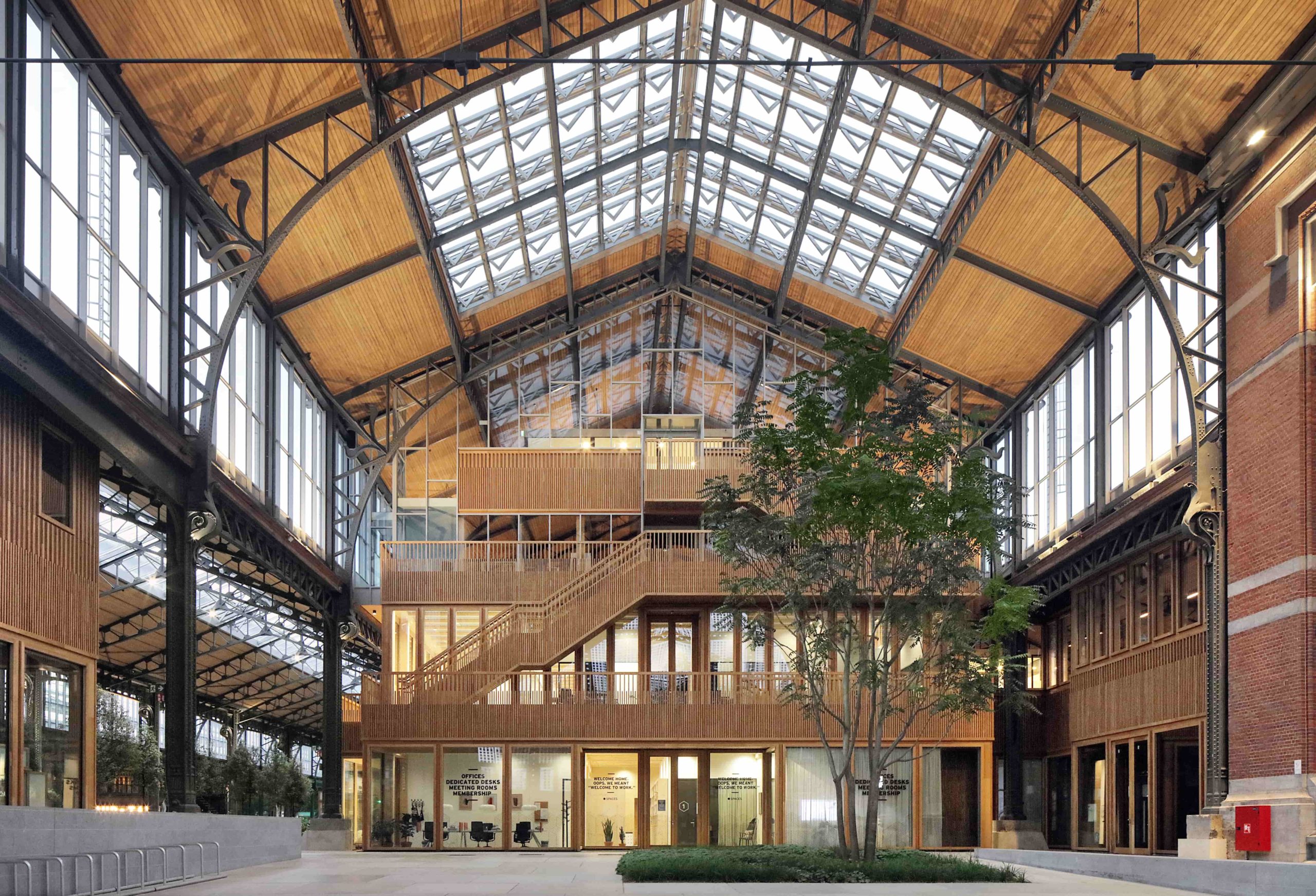
The “Gare Maritime” building in Brussels is an early 20th-century structure that was previously used as a freight station and has been vacant for some time. Its unique architectural features, both in detailing and spatial proportions, prompted the owner, Extensa, to restore the building and develop commercial and office spaces within the large volume.
To achieve this, the main hall was renovated into a well-insulated envelope that accommodates office volumes. Within the hall itself, acceptable indoor climate conditions were created through this insulation package on one hand and through intelligent control of opening elements in the facade and roof surfaces on the other, allowing certain activities to take place for most of the year.
Energy Efficiency and Sustainability
The moderate temperature maintained in the hall also benefits the energy consumption of the installed units. By allowing these to adjoin the unconditioned hall, losses to the external environment are significantly reduced compared to a traditional new-build situation. In terms of sustainability, maximum emphasis was placed on circularity, designed according to the principles of circular building. The result is an energy-neutral building that is completely independent of fossil fuel use.
The offices and retail zones themselves are climate-controlled, using a geothermal ring system fed by an open source system, to which individual heat pumps are connected. Cooling is achieved entirely passively, while heating always involves the intervention of these heat pumps. The system also results in the valorization of the simultaneously occurring heating and cooling needs in the different buildings, thereby reducing the load on the geothermal system and achieving optimal efficiency.
The project received the ARC20 Architecture Award. This award is granted to recently completed projects that innovatively combine high performance in sustainability in the broadest sense with surprising architecture.
Building Envelope and Technical Installations
The building envelope has been optimized to minimize energy loss while maximizing the use of natural daylight. Triple insulating and dynamic sun-shading glazing contribute to circularity and the reduction of energy demand. The latest state-of-the-art technical installations were provided for ventilation, cooling, and lighting.
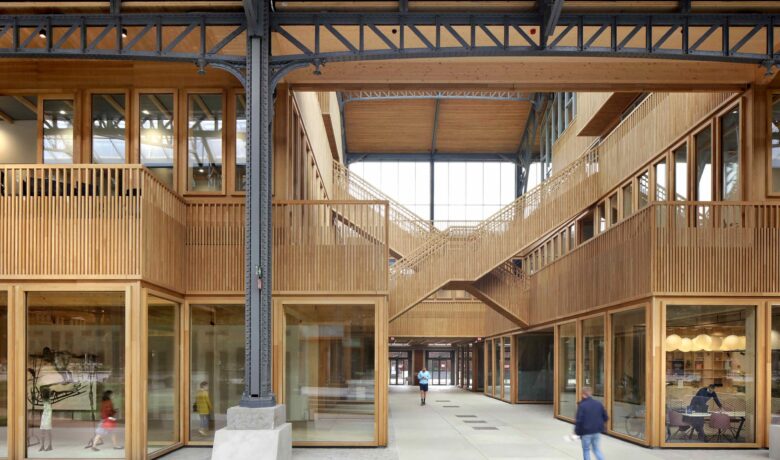
The building exemplifies flexibility and well-being. Gare Maritime will feature shops, offices, and restaurants, along with a central open promenade where events can be organized. Despite its size, the project exudes a friendly atmosphere, thanks to the scale of the pavilions, which open to the hall via balconies, and the construction method.
The choice of prefabricated CLT elements has not only shortened construction time but also allows for future disassembly of the buildings and reuse of components due to the use of mechanical connections.
Ecological Footprint and Sustainability Aspects
The limited ecological footprint during and after the renovation was achieved through intelligent choices regarding energy consumption, energy production, cooling, ventilation, water usage, and material usage. Throughout the project development, simulation software was used to pay special attention to a wide range of sustainability aspects: temperatures, light, material usage, etc. These were also validated within a BREEAM assessment methodology. Finally, a significant number of photovoltaic panels were added to the project to reduce the ultimately consumed electricity demand.
Complex Fire Safety for this Monumental Project
Transforming a decommissioned train station into a dynamic urban district is no small feat and requires close coordination between the developer, architects, contractors, government, and fire department. Sweco provided professional support from start to finish and handled the specialized aftercare for the project.
Our engineers developed a universal fire safety concept that takes into account the regulations and concerns of all partners and stakeholders. They evaluated the designs and layout plans, made technical recommendations, advised on deviation requests, and continuously consulted with the project teams.