Immersive collaboration as a strategic design instrument
What once started as an innovative way to present designs has evolved into a fully integrated project tool across multiple disciplines. VR is not used as a visual effect, but as a practical instrument to realise projects more efficiently, more accurately and with a stronger long-term vision.
Virtual reality is no longer an experimental technology within engineering and architecture. At Sweco, VR headsets are purposefully deployed as working tools within our broader digitalisation strategy. The technology supports design teams, strengthens decision-making and helps identify risks at an early stage.
From model to experience
In complex building and infrastructure projects, drawings or 3D models are not always sufficient to correctly assess spatial impact. With VR, designers, engineers, clients and end users can literally step inside a building before it is constructed. Scale, proportions, sightlines, technical installations and circulation flows are experienced at full scale.
This fundamentally changes the design dynamic. Discussions become more concrete because all stakeholders are present in the same immersive environment. Details that are difficult to interpret on a screen become immediately clear. This accelerates alignment, reduces interpretation differences and increases confidence in crucial decisions.
Typical applications include:
Immersive design reviews during concept and detailed design
Technical coordination sessions between disciplines
Functional validation sessions with users and operators
Stakeholder presentations for complex projects
VR sessions on site during construction for verification and optimisation
Clients do not need to provide specific infrastructure. Sweco ensures a stable and secure on-site setup with dedicated 5G routers, enabling immersive sessions in the office, on the construction site or at the client’s premises without technical limitations.
Added value across all project phases
Concept phase
Spatial concepts and feasibility scenarios can be tested interactively. This encourages early stakeholder involvement and strengthens spatial quality.
Design
Architecture, structure, MEP and sustainability come together in one shared digital environment. Conflicts are detected early, maintenance zones validated and circulation flows optimised.
Stakeholder communication
Immersive sessions help explain complex designs clearly to authorities and decision-makers, supporting smoother processes.
Constructability
VR can be used to verify spatial conditions, installation strategies and access and working zones before execution on site.
Operational phase
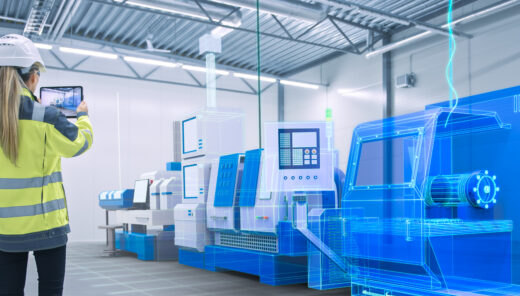
When connected to digital twins such as Twinfinity, the immersive model becomes a reference environment to better understand how design decisions influence performance and long-term use. This integrated approach directly aligns with Sweco’s full lifecycle vision. By monitoring the critical path and aligning disciplines from the start, risks and opportunities are addressed proactively rather than reactively.
Added value in complex environments
VR is particularly valuable in technically demanding environments such as laboratories, healthcare facilities and industrial buildings. In these contexts, safety, logistics, technical infrastructure and flexibility must come together within limited space.
By evaluating designs immersively:
Maintenance accessibility is validated
Technical installations are evaluated at full scale
Interaction between user and space is tested
Future adaptability is assessed
Installations are no longer abstract lines in a model but tangible elements within a real working environment. This aligns with full lifecycle thinking where long-term operation, safety and flexibility are already integrated in the early design phase.
Integrated into the digital workflow
At Sweco, VR is not a standalone tool. It is embedded in a broader BIM-driven workflow. The immersive environment is a direct extension of the coordinated model rather than a separate simulation.
This ensures:
Consistency between design and immersive validation
Early multidisciplinary alignment
Fewer clashes during construction
Better performance of the final result
The result is a proactive design approach in which potential bottlenecks are identified and resolved before construction begins.
Technology with measurable impact
The strength of VR does not lie in the technology itself, but in its impact:
Faster decision-making
Fewer design revisions
Lower execution risk
Better alignment between stakeholders
Greater confidence in complex projects
In a context where projects are becoming increasingly complex and expectations regarding quality, sustainability and performance are rising, digital experience makes it possible to think ahead and manage uncertainty more effectively.
Virtual reality is therefore not an isolated innovation, but a logical extension of Sweco’s full lifecycle approach. It supports planning, design, construction and operation, helping to realise buildings and infrastructure that are functional, resilient and future-ready.
How can we help your business? A team of experts is ready to assist you and see how we can help with your inquiry. When you submit this form, someone from our team will get in touch with you. This form is intended solely for more information about our Sweco business solutions.
Manage Cookie Consent
We use cookies to optimize our website and our services. For our policies, please visit our Cookie Policy
Functioneel
Always active
The technical storage or access is strictly necessary for the legitimate purpose of enabling the use of a specific service explicitly requested by the subscriber or user, or for the sole purpose of carrying out the transmission of a communication over an electronic communications network.
Voorkeuren
De technische opslag of toegang is noodzakelijk voor het legitieme doel voorkeuren op te slaan die niet door de abonnee of gebruiker zijn aangevraagd.
Statistics
De technische opslag of toegang die uitsluitend voor statistische doeleinden wordt gebruikt.The technical storage or access that is used exclusively for anonymous statistical purposes. Without a subpoena, voluntary compliance on the part of your Internet Service Provider, or additional records from a third party, information stored or retrieved for this purpose alone cannot usually be used to identify you.
Marketing
The technical storage or access is required to create user profiles to send advertising, or to track the user on a website or across several websites for similar marketing purposes.