
Fire safety as the foundation of operational continuity at Amsterdam Airport Schiphol
With more than 70 million passengers every year and a unique airport configuration, Amsterdam Airport Schiphol is one of the most complex infrastructure environments in Europe. Behind the scenes, thousands of technical installations, fire safety systems and operational processes work together to ensure the airport remains safe and efficient around the clock.
Fire safety is far more than a legal requirement. In an environment where hundreds of thousands of people move through the airport every day, advanced fire safety engineering, robust evacuation strategies, effective compartmentation and reliable asset management are essential to safeguard passengers and employees while ensuring the airport’s operational continuity.
Since 1996, Sweco has supported Amsterdam Airport Schiphol as a trusted partner for fire safety engineering, life safety consultancy, fire safety advisory services, commissioning of fire safety systems and the development of integrated fire protection concepts.
- Client
- Amsterdam Airport Schiphol
- Location
- Schiphol, the Netherlands
- Sweco scope
- Fire safety engineering and life safety consultancy, fire safety studies and advisory services, development of fire safety concepts and fire protection plans, evacuation strategies and compartmentation studies, asset management and compliance, commissioning of fire safety systems, end-to-end validation of safety chains, development of safety standards and operational guidelines
Nearly three decades of fire safety expertise at airports
The collaboration began with support for emergency planning and evacuation systems. As the airport continued to expand and its operations became increasingly complex, Sweco’s role evolved as well. The team contributed to the development of internal fire safety standards and helped establish an integrated asset management approach for the airport.
Today, Sweco operates under a long-term framework agreement covering a broad range of projects. On the one hand, the team provides fire safety advice for projects within the terminal environment. On the other hand, Sweco also supports infrastructure projects outside the terminal, including fire stations, operational buildings, railway stations, airfield lighting systems and other critical airport facilities.
In addition, Sweco continuously helps Schiphol assess existing infrastructure against both statutory requirements and the airport’s own safety standards. This involves not only verifying compliance but also evaluating the performance of the entire fire safety chain and its impact on the airport’s operational performance.

“At Schiphol, it’s not just about fire safety. It’s about ensuring people’s safety during an incident while keeping the airport operational as much as possible. The goal is to avoid bringing the entire airport to a standstill.”
Dirk Smeets, Fire Risk Consultant
The One Roof Concept requires a unique fire safety approach
One of the characteristics that distinguishes Amsterdam Airport Schiphol from many other international airports is its so-called One Roof Concept, also referred to as the Single Terminal Concept. While many airports consist of several separate terminal buildings, Schiphol integrates its terminals, piers and operational areas into one interconnected building.
From a fire safety engineering perspective, this creates an exceptional challenge. Conventional evacuation models and standard building regulations are often not directly applicable to facilities of this scale. A full evacuation to the outside is not always feasible or desirable and could severely disrupt airport operations.
To address these challenges, Sweco develops integrated fire safety concepts in which fire compartmentation, protected internal refuge areas and intelligent evacuation strategies play a central role. The objective is to contain incidents locally while minimising their impact on the remainder of the airport. For each of Schiphol’s main fire compartments, Sweco developed dedicated fire protection plans that combine statutory requirements, international aviation standards and the operational needs of one of Europe’s busiest airports.
Commissioning and end-to-end testing of fire safety systems
In addition to providing strategic consultancy, Sweco plays a key role in commissioning fire safety systems throughout the terminal. This includes verifying that maintenance activities and project works have been completed correctly and that all systems comply with Schiphol’s stringent safety requirements.
However, the assignment extends far beyond a traditional acceptance inspection. Sweco validates the complete fire safety chain through comprehensive operational end-to-end testing. Rather than assessing individual systems in isolation, these tests evaluate how all critical systems interact under realistic operational conditions.
From fire detection and sprinkler installations to smoke control systems, fire compartmentation, automatic door controls, fire dampers, alarm transmission systems and their integration with operational processes, every component must function seamlessly to ensure a safe, controlled and coordinated response during an incident. Sweco also verifies that all technical documentation, maintenance records and handover dossiers are complete, accurate and compliant. In doing so, Sweco supports not only the commissioning of new systems but also the sustainable management of Schiphol’s entire fire safety infrastructure.
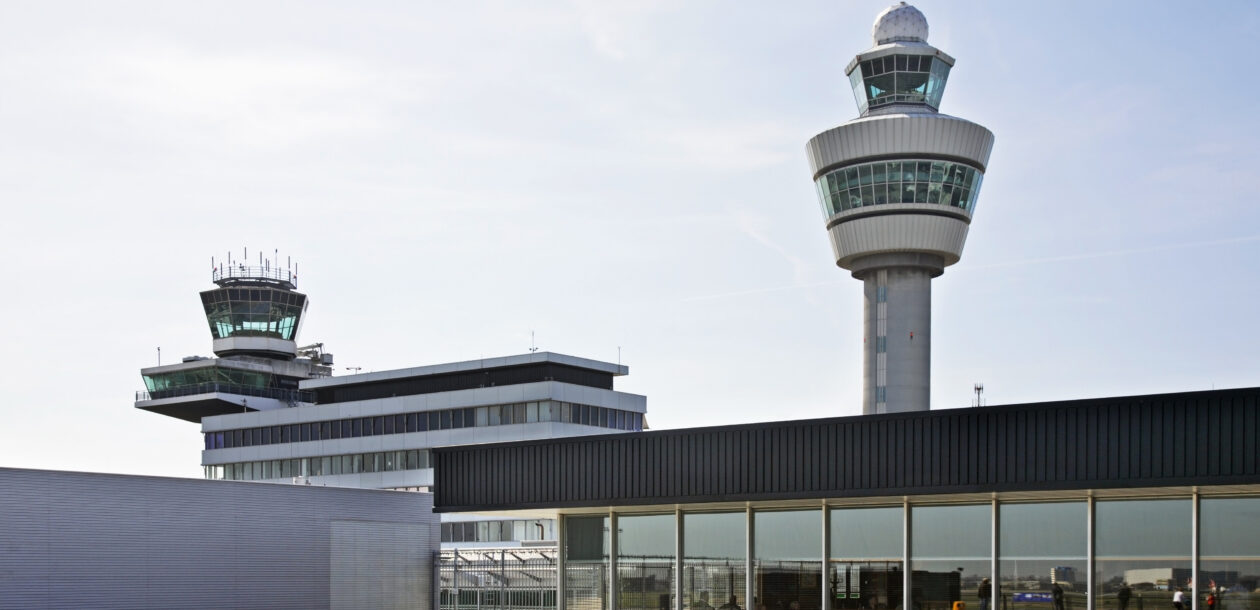
Evacuation strategies as the key to operational continuity
Because of Schiphol’s international role, fire safety is governed not only by Dutch legislation but also by international standards and aviation-specific safety requirements. In addition, every evacuation strategy must take into account the complex security environment of an international airport.
Given the scale of the terminal building, people are often directed to protected refuge areas within the terminal rather than being evacuated immediately to the outside. Through a carefully designed combination of fire compartmentation, life safety engineering and integrated evacuation concepts, parts of the airport can remain fully operational while an incident is safely contained and managed locally.
This approach not only enhances the safety of passengers and employees but also significantly reduces the operational and economic impact of an incident. Fire safety therefore becomes a fundamental building block of the airport’s business continuity strategy.
A long-term partner for fire safety engineering
After nearly three decades, the collaboration has evolved far beyond a traditional consultancy agreement. It has become a long-term partnership in which fire safety engineering, asset management, fire safety consultancy, commissioning, evacuation strategies and operational validation come together to support one of Europe’s most complex airport environments.
By being involved from the earliest design stages through commissioning and the long-term management of fire safety systems, Sweco helps ensure that Schiphol remains safe, compliant and prepared for the future. Every day, the team contributes to an airport where millions of passengers can travel safely and where one of Europe’s most important aviation hubs can continue operating, even under the most challenging circumstances.