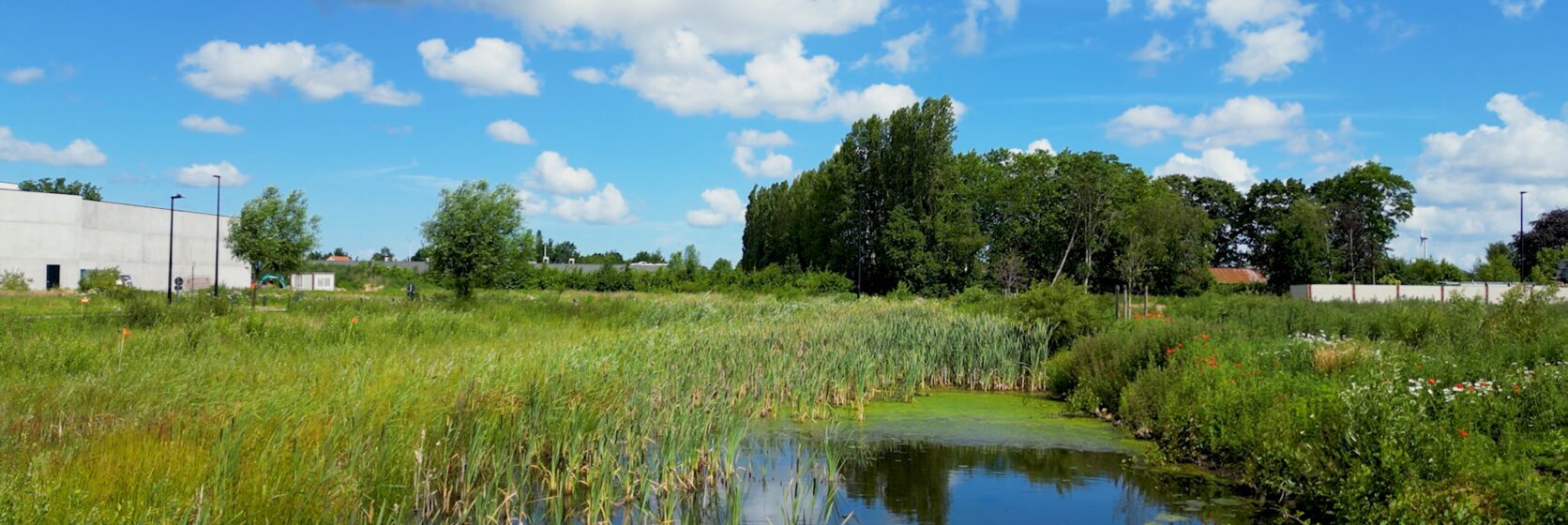
Water basins on business parks
Basins on business parks are playing an increasingly important role in climate adaptation. As part of this study, a practical guide was developed for the Ghent region, taking into account the local soil structure, groundwater levels and applicable rainwater regulations. The guide provides a clear framework for making well-considered decisions on rainwater management, even in highly paved environments. It focuses on efficient solutions for attenuation, storage and infiltration, while also supporting healthy soils and effective natural filtration.
- Expertise:
- Climate resilience & nature
- Client
- Veneco
- Location
- Maldegem, East Flanders
- Services
- Water management, biodiversity, design and management advice, hydraulic modelling
A practical guide for water and nature
Basins are increasingly being seen as more than purely functional water infrastructure. By combining different functions, they can not only collect and infiltrate rainwater, but also improve water quality, enhance biodiversity and create a more attractive working environment.
In certain situations, the collected water can also serve a practical purpose, for example for use by the fire service. In this way, basins are evolving from technical facilities into valuable landscape features that add value to both the business park and its surroundings. They can also make the site more accessible and pleasant for local residents and employees, offering places to walk, have lunch or find shade and cooling.
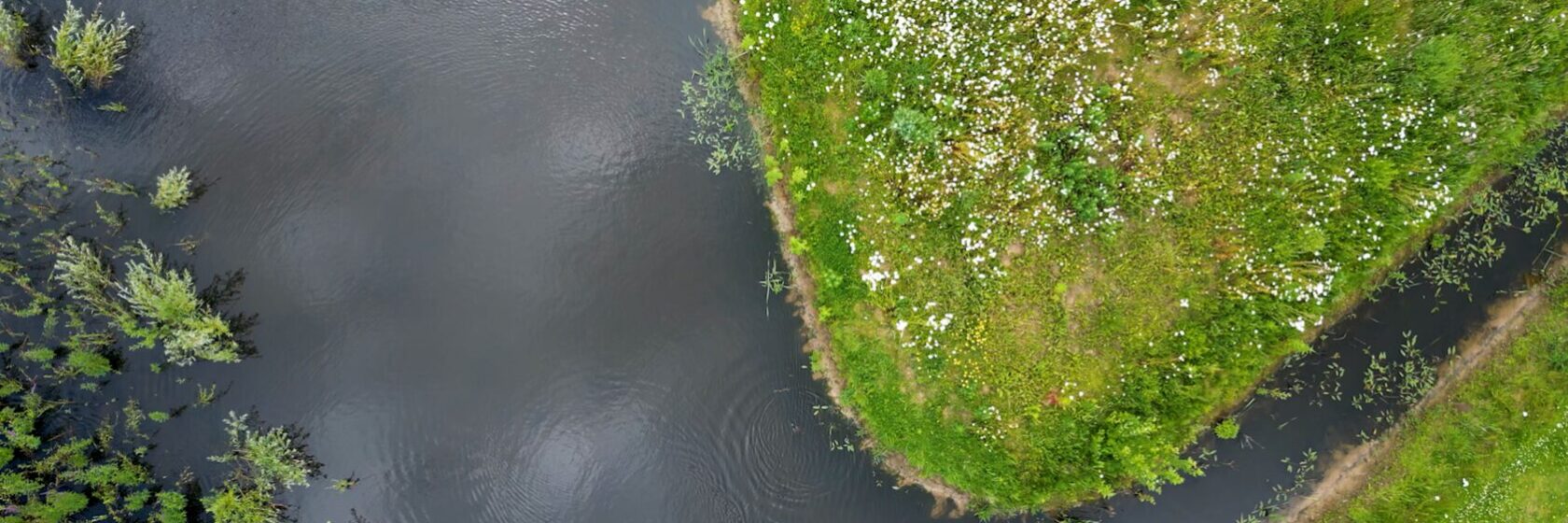
We are constantly looking for ways to optimise the water system, with more efficient solutions for the attenuation, storage and infiltration of rainwater. The strength of this approach lies in combining different functions.
Ann-Lara Aernoudts, Water Expert
More opportunities for flora and fauna
Nature-friendly basins also offer significant opportunities for biodiversity. They can act as stepping stones within the urban fabric and provide habitats for species that depend on water.
The design of the basin plays an important role in this. Gently sloping, undulating banks, variation in ground levels and diverse planting with native herbaceous plants, shrubs and trees help create an attractive and biodiverse environment. These gradients — from nutrient-rich to nutrient-poor, and from dry to wet — further strengthen species diversity. Nature-friendly management is also essential to maintaining this ecological quality in the long term.
Nature-friendly basins provide food, water, nesting sites and shelter for water-dependent species. In highly urbanised environments, they are often unique places.
Tobias Nauwelaers, Green Infrastructure Consultant
Design, management and ecological performance
Scientific research shows that basins can offer far more than water storage alone. Thoughtful design can improve infiltration capacity, help purify water and create a more enjoyable experience of nature within an urbanised setting.
Basins can also play a role in natural mosquito control and help cool the surrounding area. By considering water management, design and ecology together from the outset, it is possible to create a solution that is not only technically sound and functional, but also contributes to the long-term quality of life and attractiveness of the business park. The guide was supplemented with practical measure sheets to make these principles easy to apply in practice.
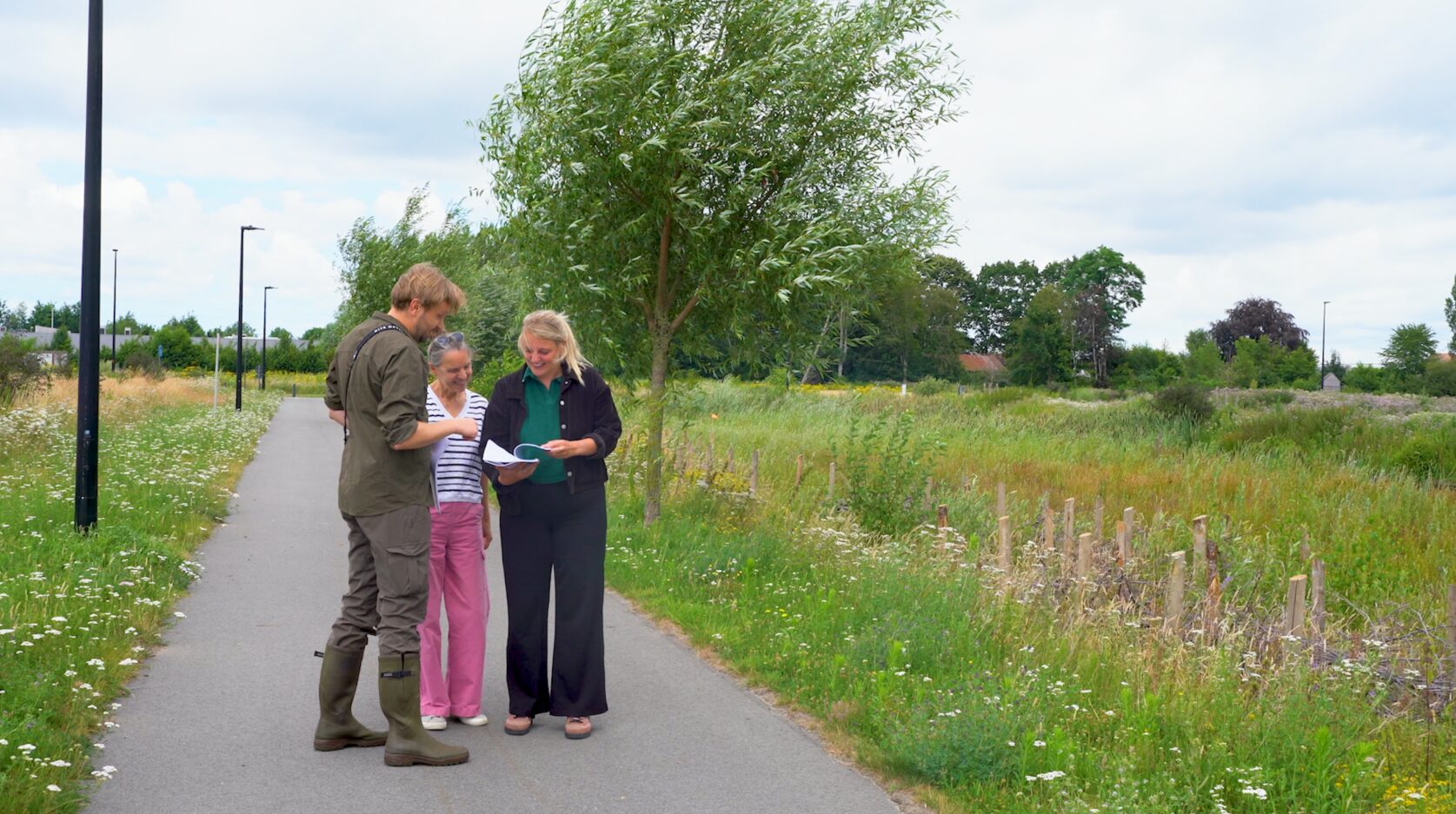

By designing basins thoughtfully, they can also play a role in biodiversity, site experience and how the site is used.
Nel Van Rentergem, Senior Project Coordinator Veneco