
Sweco Belgium
Five new hospitals for HELORA network to feature wooden structures
In the coming years, five new hospitals will be built across Wallonia, spanning Hainaut and part of Walloon Brabant. These state-of-the-art facilities for the HELORA hospital network were designed through a co-creation process following an architectural competition. The primary objective of the client was to select a team that best met the defined requirements. In response to HELORA’s strong commitment to reducing the ecological footprint of these new hospitals, the AVKT design team opted for a partial timber construction approach—still a rarity in the healthcare sector. The building permit will be submitted by the end of March, with tenders for the structural works set for summer 2026. By 2031, at least three of the five buildings are expected to be operational—a remarkable achievement.
The five hospitals will be located in Mons, La Louvière, Nivelles, Lobbes, and Warquignies, replacing outdated and suboptimal healthcare infrastructures. With around 7,000 employees, including approximately 1,000 doctors, HELORA has set high sustainability standards for its new buildings: they must be flexible, easily adaptable, scalable, and have a minimal environmental impact.
Hybrid construction structure
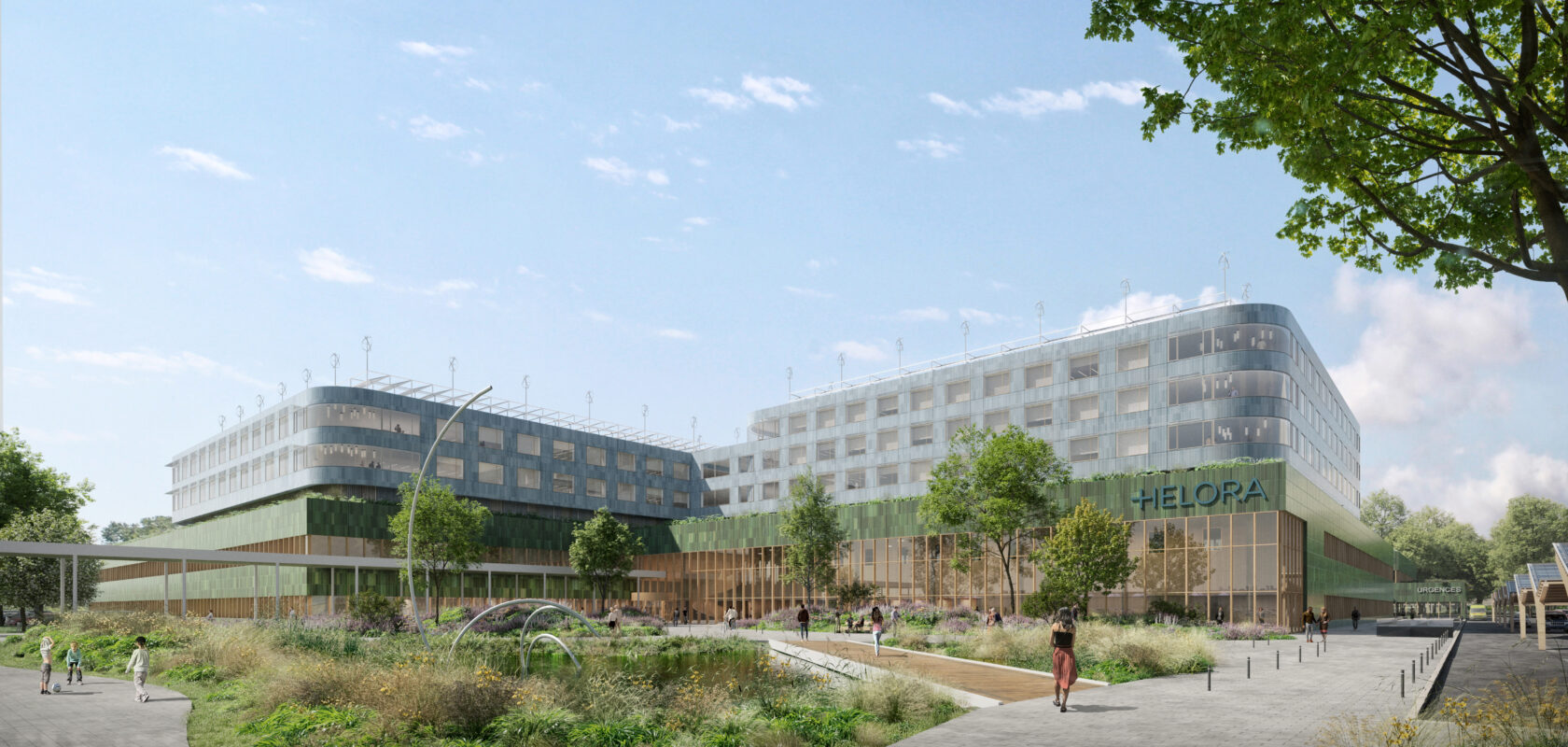
The architectural competition for this large-scale project, launched in 2023, was won by the temporary consortium Archipelago – Sweco – Tractebel. The design concept is groundbreaking: the load-bearing structure for the hospitalisation areas will be entirely wooden, a unique approach for a project of this scale in the healthcare sector. For structural and technical reasons, the base of the buildings, which houses medical-technical functions, along with the central circulation cores ensuring horizontal stability, will be built in reinforced concrete. This hybrid structural approach—combining a concrete column grid (7.80m x 7.80m) for the lower floors with a smaller-scale timber column and beam structure for the patient care floors—ensures that the hospitals are future-proof, meaning they can be easily expanded or modified while significantly reducing their carbon footprint, aligning perfectly with HELORA’s vision. The design is centred around a landscaped inner garden, multiple courtyards, and green roofs, all of which are known to have a positive impact on health and well-being. Sweco collaborated closely with Tractebel and Archipelago in co-creation to develop the project’s technical, structural, and sustainable energy solutions.

Collectively, these five new hospitals will provide 220,000 m² of floor space and accommodate between 1,500 and 1,800 beds. They will share a distinctive architectural identity, characterised by a human-scale design, abundant greenery, high readability, rounded corners, and ceramic facade panels in green and blue, a nod to the historic Boch factories in La Louvière. This signature aesthetic will make it immediately clear to visitors that they are in a HELORA hospital.
CLT and glulam timber
The wooden structure of the five buildings will consist of glued laminated timber (glulam) columns and beams, along with CLT (cross-laminated timber) floors. According to the engineers at Sweco and Tractebel, the project will require approximately 16,000 m³ of CLT and 6,000 m³ of glulam timber, all of which will be certified sustainable.
Beyond its environmental benefits, the decision to use timber was also influenced by seismic considerations, as the hospitals will be located in seismic zones. A timber structure is lighter, which reduces seismic forces. The team is also exploring the possibility of using timber-frame construction for the facades, onto which ceramic panels would be mounted, as well as dry-assembled timber interior walls made from recycled wood waste.
Challenges
Designing with timber comes with its own set of challenges. A detailed study of the column-beam connections revealed that the wooden columns needed to be slightly thicker than initially planned to meet fire safety requirements. The use of timber also impacts the construction sequence: all concrete structures, including vertical cores, must be completed before timber assembly can begin. Additionally, because wood is sensitive to moisture, the building envelope must be enclosed swiftly.
However, thanks to extensive standardization and prefabrication of timber elements, the construction phase will be significantly shorter than traditional methods, helping to offset the higher initial cost of timber compared to conventional materials. The design team has also observed that banks offer better financing conditions due to the project’s sustainability features, further supporting the financial viability of timber construction.

A circular approach
The design by Sweco and Archipelago embraces circularity. The adaptability of the buildings, the renewable nature of timber, and the ability to dismantle structural components and ceramic facades all contribute to a forward-thinking, sustainable approach. HELORA’s choice of timber construction, circular principles, and thoughtful architecture demonstrates that hospitals can be not only functional but also environmentally responsible and adaptable. When completed in 2031, this project will undoubtedly set a new benchmark for healthcare architecture.
Other News

The parking ladder: take control of parking policy, one step at a time
Read more

Approved by children: designing safe school environments
Read more

More eyes at sea: Sweco designs offshore platform concept for marine monitoring and enforcement in the North Sea
Read more