
Sweco Belgium
Full lifecycle in practice: Usquare.brussels and the Herman Teirlinck building
How does the full lifecycle principle take concrete shape in complex construction and reconversion projects? Through the redevelopment of the Ixelles Barracks into Usquare.brussels and the Herman Teirlinck building at Tour&Taxis, we show how vision, design, engineering and long-term value come together in one integrated approach.
Redevelopment of the Ixelles Barracks into Usquare.brussels
Usquare.brussels gives the former Fritz Toussaint Barracks in Ixelles a second life as an open, mixed-use and future-oriented urban district. The redevelopment, driven by the Brussels-Capital Region, VUB and ULB, strongly focuses on circular renovation and sustainable urban heritage. The former gendarmerie barracks are being repurposed into a university hub, complemented by housing, neighbourhood facilities and public spaces that integrate seamlessly into the urban fabric.
Within the Usquare project, the full lifecycle principle was applied from the master planning stage and during the development of the Regional Land Use Plan (PAD) for the redevelopment of the former Royal Gendarmerie School in Ixelles. At this early stage, not only spatial choices were defined, but also strategic guidelines for sustainable urban development, energy, circularity and the integration of the site into its urban surroundings.
We contribute to the development of Usquare.brussels through various assignments. Our full lifecycle approach is clearly reflected by bringing together disciplines and insights across different assignments. From the outset, we defined the main lines: a future-oriented spatial framework and clear ambitions in placemaking, sustainability, energy and circularity. In the following phases, these were further developed by the architects, with Sweco acting as engineering consultant.
Hélène Rillaerts, Team Manager Urban Projects

Interaction between design, engineering and heritage
This long-term vision formed the framework for the subsequent design and engineering phase, in which structural design, building services, acoustics and sustainable design were developed coherently, with respect for the architectural and heritage value of the existing buildings. By continuously aligning design, process and technical depth, feasibility, permitting and constructability were safeguarded throughout the trajectory.
At the same time, the project anticipated future use and management by focusing on energy performance, flexibility and reversible, demountable solutions. The result is an integrated reconversion that is feasible today and prepared for future adaptations, with minimal material and energy impact.
images Usquare.brussels: 1. Sweco, 2. ©Jasper Van der Linden, 3. ©Stijn Bollaert


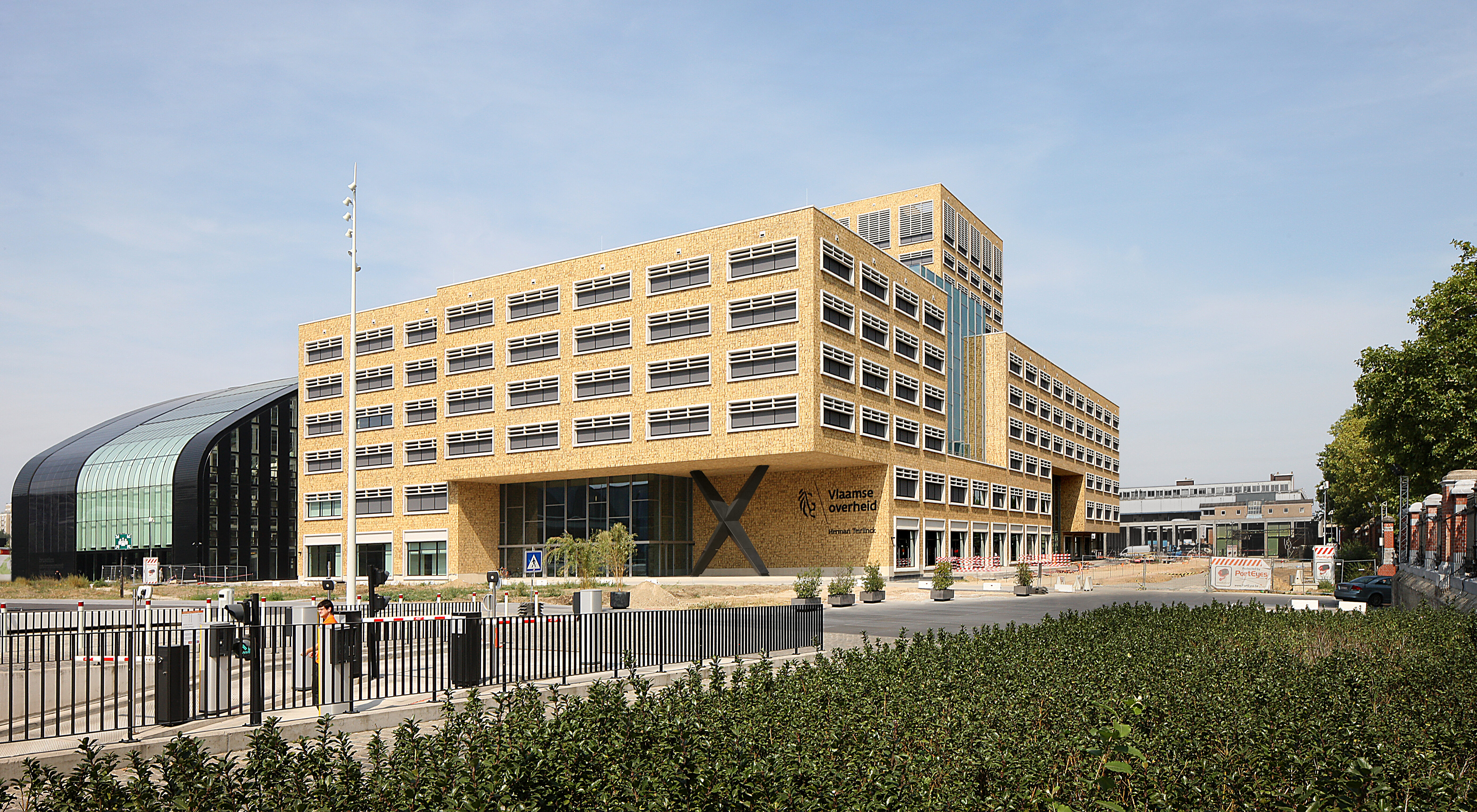
Herman Teirlinck building: new passive office building
The Herman Teirlinck building, located at the Tour & Taxis site in Brussels, is the largest freestanding passive office building in Belgium and today accommodates the Flemish Government. From the outset, the building was conceived as a benchmark for sustainability, energy efficiency and healthy indoor comfort. With its meandering shape, four green courtyards and strong focus on daylight and wellbeing, it offers a high-quality working environment for approximately 2,500 employees. Sweco was involved in several key phases of the project and remained actively engaged after completion, making the building a strong example of our full lifecycle approach in practice.
The Herman Teirlinck building proves the power of collaboration. Together with the ‘Agentschap Facilitair Bedrijf’ and Harvest Management, we continuously optimise building performance through data, Model Predictive Control and smart fault detection. In 2026, we will take the next step towards fossil-free operation by phasing out the gas boilers.
Kurt Corvers, Business Unit Manager Buildings
From vision to direction – planning
During the planning phase, the foundation was laid for a sustainable and future-oriented development. The project started from clear ambitions regarding energy performance, comfort and ecological impact. Thanks to in-depth analyses and simulations, the building envelope, orientation and core concepts were aligned from the outset with passive design principles and long-term use.
From ambitions to solutions – design
These principles were then translated into the design. Advanced simulations made it possible to carefully coordinate façades, windows, insulation, solar shading and technical installations. The result is a building with high energy performance, ample daylight and a stable indoor climate, supported by geothermal energy, concrete core activation, dynamic ventilation and efficient lighting.
From design to reality – execution
During execution, the focus was on the consistent implementation of these technical concepts. The combination of geothermal heat pumps, adiabatic cooling, concrete core activation, climate ceilings and solar panels resulted in a building that is not only sustainably designed but also technically coherent and high-performing.
From completion to continuous optimisation – operation
The added value of full lifecycle thinking becomes most visible during operation. Eight years after completion, the building was further optimised through Model Predictive Control (MPC). Using dynamic simulations and building data, the HVAC installation is continuously monitored and adjusted. This led to energy savings of nearly 30% at HVAC level, while user comfort improved. Fault detection through digital models also enables proactive maintenance and supports further reductions in energy and maintenance costs. In this way, the Herman Teirlinck building continues to evolve, in line with ambitions for CO₂ neutrality and long-term resilience.
images Herman Teirlinck building: main image ©Bram Goots. 1. ©Filip Dujardin, 2 and 3 ©Bram Goots


Other news
Expertise in action: Sweco’s project management for three distinct police projects
Read more

When circularity fails, it is usually the data
Read more

Sweco supports major hydrological system restoration project in the valley of the Kleine Nete
Read more
