

Sweco Belgium
When circularity fails, it is usually the data
The circular economy is often framed as a material challenge: better products, improved recycling technologies, more thoughtful design. Yet, repeatedly, circular ambitions fail in practice, not because materials degrade or technologies fall short, but because information does. Across industries, manufacturing, and the built environment, circular outcomes are systematically undermined by missing, fragmented, or non-standardized data. The result is a persistent paradox: technically reusable materials are downgraded to waste, buildings consume far more resources than expected, and products age silently without producing the signals required for improvement.
Circularity, in other words, does not only fail at the material level. It also fails at the data level.
Buildings and products as data-silent systems
Despite living in an era of so-called “smart cities”, most buildings remain fundamentally unintelligent. They consume energy, regulate indoor environments, and age structurally, yet they do so in silence. Basic questions, how a building performed during recent heat waves, how indoor conditions evolved over time, or how energy use compared to expectations, often remain unanswered. In many cases, this information either does not exist or cannot be accessed. Buildings function as black boxes, even though we spend most of our lives inside them.
This problem extends to every aspect of a building. Heating systems clog gradually without warning, components age unevenly depending on climate and use, and products drift away from their intended performance without leaving any trace. Once delivered, intelligence is effectively frozen. The system has very limited memory of how problems emerge and little capacity to explain why performance degrades.
Digital systems behave very differently. When software degrades, logs record events, errors generate feedback, and engineers can analyse failures, update the system, and improve performance. Learning is embedded in the architecture itself. Most physical products, by contrast, are designed in a way that makes learning structurally impossible. Without visibility, improvement becomes guesswork. Without feedback loops, circular optimisation cannot occur in a systematic way.
Circularity requires learning, not perfection at delivery
This structural silence explains why the circular economy cannot be reduced to better recycling. At its core, circularity is about value retention over time: maintenance, repair, upgrade, and reuse. Achieving this requires systems that can observe their own behaviour throughout their life cycle.
A learning system is not one that is perfect at the moment of delivery, but one that improves continuously by eliminating waste, wasted materials, wasted energy, and wasted effort, during use. This logic underpins concepts such as Product-as-a-Service, modularity, and design for disassembly. However, without data from the use phase, these remain abstract principles rather than operational realities.
Circularity therefore demands a shift in design philosophy: from static goods to adaptive systems, and from one-off optimisation to continuous learning.

The hidden bottleneck: fragmentation instead of interoperability
If the circular economy is so compelling in theory, why does it still struggle to scale in practice? The answer lies in a structural bottleneck that is rarely addressed: fragmentation.
Each organisation defines circularity differently. Each platform uses its own indicators and file formats. Each certification introduces its own terminology. Circular data is generated everywhere, in sensors, factories, procurement tools, and life-cycle assessments, yet almost none of it connects. We collect data, but we do not learn from it. We talk about circularity, but we rarely measure it in a way that enables shared understanding or coordinated action.
This situation closely mirrors global logistics before the introduction of the shipping container. Goods were handled differently in every port, repackaged at every handover, and delayed for weeks. Global trade did not scale because of faster ships or better ports, but because of one simple innovation: a standard box that fits everywhere. The container changed not what was transported, but how coordination happened.
The circular economy faces the same problem today. We do not need more pilots or isolated dashboards. We need a shared protocol.
Last week, I sat in my office with what seemed like a simple task:
What was the history of temperature and humidity in this room over the summer?
I wasn’t looking for high-tech wizardry, just basic data to understand how the building handled the last heat waves. After chasing emails, and dead ends, I had to give up. That’s when the irony struck me. We live in an era of “smart cities”, yet the very buildings we spend 90% of our lives in remain black boxes. We need to change that.
Jeannot Schroeder, CEO +ImpaKT, part of Sweco
Missing data as a systemic risk amplifier
The consequences of fragmented data are not theoretical; they shape real-world decisions on construction sites and in supply chains. In circular construction, reclaimed materials are frequently specified based on circular declarations. Yet during dismantling, uncertainty often emerges around historic treatments or potential contaminants. In the absence of credible, standardised data, materials that are technically reusable are reclassified as liabilities, and disposal becomes the rational decision.
Take treated wood, for example. Research shows that in many reclaimed wood streams, contaminants are depth-dependent and can be removed during standard remanufacturing processes. From a technical and ecological perspective, the core material is fit for reuse. However, regulatory thresholds and decision frameworks remain oriented towards waste treatment rather than higher-value reuse. Practitioners are left operating in a grey zone between “potentially hazardous” and “not formally addressed”.
This creates a structural bias. Missing data behaves like a pollutant in decision systems. It increases perceived risk, blocks viable reuse pathways, and systematically pushes actors back towards linear outcomes. Risk is not eliminated; it is displaced, often onto contractors or regulators who choose the safest option, incineration. Circularity fails not because materials are inadequate, but because information does not survive beyond the moment of sale.
Standardisation as circular infrastructure
If fragmentation is the bottleneck, standardisation is the infrastructure that resolves it. Circularity can only scale when data becomes a shared language, when the circular attributes of products are described once, interpreted consistently, and verified across the entire value chain.
This is the role of the Product Circularity Data Sheet (PCDS), formalised under ISO 59040 and co-developed by the Luxembourgish SWECO team. The PCDS provides a standardised dataset describing key circular attributes such as repairability, separability, next use, continuous cycles, material health, and transparency. Importantly, it does not prescribe design solutions; it standardises information.
Like the shipping container, the PCDS changes not only what is exchanged, but how information is structured in a standardised way. Once circular data is standardised, a transformation loop becomes possible: data generates insights, insights inform design decisions, and design decisions enable long-term viable circular business models. Circularity shifts from a compliance exercise to a learning system.
From data container to decision engine
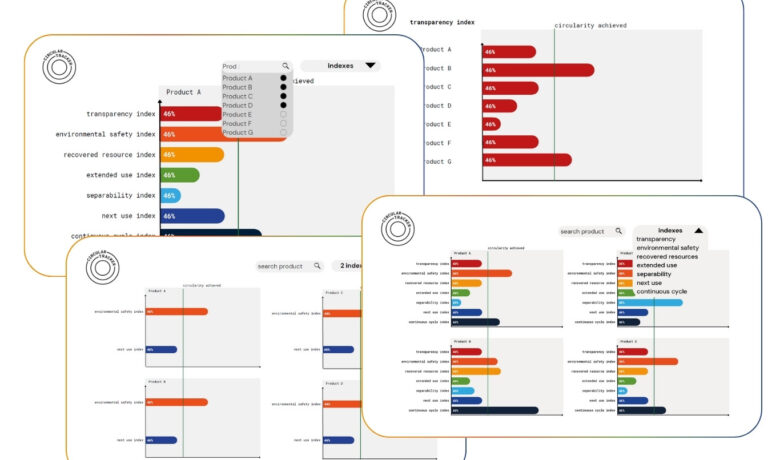
Standardised data alone is not sufficient; it must be translated into operational decision-making. This is where tools such as CircularTracker play a critical role. Built on PCDS data, CircularTracker converts standardised information into a comprehensive and comparable assessment of product circularity. A global index is complemented by detailed sub-indicators addressing resources, extended use, separability, next use, continuous cycles, environmental health, and transparency.
The strength of this approach lies not in producing a single score, but in enabling comparison and feedback. Designers can evaluate how design changes affect circular performance before production. Manufacturers can compare product generations over time. Public and private clients can define minimum circularity thresholds and verify compliance objectively. Circularity becomes measurable, falsifiable, and improvable.
In this sense, CircularTracker functions not merely as a reporting instrument, but as a decision engine embedded in a broader learning architecture.
The circular mandate
The question facing the circular economy is no longer whether circular materials exist, they clearly do. The real question is whether our information infrastructures are mature enough to allow these materials to survive real-world decisions. As long as buildings remain data-silent, products remain memoryless, and circular data remains fragmented, circularity will continue to fail quietly, downgraded by default.
The true mandate of the circular economy is therefore not perfection at delivery, but intelligence over time: designing systems that can observe themselves, learn from use, and improve continuously.
When buildings stop being dumb, circularity stops being fragile.
Overig nieuws

More eyes at sea: Sweco designs offshore platform concept for marine monitoring and enforcement in the North Sea
Read more

Virtual Reality: experience your project before it is built
Read more

Why a charging station is much more than just a charging station
Read more