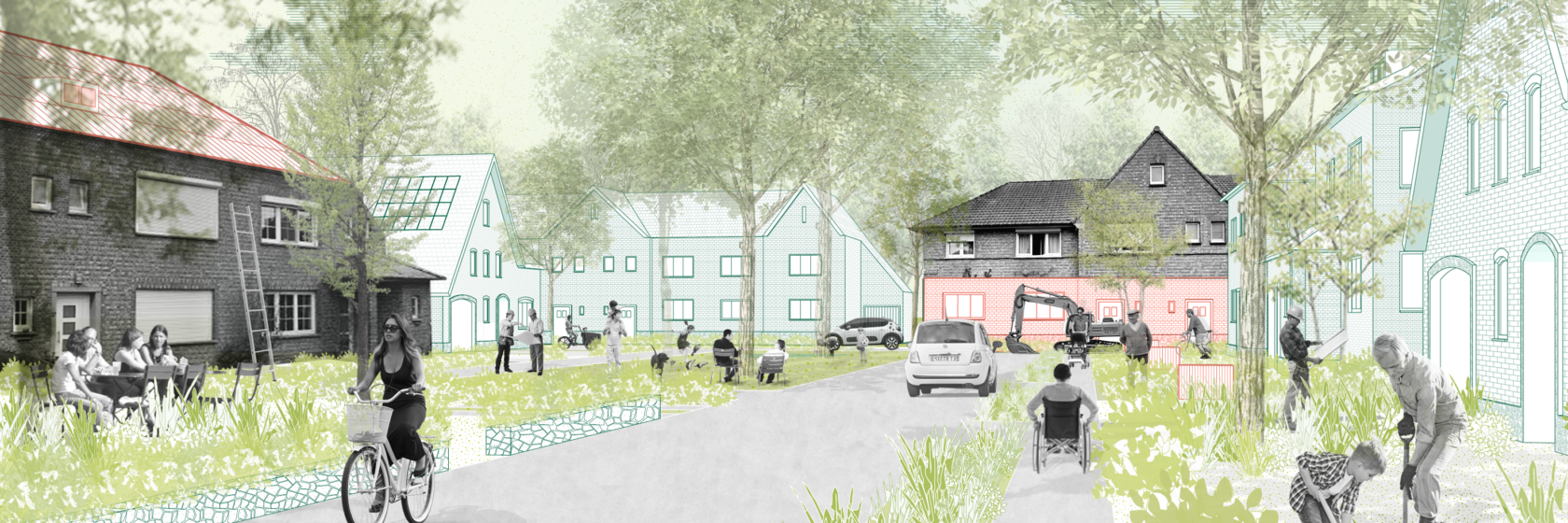
A future vision for a heritage-rich garden suburb in Leuven
Climate District Ter Elst
How can a valuable garden suburb become climate-neutral without losing its distinctive character? For Ter Elst in Leuven, Sweco is developing a broadly supported transition plan together with a multidisciplinary team. The plan brings together energy renovation, heritage conservation, climate adaptation, new housing models and sustainable mobility.
- Expertise:
- Liveable cities
- Client
- Team Vlaams Bouwmeester
- Location
- Ter Elst garden suburb, Leuven
- Sweco scope
- Energy transition and energy advice as part of an integrated district vision
- Partners
- Omgeving, Transition Stories, RE-ST architecten et SuMa consulting
A climate-neutral garden suburb that retains its identity
In spring 2020, the Department of Environment, Team Vlaams Bouwmeester and the Flemish Energy and Climate Agency launched a call for district-scale redevelopment projects. This provided local authorities and public-sector clients with support to develop renovation and climate measures in an integrated way.
For the Ter Elst garden suburb in Leuven, the ambition is clear: to develop a collective renovation and energy transition that can serve as an example for other heritage garden suburbs in Leuven and across Flanders.
The challenge goes beyond energy-efficient renovation. The vision also explores how the district can evolve into a liveable, inclusive and climate-resilient neighbourhood. Housing quality, affordability, mobility and the design of public space are key considerations.
Research by design connects all district challenges
A climate transition never takes place in a vacuum. The spatial context, architecture and socio-economic mix of a neighbourhood all help determine which solutions are both feasible and desirable.
Omgeving coordinates the project and leads the research-by-design process. In this role, the practice brings together the various challenges within a single, integrated district vision. Particular attention is given to climate adaptation, sustainable mobility, the quality of public space and the spatial integration of energy infrastructure.
The energy transition is therefore not approached as a purely technical intervention in individual homes, but as an opportunity to future-proof the entire district. This integrated approach explores how interventions can reinforce one another, from greening and water management to mobility, public space and collective energy systems.
A toolbox for heritage-sensitive energy renovation
Sweco contributes its energy expertise and works closely with RE-ST architecten. Together, they are developing a toolbox of suitable renovation and energy measures for homes in Ter Elst.
The measures are assessed in relation to the heritage value and overall character of the garden suburb. Energy performance, living comfort and spatial quality go hand in hand with preserving the neighbourhood’s distinctive character. The result is a robust framework that helps residents, owners and decision-makers make informed choices.
Residents as co-creators of the transition
A successful district transition requires the involvement of residents. Participation therefore runs as a common thread throughout the process. Transition Stories leads the stakeholder engagement process and creates space for dialogue, knowledge-sharing and collaboration.
By involving residents from the planning stage onwards, the transition plan is better aligned with their needs and expectations. This not only builds support, but also increases the likelihood that residents will actively contribute to the implementation of collective and individual measures at a later stage.
An inclusive and financially viable approach
Alongside the technical and spatial challenges, economic feasibility is also a key consideration. SuMa consulting is exploring how individual and collective measures can be financed through investment and incentive models.
The approach focuses on an inclusive transition: residents with differing financial means must also be able to take part in making their neighbourhood more sustainable. The project also examines the role the local authority can play in supporting and accelerating implementation.
An assessment framework helps to make decisions more objective throughout the process. This enables all stakeholders to set priorities based on clear criteria.
Ter Elst as an inspiration for Flanders
With Climate District Ter Elst, the City of Leuven and Team Vlaams Bouwmeester demonstrate how energy transition, heritage and quality of life can reinforce one another. The integrated approach provides not only a future perspective for the district, but also valuable lessons for similar garden suburbs throughout Flanders.