Public Space & Sustainable mobility
De Haan through road connects mobility with a liveable village centre
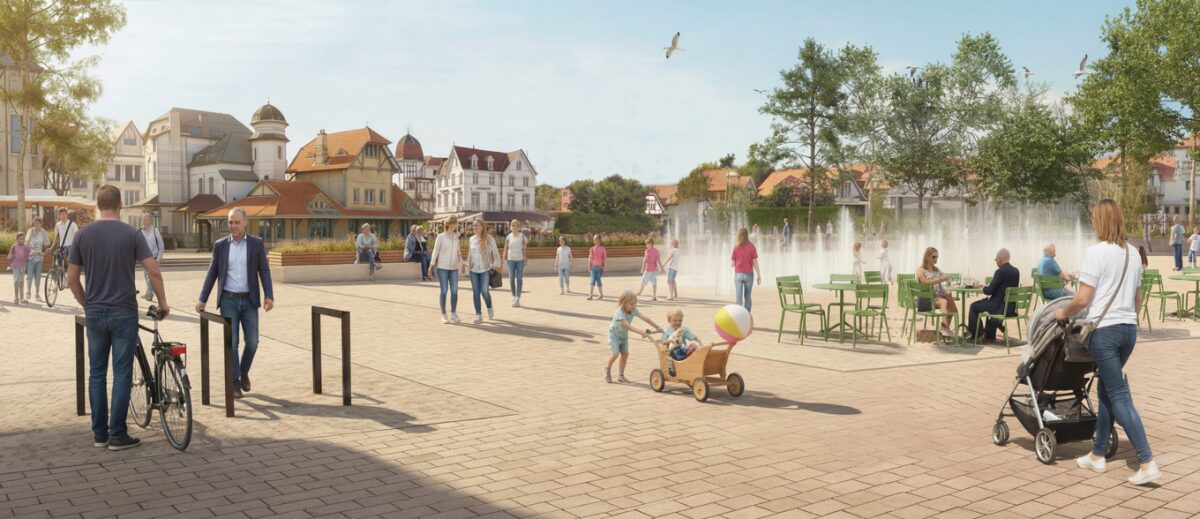
Today, the Nieuwe Rijksweg (N34y) has a major impact on the centre of De Haan. For the planned redevelopment, Sweco prepared a preliminary design featuring lower speeds, an adapted traffic structure, the F34 cycle highway and more space for people to spend time in the central area.
The design opts for a fully at-grade solution without a tunnel. One-way traffic is retained in the central area, while two-way traffic is introduced outside the centre. A 30 km/h speed limit applies at the Leopoldlaan–Stationsstraat junction, creating space for greenery, terraces, markets and events.
- Expertise:
- Transport & Mobility, Liveable cities, Liveable cities
- Client
- Agency for Roads and Traffic (AWV), together with the Department of Environment, the Province of West Flanders and the municipality of De Haan
- Location
- De Haan, Nieuwe Rijksweg (N34y)
- Services
- Landscape design; urban planning and public space; urban mobility planning; participation and co-creation; mobility studies; technical and geotechnical investigation; cost-benefit analysis
Redesigning junctions for active mobility
The major junction of the Nieuwe Rijksweg with Leopoldlaan and Stationsstraat is complex and strongly geared towards car traffic. At the same time, the future F34 cycle highway creates new opportunities for active mobility. Sweco explored how a clear traffic structure could be combined with a more attractive public realm, more greenery and a stronger sense of place.
Technical investigation of the through road
Sweco was selected to investigate the future redevelopment. During the study, tunnel options, an underpass, a series of underpasses and fully at-grade scenarios were examined. Boreholes were drilled to a depth of 20 metres at four locations to map the soil structure and groundwater level. The alternatives were assessed in terms of road safety and traffic flow, spatial quality, technical and geotechnical feasibility, costs, maintenance and societal benefits. The potential for underground parking was also examined.
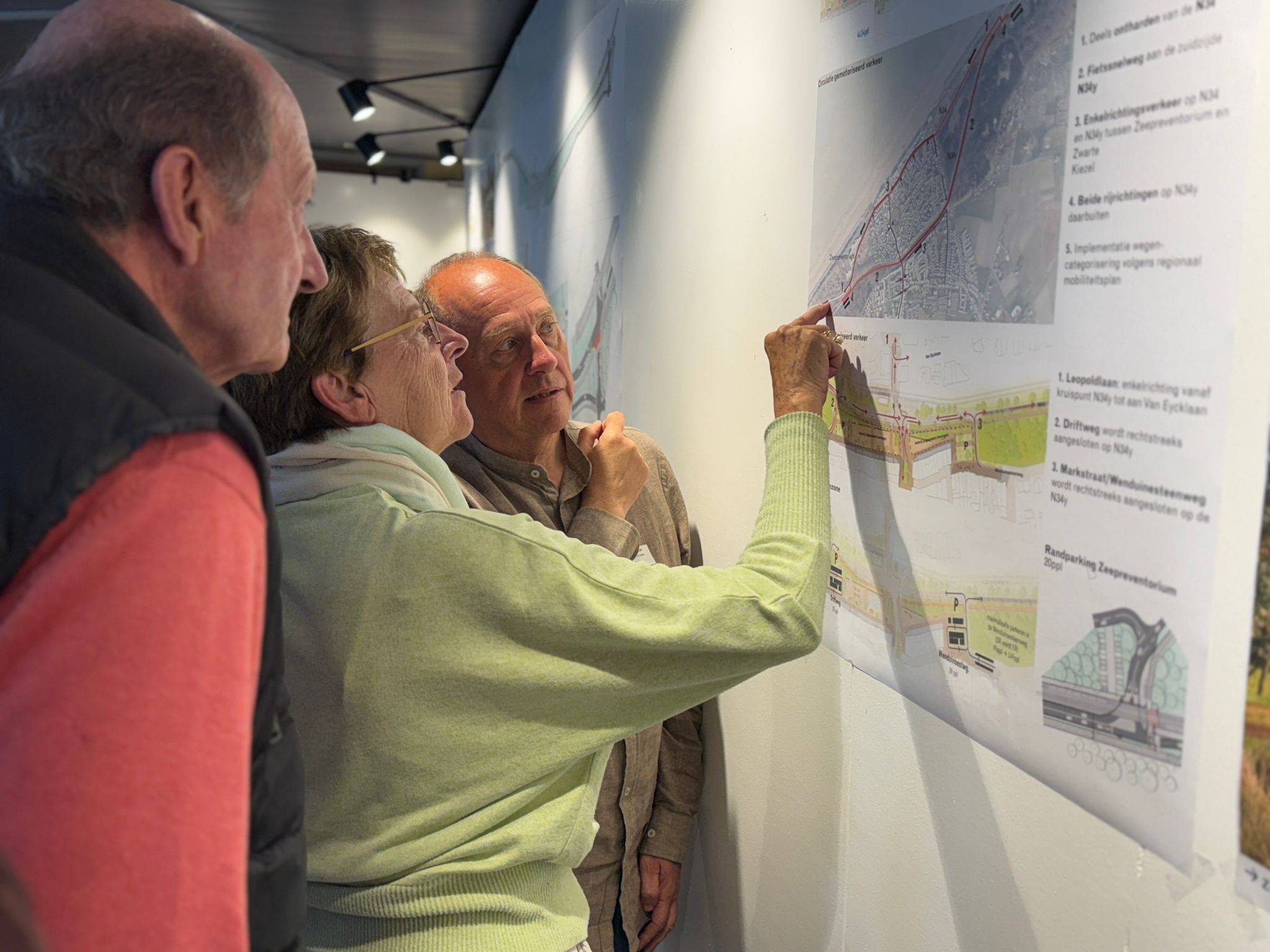
Participation with residents and local businesses in De Haan
Residents, users, local businesses, associations and municipal advisory councils were actively involved. Local knowledge was incorporated into the design through two dialogue evenings and design weeks. More than 170 people attended the first dialogue evening, spread across three working sessions. This participatory approach helped refine the scenarios and gradually shape a broadly supported preferred solution.
Preliminary design for the N34y with cycle highway
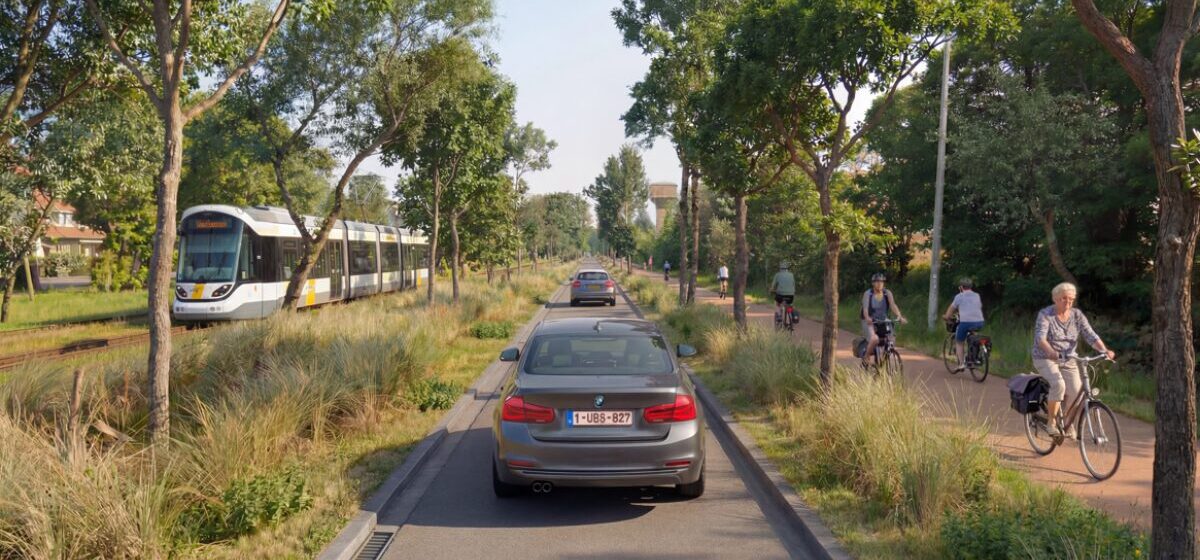
The preliminary design deliberately opts for a balanced, at-grade redevelopment without a tunnel. In the central area, one-way traffic on the N34 and N34y is retained; outside the centre, two-way traffic is introduced on the N34y. A 30 km/h speed limit applies at the Leopoldlaan–Stationsstraat junction. Parking in the central area is reduced to create space for greenery, social interaction and a more attractive public realm. The F34 cycle highway is integrated along the southern side of the N34y.
- retention of one-way traffic on the N34 and N34y in the central area;
- two-way traffic on the N34y outside the centre;
- a 30 km/h speed limit at the Leopoldlaan–Stationsstraat junction;
- integration of the F34 cycle highway along the southern side of the N34y;
- a peripheral car park with around 20 spaces near the Zeepreventorium and additional parking spaces in Wenduinesteenweg;
- a central area with space for greenery, terraces, markets and events.
Six zones for the redevelopment
The preliminary design divides the route into six consecutive zones, each with its own function and layout: the gateway near the Zeepreventorium, the connection between the Zeepreventorium and the centre, the central area around Leopoldlaan and Stationsstraat, the area near Wenduinesteenweg, the continuation towards Vosseslag and the connection to the wider coastal route. Near the Zeepreventorium, traffic lights, the transition between one-way and two-way traffic, retention of the tram stop, the cycle highway and an additional peripheral car park come together. In the central area, the emphasis is on quality of place and public life.