Healthy Soil & Water
Scheldt Quays Nieuw Zuid: a blue-green park as a sponge between the city and the Scheldt
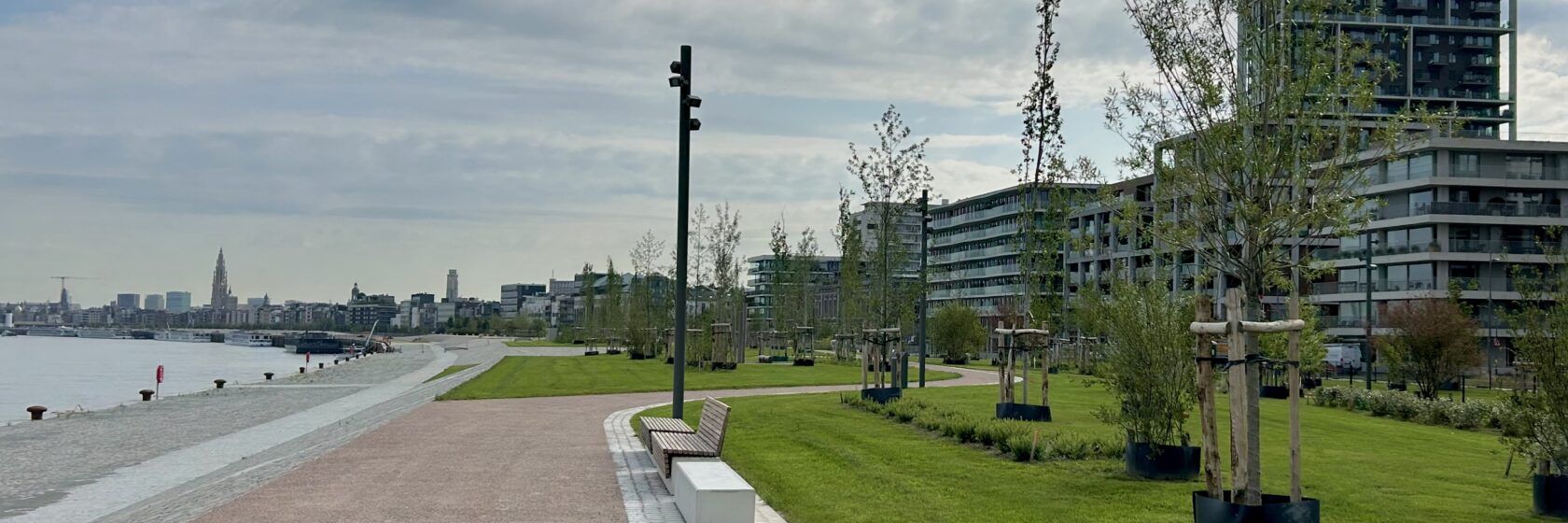
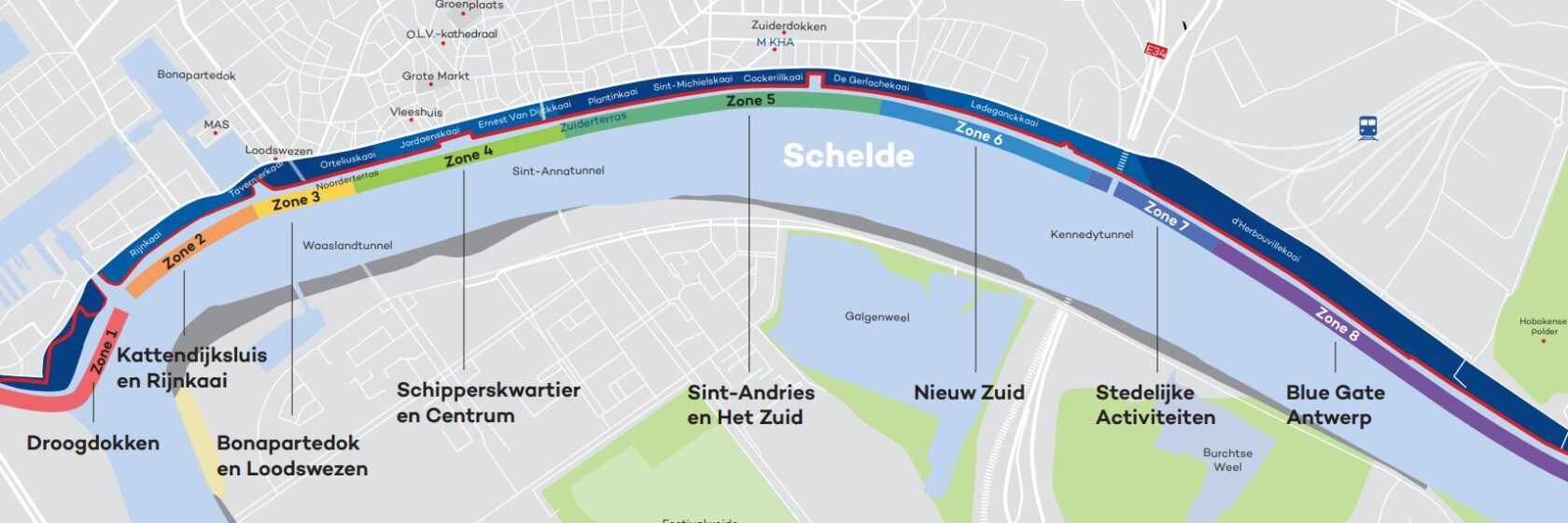
On the Scheldt quays at Nieuw Zuid, AG Vespa is developing Park aan de Stroom, a new public green space of approximately 5.5 hectares.
Sweco supports AG Vespa with an integrated water concept in which buffering and infiltration play a central role.
The result is a park that captures, retains and purifies rainwater and returns it to the local water system.
- Expertise:
- Climate resilience & nature, Water, Liveable cities
- Client
- AG VESPA
- Location
- Scheldt Quays, Antwerp
- Sweco scope
- Definitive design, technical implementation, permitting and tendering, overall coordination and follow-up
- Partners
- PROAP, de Vlaamse Waterweg
Water and soil as guiding principles in the design
The public space is designed as a blue‑green system, featuring a water element, water channels, a water forest and a basin with underground rainwater storage.
The water system is designed so that it:
- discharges rainwater as much as possible above ground rather than via the sewer system;
- buffers and infiltrates water with a time delay;
- supports the local groundwater balance;
- enhances both the ecological quality and the user experience of the park.
The design explicitly takes the existing subsurface as its starting point. Micro-relief, meandering water channels, carefully selected vegetation and permeable materials ensure that water is retained on site as much as possible.
Rainwater collection and buffering
At the heart of the system lies a basin with underground rainwater storage.
This underground buffer facility is connected to a pond and the water channels. Water is routed to the pond via the buffer facility, where aquatic plants provide natural purification.
An underground pipe also runs from the water buffer through the park. At several points, city services can draw on the buffered water to irrigate the greenery.
Water channels:
delay, purification and cooling
A network of shallow, meandering water channels guides rainwater through the park. A circular pipe returns the water to the buffer basin.
The channels fulfil several functions:
- Cooling effect: through slow flow and evaporation, the channels help cool the park.
- Natural purification: sedimentation allows solid particles to settle, while aquatic plants biologically absorb nutrients.
- Experience and microclimate: open water enhances the quality of stay along this wide, open Scheldt quay.
The channels are designed so that:
- They can be closed off in different sections, allowing them to overflow in a “natural” way and, among other things, irrigate the water forest.
- When the Scheldt floods, the system closes automatically, preventing river water from flowing back towards the water buffer.
- Thanks to a separate compartment with aquatic plants, they reinforce the green character of the Scheldt quays and contribute to water purification.
The water forest and infiltration: a sponge in the city
One of the most distinctive elements is the water forest.
In this zone, the soil is deliberately allowed to become temporarily wet to very wet. Trees and underplanting that can tolerate fluctuating groundwater levels and periodic inundation – such as willow, alder, poplar and moisture-loving shrubs and herbaceous plants – thrive here.
The water forest:
- allows rainwater to infiltrate through permeable soil layers, helping to replenish groundwater;
- buffers water during peak rainfall via the concave soil profile and vegetation (retention);
- creates a wet biotope with high biodiversity of insects and birds;
- has a strong heat‑mitigating effect through evaporation and shade.
The rest of the park consists of permeable grassed areas and planted zones, alongside paths with semi-bound surfacing. As a result, a substantial proportion of rainwater can infiltrate locally rather than running off immediately.


The relationship with the Scheldt
The proximity of the Scheldt makes the groundwater system complex and dynamic.
The design takes into account:
- Fluctuating groundwater levels, through continuous monitoring of the Scheldt water level and alignment of the pumping system with it;
- Planting and detailed infiltration measures that can tolerate different degrees of wetness, in line with the existing soil texture.
Together, the park and the Scheldt form a complementary groundwater system: the Scheldt provides the regional reference level, while the park acts as a local groundwater buffer and sponge. This buffer zone sits between the drier, intensively used parts of the quay (paths and seating areas) and the potentially wetter zones closer to the Scheldt.
With Park aan de Stroom, Sweco demonstrates how buffering and infiltration together can create a climate-adaptive park that retains water, cools its surroundings, strengthens biodiversity and better prepares the city for drought – with water and soil as guiding factors.