
Bridge Design and Steel Engineering
Steel cycle bridge over the Schipdonk Canal
The new Rudy Dhaenens Bridge removes a major bottleneck on the F6 cycle highway between Ghent and Bruges. Sweco brought together mobility, architecture and civil engineering in one integrated approach, supporting the Province of East Flanders from the initial feasibility choices through to on-site execution.
- Expertise:
- Transport & Mobility
- Client
- Province of East Flanders
- Location
- Landegem (Deinze), across the Schipdonk Canal
- Services
- Integrated project support, mobility advice, architecture and bridge design, structural engineering, permits, procurement and construction support
- Partners
- Artes Group, Aelterman BV, City of Deinze, De Vlaamse Waterweg nv, ERDF
Missing link on the F6 cycle highway
The F6 connects Ghent, Deinze, Aalter and Bruges and is used by thousands of cyclists every day. Near the railway bridge in Landegem, however, they had to cross the canal via a steep, narrow service path with a grated surface. The passage was uncomfortable and difficult to access for cyclists with reduced mobility and users of cargo bikes or longtails. The new bridge removes this barrier and creates a smooth, clear and safe connection. It also improves the link to the F422 along the canal towards Deinze and Eeklo. The project includes 0.8 kilometres of cycling infrastructure between Stationsstraat and Olmweg.


300 tonnes of steel, ample cycling comfort
Sweco designed a slender steel arch bridge that echoes the design language of the adjacent railway bridge and fits carefully into the canal landscape. The carriageway provides four metres of space for the cycle highway, with a 0.75-metre safety strip between the cycle path and the railings on either side. The arches incline inwards by five degrees, reinforcing the perspective and giving cyclists a broad, open experience on the bridge deck. The steel structure, including formwork, weighs approximately 300 tonnes. The choice of materials also prioritises durability and low maintenance.
Sweco connects design and execution
Sweco played a connecting role across mobility, architecture, civil engineering and construction. Starting from the wider cycling connection, the multidisciplinary team developed a solution that combines road safety and cycling comfort with spatial integration, structural clarity and technical feasibility. By bringing the different disciplines together around one design from the outset, choices concerning form, stability, permits and construction could be continuously aligned.
This integrated approach extended from the initial survey and options assessment to the permit and procurement documents and on-site follow-up. Buildability was a key consideration from the feasibility stage. The bridge was dimensioned so that it could pass beneath every bridge along the delivery route. This allowed the steel structure to be built under controlled conditions at Aelterman’s workshop, transported by water to Landegem and then jacked up, rotated, floated into position and assembled on site. In this way, Sweco translated the design ambition into an executable solution and safeguarded quality through to delivery.

Safer junction, cycle street and Hoppin point along the F6
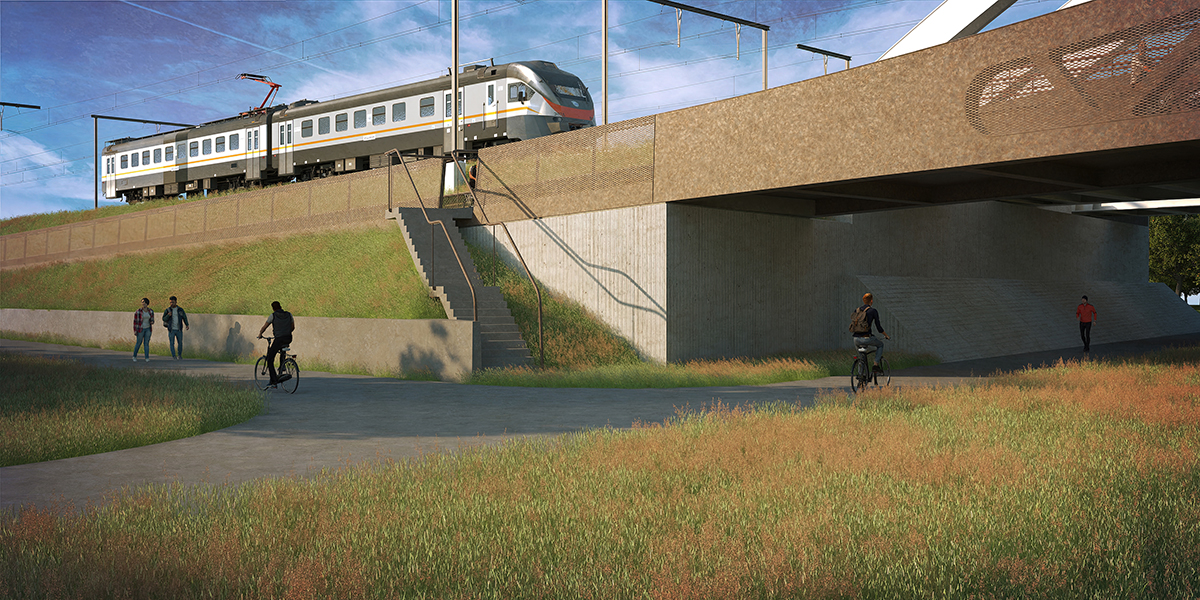
The new crossing forms part of an integrated cycling connection that also upgrades the approach routes. The junction with Stationsstraat will be redesigned to make the crossing safer for cyclists heading towards Heist. On the opposite side, the bridge connects to Lambroekstraat, which will become a cycle street as far as Olmweg. Near the former station building, a segregated cycle path in permeable asphalt will allow rainwater to infiltrate locally.
The parking spaces will also be reorganised, enabling the station area to develop further as a Hoppin point. These interventions support the Province’s ambition to develop the F6 between Aalter and Ghent into a high-quality east–west connection by 2030.
Photos: © Province of East Flanders, ERDF, Artes, Aelterman // Visualisations: © Sweco