Designed together with children for a sustainable and traffic-safe future
Safe school environment in Hamont-Achel
A safe school environment starts with listening to the people who use it every day. In Hamont-Achel, Sweco, together with subcontractor Bochtwerk and on behalf of the City of Hamont-Achel, is developing an integrated design for the redevelopment of the surroundings of Hamont-Lo Primary School and WICO Campus Hamont. As part of the wider cycling and sewerage project in Haag, Dijk, Salvatorstraat and ‘t Lo, the project brings together traffic safety, sustainable mobility, climate adaptation and participation in one future-oriented public space designed around the needs of children.
Facts about the project
- Client
- City of Hamont-Achel
- Location
- Hamont-Achel, Belgium
- Sweco scope
- Mobility study, traffic safety, spatial design, landscape architecture, participation, sustainable water management, cycling infrastructure design, technical engineering
- Stakeholders
- City of Hamont-Achel, Hamont-Lo Primary School, WICO Campus Hamont, Fluvius, local residents, parents, pupils and teachers
A school environment designed around traffic safety
A school environment is much more than a road alongside a school building. Every morning and afternoon, hundreds of cyclists, pedestrians, cars and buses come together within a limited space. This requires a carefully considered design in which traffic safety, clarity and quality of life are perfectly balanced.
The City of Hamont-Achel therefore chose not to opt for a conventional redevelopment of the cycle paths, but for a comprehensive vision that anticipates the future expansion of the school and growing mobility flows. Sweco developed an integrated design in which infrastructure, landscape, water management and mobility reinforce one another.

The project is part of the redevelopment of the Supra-Local Functional Cycling Route Network (BFF) and is being combined with the construction of a new separated sewerage system. By carrying out both projects simultaneously, a sustainable solution is created while minimising future disruption.
Designing through the eyes of children
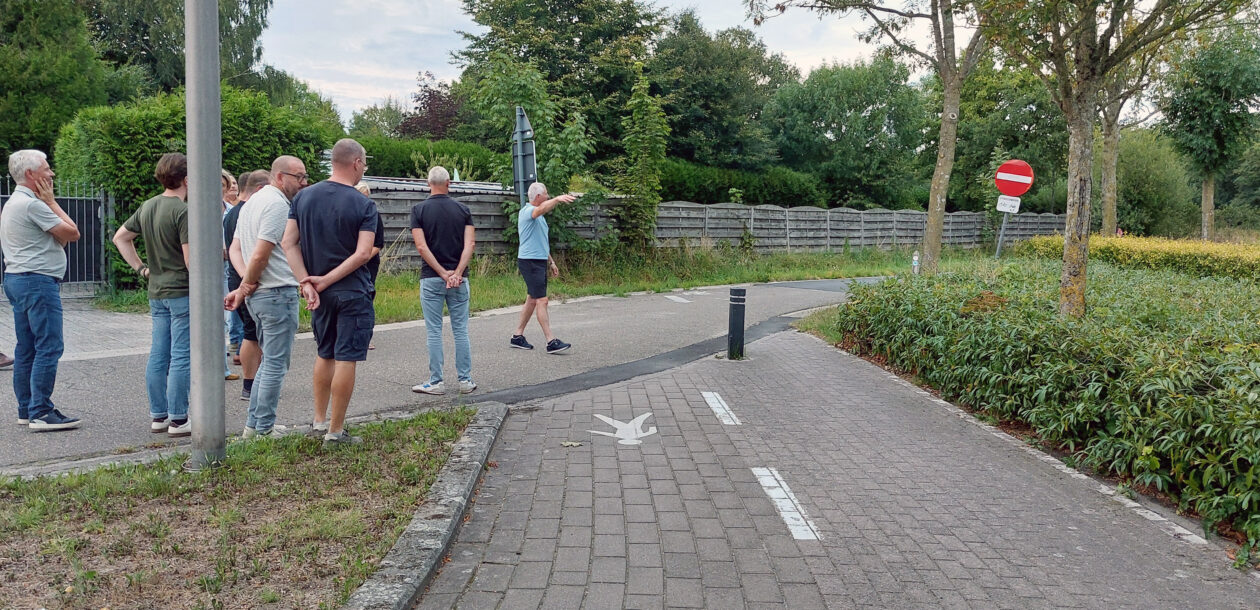
What sets this project apart is the way the design was developed. Rather than relying solely on traffic models and technical analyses, Sweco chose to actively involve the people who use the area every day. The pupils, in particular, played a central role. During interactive workshops, sixth-year pupils first learned about the project and the challenges surrounding traffic safety. They then explored the school environment together with our mobility experts to show the routes they use every day.
Among other things, they identified:
- where they feel unsafe;
- which routes they use every day;
- where conflicts occur between cyclists, cars and pedestrians;
- which solutions they believe could improve safety.
These first-hand experiences provided insights that often remain hidden in conventional traffic studies. The pupils’ observations were incorporated directly into the final design and formed an important basis for its further development. This approach is fully aligned with the Child Standard, or the 8 to 80+ principle, whereby public space is designed from the perspective of the most vulnerable road users, helping to ensure that it is safe, pleasant and accessible for everyone.
Traffic safety as the starting point
The existing school environment presented several traffic safety challenges.
During the morning and afternoon peak periods, hundreds of traffic movements created conflicts between cars, cyclists and pedestrians. Parents parked in unsuitable locations, queues obstructed the public road and cyclists regularly had to manoeuvre around parking vehicles.
The on-site analyses identified several key issues, including:
- conflicts between cyclists and parking cars;
- busy Kiss & Ride periods;
- insufficient safe crossing points;
- congestion on access roads;
- unclear traffic flows;
- limited space for active mobility.
These observations formed the basis for the new spatial design.

An integrated design
The new design reimagines the entire school environment based on one integrated vision.
Key interventions include:
- a traffic-safe 30 km/h zone with traffic-calming measures;
- new segregated cycle paths;
- safe staggered crossings for cyclists;
- an optimised Kiss & Ride zone;
- additional parking spaces for parents and staff;
- wide and accessible footpaths;
- green central verges and new trees;
- permeable parking spaces;
- bioswales for rainwater infiltration;
- new bus stops and a flex bus stop;
- a clear separation between pedestrians, cyclists and motorised traffic.
Alongside the redevelopment, a completely new separated sewerage system will be installed. By managing rainwater and wastewater separately, the project contributes not only to a safer school environment but also to a climate-resilient and sustainable public space.
Participation as the key to a widely supported design
A safe school environment can only be created when all users are heard. Sweco and Bochtwerk therefore organised an extensive participation process involving local residents, parents, schools, municipal services and other stakeholders. Through site visits, interactive workshops and consultation sessions, local insights were translated into concrete design choices. The active involvement of the pupils made a particular difference. Their everyday experiences provided an important source of inspiration for solutions that are both technically sound and practical in daily use. The result is a design that has broad support within both the school community and the surrounding neighbourhood.
Building a safe and sustainable school environment together
This project demonstrates how mobility projects can deliver much more than infrastructure alone. By bringing together traffic safety, sustainable mobility, quality of life, climate adaptation and participation from the earliest design stage, Sweco is creating a public space that is ready for the future. The new school environment in Hamont-Achel will support smoother and safer peak school traffic, encourage cycling and walking, improve quality of life and create a green public space where children can move around safely and independently. Together with the City of Hamont-Achel, we are creating a school environment in which safety, sustainability and children’s everyday experience are at the heart of the design.