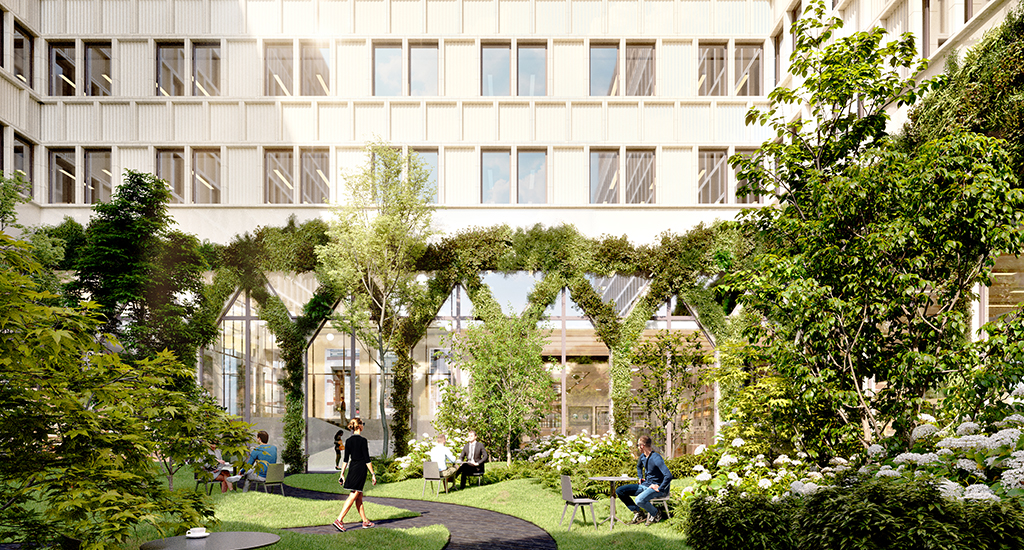
The most sustainable building in the Brussels’ European Quarter
Turning Total’s former headquarters, located on Rue de la Loi in the Brussels European quarter, into an exemplary, eco-friendly complex, is the objective for this iconic building of the 1930s.
- Client
- Immobel
- Location
- Brussels
- Period
- 2022-2025
- Partners
- Neutelings Riedijk Architects & Jaspers-Eyers Architects
- Services
- MEPF Study and follow-up, Sustainability advice
- Surface
- 34,000 m²
- Certification
- BREEAM Oustanding, WELL Platinum, DGNB label
Making the client’s and the architect’s dream come true is a fulfilling challenge. To reach our goal, the building team has opted for a drastic redevelopment and transformation, with a clear focus on sustainability, well-being and circularity.
In the spirit of this sustainable transformation, we have studied the design of the facades, the thermal envelope, the airtightness and the compactness of the building to guarantee high thermal performance. This is always done with a view to reducing the primary energy consumption of the building.
A well thought-out insulation concept
The project is built to the passive standard where possible. That is, as far as the new construction part is concerned. All windows are triple glazed to limit heat loss. The existing facades to be renovated are fitted with efficient internal insulation so that there is no need to modify the exterior of these facades. The above efforts ensure that the average thermal transfer coefficient of the facade, including windows, remains below 0.5 W/m²K.
Intelligently leveraging natural light
We plan the continuous occupancy spaces, such as offices in the first daylight zone, i.e. the space adjacent to the facades. Functions with lower lighting requirements are positioned in the second daylight zone. The new facade is equipped with a percentage of windows between 30 and 35%, making it possible to find an optimization between providing sufficient light and desired solar gains, and limiting cold and heat losses. A high light admission factor is at least as important as the percentage of glass.
Based on a solar study, we determine on which facades mobile external blinds are desirable. The translucent sections aim for an optimal balance between the very high light transmittance of over 60% and a very low combined solar factor value of around 10%.
A skyrocketing energy performance
Heating and cooling
Only geothermal energy is used for heating and cooling. This involves extracting groundwater from aquifers, extracting heat or cold from it, and then returning the water. The already low thermal demand of the buildings results in very low electricity consumption thanks to the high efficiency, a COP above 5, of the heat pumps.
The presence of a thermally activated 400m³ buffer tank allows heat and cold to be stored, thus optimizing the use of the installed capacity while taking advantage of the sometimes diverse thermal demands of buildings.
Combined with a detailed control strategy driven by a Whitebox MPC self-learning controller, this regulation considers the weather, expected occupancy, building inertia, etc. This allows even better control over energy consumption and comfort.
Auxiliary energy for air handling unit fans
Particular attention is paid to the design of an aeraulically optimized network of ducts. The adjustment and control strategy is also optimized to achieve the lowest possible pressure loss. The air handling units will be larger, so that all the modules in them will generate a 15% reduction in pressure loss. Consequently, the total required lift height of the fans will be limited, which has a direct impact on the corresponding energy consumption.
Auxiliary energy for hydraulic pumps
Proper selection and adjustment of hydraulic valves can positively influence the pressure drop necessary for the circulation pumps. This is the same for the dimensioning of these elements and the complete pipe network. We have outlined a detailed and intelligent control strategy to further reduce consumption.
Efficient LED lighting
A good daylighting concept is essential to reduce the amount of energy used for lighting. On the one hand, the choice is for efficient LED lighting controlled by a sophisticated system based on a wide range of parameters; on the other hand, the need for lighting is further reduced by the future interior design and the judicious placement of functions.
Photovoltaic panels
The technical installations will be powered by heat pumps. In addition, there is a field of photovoltaic solar panels on the roof of the building. The newly constructed facades will also be equipped with photovoltaic panels. These will be integrated into a system of wooden frames allowing the photovoltaic panels, among other infill elements, to become part of the overall architecture of the façade.
Photo: © Neutelings Riedijk Architects & Jaspers-Eyers Architects