
UZ Brussel prepares for the future
The UZ Brussel campus has evolved in a typical way as a university hospital over time. After decades, the organic expansions and adjustments have brought several challenges to the surface: space shortages, fragmented services, circulation, and parking issues.
- Client
- UZ Brussel
- Architect
- Sweco
- Location
- Brussel
- Period
- 2014-2029
- Expertises
- Architecture, MEP, Structural Engineering, Digital Engineering, Infrastructure, Sustainable Design
- Solutions
- Master planning, Building Simulations, Feasibility Studies, Building Physics
Sweco designed a spatial plan that outlines the care strategy for the future. This living document highlights an acute need for expansion and reorganization for most medical services, such as the medical technical block, the outpatient clinic, the emergency department, and specialized centers. The spatial plan also optimizes the interaction between these services by reorganizing the logistics and visitor circuits and separating different circulation flows.
Furthermore, the specialized centers need to be developed into clear entities within a coherent whole. All of this must be accomplished without disrupting daily activities and with minimal temporary housing. Accordingly, several preparatory and related projects are necessary.
Temporary Oncology Centre

The former oncology center had to be demolished for a new medical technical block that will house a new oncology center. A temporary oncology center with a day hospital, consultations, and radiotherapy will bridge a period of ten years. The five-story steel structure is clad with sandwich panels and façade grilles. The temporary center connects to the consultation building for internal communication. The layout also facilitates the future demolition of existing buildings.
Emergency department
The emergency department at UZ Brussel has grown into one of the largest emergency departments in the country. More than 65,000 patients are treated annually, in close collaboration with all medical specialties on the campus.
The existing emergency department was completely stripped and renovated over several years. Additionally, expansions were made for the short care and response unit, including EMS garages, reception, and triage. The result is a large, integrated emergency department with care pathways for each pathology. This efficient approach to care needs significantly reduces waiting times. Central workspaces provide emergency doctors with maximum oversight and reduce walking distances.
Thanks to well-thought-out phasing, the busy emergency department remained fully operational during the construction work.

In addition to these preparatory works, two new additions will leave their mark on the renewed care campus. The new medical technical block will centralize all critical services in an impressive and vibrant building. The Landmark building will serve as a new gateway, giving the campus a fresh appearance.

Related content
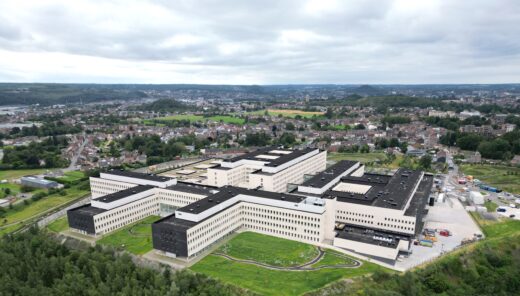
Revisiting Grand Hôpital de Charleroi 15 months after inauguration – part 1
Read more

A sustainable design for the WZC in Wakken
Read more

With Nobel I and a new parking facility, UZ Gent prepares for the construction of its new hospital
Read more