Digital site monitoring and BIM: improving collaboration throughout construction and renovation projects
Digital site monitoring is transforming the way construction and renovation projects are managed. By bringing together site data, photographs, drawings and BIM models within a single digital environment, project teams gain faster access to up-to-date information, improve collaboration across disciplines and make better-informed decisions.
At Sweco, we use digital technologies to deliver projects more efficiently, transparently and with a future-focused approach. By combining digital innovation with our expertise in design, engineering and project management, we support our clients throughout every stage of the construction process.
Why digital site monitoring is becoming increasingly important
Construction and renovation projects are becoming increasingly complex. Multiple stakeholders work simultaneously on the same project while large volumes of information are continuously updated. When photographs, drawings, comments and technical documentation are spread across different systems, the risk of miscommunication, duplicated work and project delays increases.
Digital site monitoring brings all project information together in one central environment. As a result, designers, engineers, contractors and project managers always have access to the same up-to-date project information.
The benefits are clear:
- A single source of truth for all project data
- Improved collaboration between internal and external stakeholders
- Reduced administrative workload
- Faster decision-making
- Greater control over quality and project execution
- Better tracking of changes throughout the construction process
From the physical construction site to a digital project environment
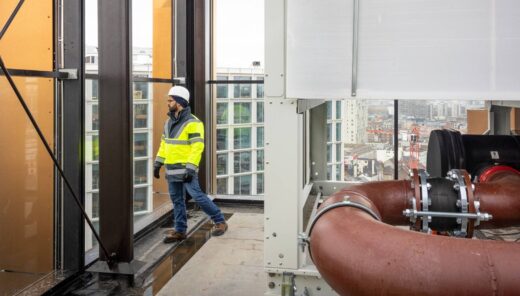
Thanks to innovative digital technologies, construction sites can now be captured digitally and made accessible to every project stakeholder. This creates a continuously updated digital representation of both the existing conditions and the progress of the works.
Project teams can inspect spaces, technical installations and structural details without needing to be physically present. This makes it easier to share information, analyse situations and make informed decisions, even when teams are working across multiple locations.
By digitally documenting the construction site, a permanent visual archive is created that remains valuable during and after project delivery. Clients can review the building’s history at any time, monitor its evolution and easily revisit the situation at every stage of the project.


Creating a complete picture with 360° image capture
One of the key innovations in digital site monitoring is the use of 360° cameras. As users walk through a building or construction site, images are automatically captured to create a complete visual record of the environment.
Unlike traditional photographs, which only show a limited perspective, 360° imagery allows users to freely explore a space afterwards. This provides project teams with significantly more context and detail without having to revisit the site.
Each image is linked to its exact location within the building or on the project plan. Users can easily navigate to a specific room or area and inspect the situation as if they were physically present. This simplifies the verification of technical details, documentation of existing conditions and monitoring of construction progress.
An additional advantage is that virtually every part of a space is captured automatically during a walkthrough. Instead of relying on a limited number of photographs focused on specific points of interest, project teams obtain a far more comprehensive representation of reality. As a result, valuable information can still be retrieved afterwards, even if it was not specifically captured with a particular purpose in mind.
Connecting BIM and site data for deeper project insights
The real value is unlocked when visual site information is integrated with BIM models.
By capturing the construction site at regular intervals, historical and current images of the same location can easily be compared. This not only makes project progress visible but also provides reliable visual evidence for warranty cases, damage claims and dispute resolution.
Integrating BIM with digital site monitoring delivers several important benefits:
- Improved quality control
- Faster identification of deviations and issues
- More efficient management of design and construction changes
- Better insight into project progress
- Reliable project documentation throughout the entire asset lifecycle
For renovation projects, this approach offers additional advantages. Existing buildings often contain complex situations that are not fully reflected in drawings or laser scans. By combining BIM with rich visual site information, project teams gain a more complete understanding of existing conditions, resulting in more accurate models and better-informed design decisions.

Smarter collaboration across the entire project team
Construction projects bring together a wide range of disciplines. Architects, engineers, contractors, facility managers and clients all rely on accurate and up-to-date information to make informed decisions.
By making all project data available within a single digital environment, collaboration becomes more transparent and efficient. Users can access information based on their role and instantly retrieve the data that is most relevant to them.
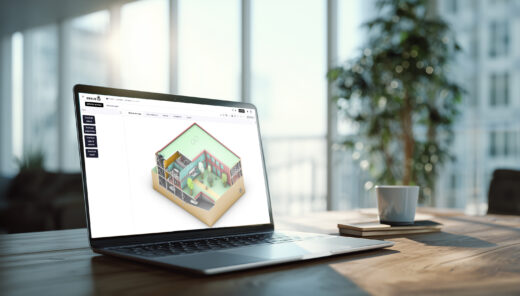
Instead of searching through folders, reports or photo libraries, project teams can simply select a location on the floor plan and immediately access the corresponding images, documentation and project information. This accelerates communication while significantly reducing the risk of errors caused by outdated information or multiple document versions.
Digitalisation as a driver for the construction industry of tomorrow
Digital site monitoring is part of the broader digital transformation taking place across the construction and real estate sectors. By connecting BIM, 360° image capture, data integration and digital collaboration platforms, organisations can design, deliver and manage projects more efficiently throughout their entire lifecycle.
At Sweco, we believe digitalisation is about far more than technology alone. It is about creating tangible value for clients, project teams and end users. By making project data more accessible and strengthening collaboration, we help create smarter, more sustainable and more manageable buildings and infrastructure.
Digital site monitoring plays a key role in bridging the gap between design, construction and asset management, ensuring that projects remain supported with reliable information throughout their complete lifecycle.
Would you like to discover how digitalisation can strengthen your construction or renovation project?
Our experts combine expertise in BIM, digital engineering, project management and data integration to deliver complex projects more efficiently. Together, we explore how digital site monitoring can improve project outcomes, increase transparency and enhance quality throughout the entire lifecycle of your building or infrastructure.

Anthony Kennes
Team Manager
Willem Bastiaens
BIM Expert