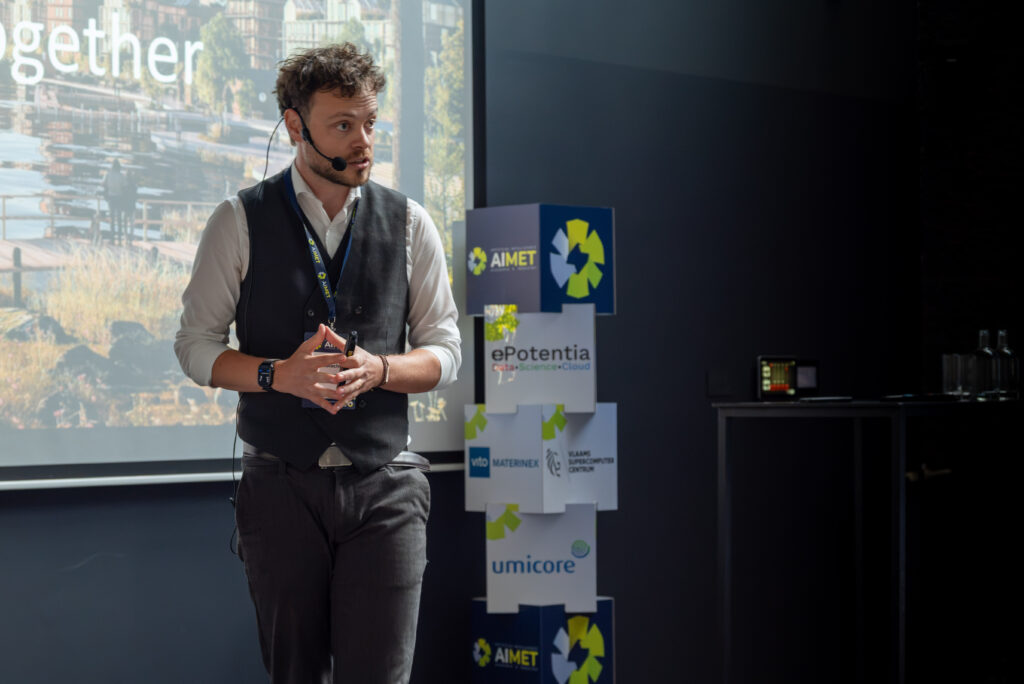
Artificial intelligence can help industrial organisations optimise engineering processes, improve asset management and make better-informed decisions. Real business value emerges when AI technology is connected to reliable data and engineering expertise. At AIMET 2026, an event organised by FMV, Joren Lambrecht, Team Manager and Innovation Manager at Sweco, explored how AI, data and digital technologies can transform industrial processes. His message: start with engineering and operational needs, not technology alone.
AI in engineering: start with the operational challenge
From automating repetitive tasks to improving operational decision-making, AI offers opportunities across the industrial sector. But adopting new tools does not automatically improve results. The challenge is identifying where they can make a meaningful difference within existing engineering processes.
While productivity improvements can deliver immediate benefits, the greatest opportunities often lie in transforming core engineering processes and developing digital solutions that address specific industrial challenges.
Turning industrial data into actionable knowledge
Technical drawings, equipment specifications, supplier documentation, maintenance records and operational data contain valuable knowledge throughout an asset’s lifecycle. Yet this information often remains fragmented across systems, departments and document formats. Engineers can lose time locating reliable information or repeating work, while decisions may rely on incomplete or outdated data. AI can help make this knowledge accessible, but only if the underlying information is organised, interpreted and validated.
“Many companies can use the same AI models. I believe the difference will increasingly come from the data and engineering knowledge we connect to them.”
Team Manager and Innovation Manager at Sweco
Why reliable AI needs engineering judgement
AI can analyse large volumes of information, identify patterns and automate parts of complex workflows. However, technical information cannot always be interpreted correctly without understanding its engineering context.
For example, two equipment specifications may appear similar while representing significantly different technical requirements. Likewise, historical supplier quotations may contain comparable prices but refer to different scopes, materials or operating conditions.
Without appropriate validation, automated analysis could produce misleading conclusions.
Engineers establish validation rules, interpret results and assess whether information is suitable for a specific application. Their judgement helps make knowledge more consistent and reusable. The objective is not to replace expertise, but to strengthen it through better information and more efficient processes.
Connected industrial data for better asset management
Industrial facilities continuously evolve: equipment is replaced, installations are modified and operational requirements change. Each modification generates technical information that must remain accurate, accessible and connected to the physical asset.
When engineering databases, document platforms, maintenance systems and operational applications are disconnected, maintaining a reliable asset overview becomes difficult. An integrated approach to information management can help organisations:
Improve operational reliability by making relevant technical information easier to access and verify.
Reduce inefficiencies by limiting duplicate work, manual information transfers and unnecessary checks.
Support better decision-making through consistent and connected engineering data.
Optimise asset performance by combining technical information with operational insights.
Support sustainability objectives by identifying opportunities to improve resource efficiency and operational processes.
These benefits require more than software integration: a clear information strategy, effective data governance and an understanding of how engineering and operational teams use data. Sweco brings together engineering, data analytics, software development and systems integration to address these challenges.
A secure environment and clear data governance are essential to this approach. Sensitive engineering, operational and client information must be managed in a way that protects confidentiality throughout its lifecycle. This means controlling who can access, use and share data, including when it is processed by AI tools.
From AI experimentation to measurable business value
Moving beyond isolated AI experiments starts with a clearly defined problem and an intended operational improvement. At AIMET 2026, Joren highlighted three questions to identify valuable opportunities:
Which information do you not trust today?
Identify missing, inconsistent or outdated information that introduces uncertainty into engineering and operational decisions. This reveals where data quality needs attention.
Which process still requires too much manual effort?
Look for repetitive engineering tasks, manual data transfers and lengthy document reviews. Focus automation on improving the entire workflow, not just accelerating individual tasks.
Which decision would improve if the right data were connected?
Explore where connecting information sources would provide a more complete view of industrial assets and processes, supporting better-informed decisions.
These questions help prioritise AI initiatives by their potential operational impact, rather than by the appeal of the technology.
Sweco’s role in industrial digital transformation
As an engineering and architecture consultancy, Sweco understands the complexity of industrial environments. Combining this sector knowledge with AI, data management, analytics and digital development helps bridge the gap between operational requirements and technological possibilities.
The result is an approach centred on actual engineering needs, reliability, usability and long-term value. Digitalisation becomes part of improving engineering services, operational processes and asset management, rather than a separate technology exercise.
Sharing expertise at AIMET 2026
AIMET 2026 offered an opportunity to exchange knowledge with industrial professionals on data quality, process optimisation and interdisciplinary collaboration. For Sweco, contributing engineering experience to this dialogue also provides insights into emerging industrial challenges and opportunities.
Turn your industrial AI opportunity into a next step
Where could better data or a more efficient engineering process make the biggest difference in your organisation? Contact Sweco to discuss your industrial AI challenge and explore how engineering expertise, data management and digital technologies can help improve your operations.
Technology creates possibilities. Engineering expertise turns them into value.
Receive updates on groundbreaking projects, sustainable solutions, and exclusive insights from Sweco. Subscribe now and be part of the future transformation.
We and our partners use cookies and similar technologies to operate our website, analyse traffic, personalise content, and serve and measure personalised ads. You can accept all cookies, reject non-essential cookies, or manage your preferences below. For more info, please visit our Cookie Policy
Functional
Always active
The technical storage or access is strictly necessary for the legitimate purpose of enabling the use of a specific service explicitly requested by the subscriber or user, or for the sole purpose of carrying out the transmission of a communication over an electronic communications network.
Preferences
De technische opslag of toegang is noodzakelijk voor het legitieme doel voorkeuren op te slaan die niet door de abonnee of gebruiker zijn aangevraagd.
Statistics
De technische opslag of toegang die uitsluitend voor statistische doeleinden wordt gebruikt.The technical storage or access that is used exclusively for anonymous statistical purposes. Without a subpoena, voluntary compliance on the part of your Internet Service Provider, or additional records from a third party, information stored or retrieved for this purpose alone cannot usually be used to identify you.
Marketing
The technical storage or access is required to create user profiles to send advertising, or to track the user on a website or across several websites for similar marketing purposes.