How can a city or municipality make the switch to fossil-free heating? Around one fifth of Belgium’s greenhouse gas emissions is linked to buildings. The greatest challenge lies in the existing building stock. But where should local authorities start? Our energy experts, Daan Ongkowidjojo and Karen Merlevede, explain how a heat plan can help municipalities set priorities.
For cities and municipalities, the heating transition means systematically moving away from fossil fuels.
Fossil-free construction is already a key focus for new-build developments and projects in Flanders and Brussels. The transition must now accelerate in existing buildings. Renovation rates need to increase, and action cannot depend solely on isolated initiatives. Policies differ across Belgium’s three regions, but a more targeted approach is needed everywhere.
A heat plan as the basis for local decision-making
A heat plan provides direction for this approach. It explores how a city, municipality or neighbourhood can meet its future heat demand sustainably. It is not a technical implementation plan, but rather a guide and strategic framework for policy decisions and investment.
It identifies where collective district heating networks are appropriate, where individual solutions are more suitable, and where a combination of both may be possible.
The right solution differs from one neighbourhood to another
Sweco starts by analysing supply and demand. How much heat will buildings require once their energy performance has been improved? Which sources, such as geothermal energy or waste heat, will be available in the long term? And which solutions are technically and economically viable?
A neighbourhood with schools, public buildings or a swimming pool offers different opportunities from a purely residential area. Connections between neighbourhoods also matter. For example, waste heat from a local business could help heat nearby buildings. Together with the company, we assess whether this source can be used and what its long-term potential is. The temperature of the available heat also influences the extent to which buildings need to be renovated.
A dedicated Sweco tool visualises future heat demand. Using geographical analysis, including GIS, we identify where buildings can be grouped together and where collective solutions are most promising. For specific projects, we compare different configurations from both a technical and economic perspective, including their whole-life costs and total cost of ownership.
Data and models do not tell the whole story. That is why we validate our analyses against the local authority’s knowledge: which developments are planned, which initiatives are already under way, and what challenges are being encountered locally? This combination of data, expertise and local insight provides the basis for sound decision-making.
We help local authorities put the pieces of the puzzle together in a way that suits the context of their neighbourhood, city or municipality.
Daan Ongkowidjojo,Business Unit Manager Climate
From a heat vision to an achievable strategy
Based on this analysis, Sweco works with the local authority to develop a heat vision that reflects its ambitions. A heat strategy or heat policy plan then translates this into priorities: where should the authority begin, and which projects and investments should take precedence?
We align energy choices with spatial developments and policy objectives, translating technical insights into a clear narrative tailored to the local context.
Planned works can help get implementation under way. If sewerage works are scheduled, for instance, this may provide an opportunity to investigate the installation of a district heating network at the same time. For new developments, local authorities can use their spatial planning and legal powers to create conditions that support sustainable solutions – for example, through planning instruments, local regulations and, where legally permitted, planning conditions.
Public space also presents opportunities. By combining heat projects with the removal of hard surfaces, more street greenery, revised parking policies or the creation of a wadi, a municipality can invest in both sustainable heating and a more pleasant living environment.
Working together around local heat sources
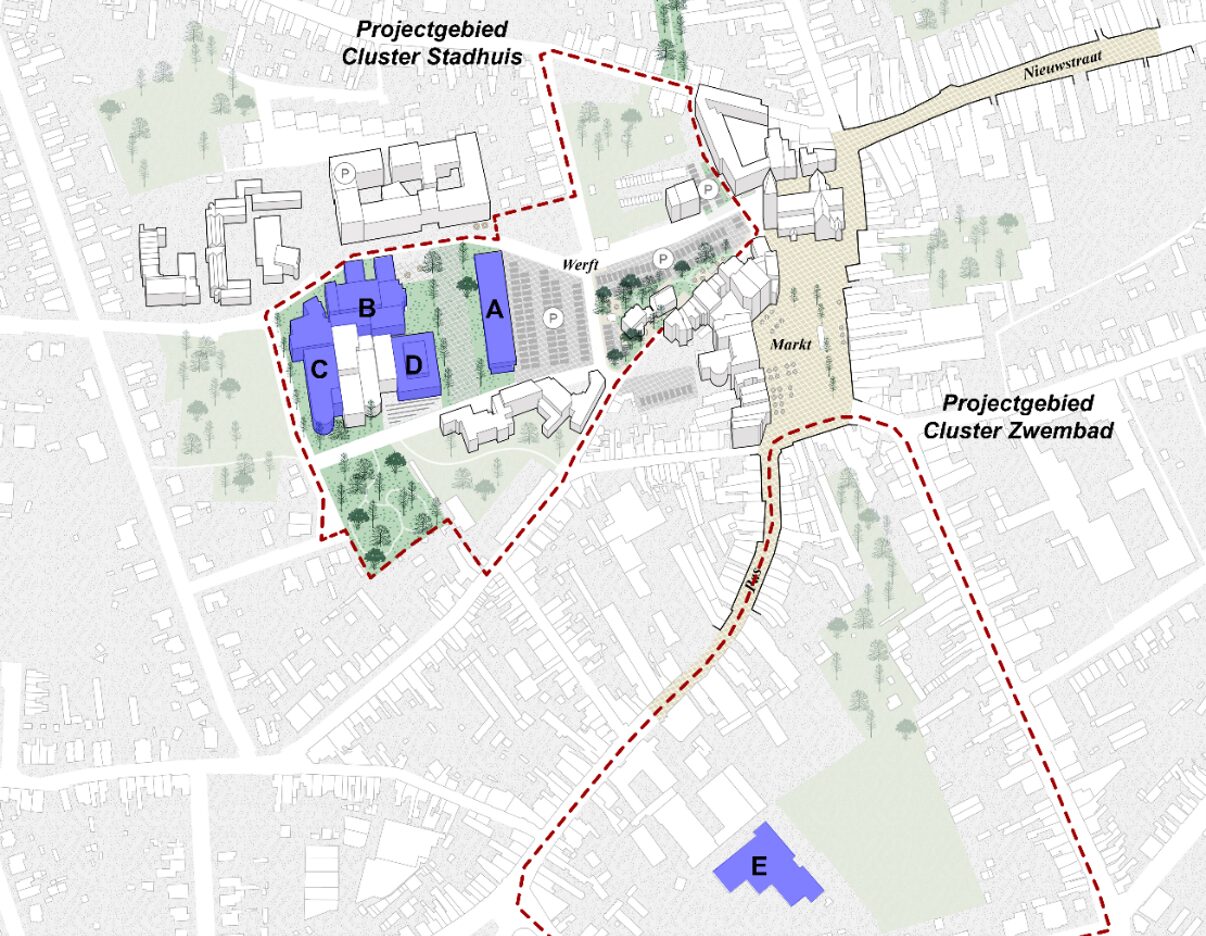
In Geel, this move towards implementation is taking shape through two concession clusters in the town centre. Working with IOK, the city sought a heat company to develop and operate both the heat generation facilities and the district heating network. Sweco provided technical and financial support, while GD&A Advocaten advised on legal matters.
The city put forward its own buildings as guaranteed initial customers. This creates a viable base case, to which other existing and future buildings can later connect. The contract was awarded to Tethys at the end of 2025, with the contractual arrangements further finalised in 2026.
The aim is not to make Geel’s entire heat supply sustainable overnight, but to begin with a clearly defined project that is technically, financially and organisationally viable.
Taking smaller steps is often more effective than trying to do too much at once.
Daan Ongkowidjojo, Business Unit Manager Climate
Kleine stappen maken de transitie werkbaar
Attempting to tackle everything simultaneously increases complexity and makes it more likely that projects will fail to get off the ground. The heating transition therefore requires decisive leadership and a clear sequence of actions. A heat plan helps determine which step should come first, guided by a long-term vision.
By combining technical, economic and spatial expertise with local knowledge, the heating transition becomes more than simply an energy project. It becomes an opportunity to shape sustainable heating and a more liveable environment together.
Would you like to accelerate the heating transition in your city or municipality? Get in touch with our experts.
Receive updates on groundbreaking projects, sustainable solutions, and exclusive insights from Sweco. Subscribe now and be part of the future transformation.
Manage Cookie Consent
We and our partners use cookies and similar technologies to operate our website, analyse traffic, personalise content, and serve and measure personalised ads. You can accept all cookies, reject non-essential cookies, or manage your preferences below. For more info, please visit our Cookie Policy
Functional
Always active
The technical storage or access is strictly necessary for the legitimate purpose of enabling the use of a specific service explicitly requested by the subscriber or user, or for the sole purpose of carrying out the transmission of a communication over an electronic communications network.
Preferences
De technische opslag of toegang is noodzakelijk voor het legitieme doel voorkeuren op te slaan die niet door de abonnee of gebruiker zijn aangevraagd.
Statistics
De technische opslag of toegang die uitsluitend voor statistische doeleinden wordt gebruikt.The technical storage or access that is used exclusively for anonymous statistical purposes. Without a subpoena, voluntary compliance on the part of your Internet Service Provider, or additional records from a third party, information stored or retrieved for this purpose alone cannot usually be used to identify you.
Marketing
The technical storage or access is required to create user profiles to send advertising, or to track the user on a website or across several websites for similar marketing purposes.