
Sweco Belgium
Aquatic sediment studies: a new responsibility for owners, operators and managing authorities
The quality of our watercourses is under greater scrutiny than ever before. Flanders has a dense and complex network of watercourses, the vast majority of which – an estimated 95% – are non‑navigable. In 2024, the 2006 Soil Decree was amended, with major implications for how sediment contamination is investigated and remediated in these non‑navigable watercourses.
For owners, operators, authorities and watercourse managers, this brings greater clarity, but also increased responsibility.
Why sediment investigations are becoming more important
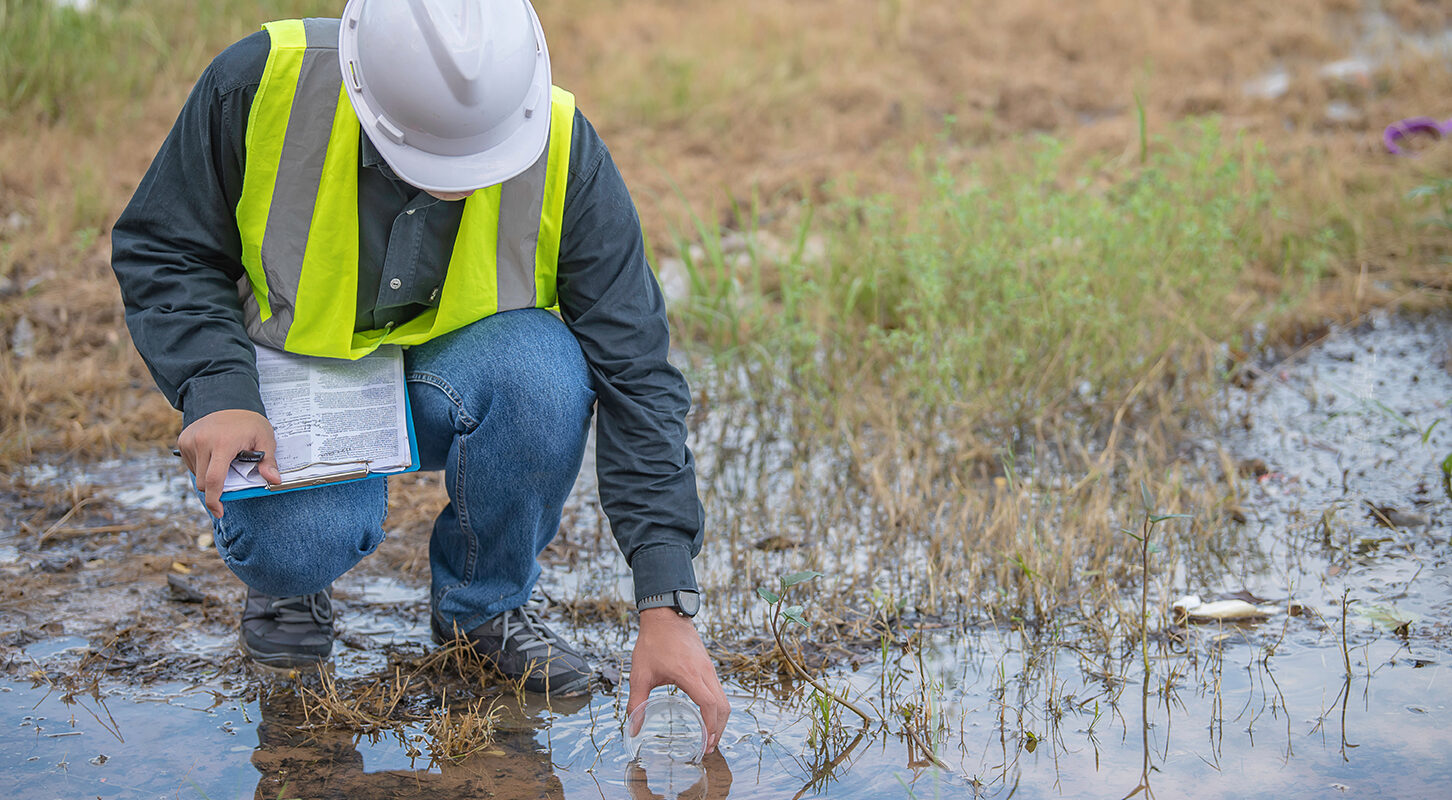
The sediment layer consists of the solid part of the soil and deposited material. Contaminated sediment or sludge may contain hazardous substances that can be released under certain conditions, such as low flow rates or dredging. In this way, contamination can affect water quality once again.
A watercourse is a dynamic system: sediment and surface water influence each other’s quality. This interaction can occur through, among other things, bank erosion, sediment input, discharges and maintenance works.
Sediment investigations enable us to determine:
- the extent to which poor water quality or ecological problems are caused by contamination of the sediment layer;
- whether this is due to internal loading and/or current discharges.
Sediment and the Water Framework Directive: a hidden lever for better water quality
Sediment and the Water Framework Directive: a hidden lever for better water quality
The European Water Framework Directive (WFD) requires Member States to achieve good ecological and chemical status for their surface waters, supported by monitoring and concrete measures. According to WFD assessments, water quality in Flanders remains poor:
- the chemical status of (almost) all Flemish surface water bodies is classified as “not good”;
- only a very limited number of water bodies achieve the required good ecological status or potential.

The new Soil Decree focuses on accountability
The 2024 Soil Decree introduces two important changes relating to sediment contamination in non‑navigable watercourses:
- Mandatory sediment study as part of the exploratory soil investigation
For an exploratory soil investigation (OBO), it is now mandatory to assess whether sediment contamination is present in the adjacent or affected watercourse.
- Clear remediation obligations for sediment contamination
Remediation responsibilities and associated costs are clearly allocated among the various actors:- the operator, user or owner of the investigated land, if the contamination can be attributed to risk activities;
- the watercourse manager, if the contamination is not related to the investigated land;
- in cases of mixed contamination, joint remediation by the operator, user or owner and the watercourse manager – based on an allocation key determined by OVAM.
Sweco supported OVAM in developing an innovative fingerprinting method to analyse attributable sources.
Read more about this innovative method.
Did you know?
In certain situations, sediment investigations are legally required, for example when transferring a risk site or when closing or ceasing a risk activity (including bankruptcy or liquidation). OVAM may also impose an obligation or require periodic investigations for certain risk sites.
Unsure whether you are legally required to carry out a sediment investigation?
Sediment investigations in practice: approach and methodology
Sediment investigations therefore focus on a dynamic system, with various potential sources of contamination (historical and/or current) and multiple stakeholders. This makes it difficult to clearly attribute the source of contamination.
Sweco adopts a system‑based approach with a focus on risk management. This goes beyond the mere removal of contaminated material. Such cost‑effective and sustainable solutions require a highly specific approach.
In a FIRST PHASE, our sediment experts examine the following aspects:
How is the hydrological system – and, more specifically, the sediment system – structured?
- The relationships and interactions between surface water, sediments, groundwater, rainwater and discharges
- Water and substance transport mechanisms within stream systems
- Which stakeholders are involved, and what is the role of each?
- How do stakeholders approach sediment contamination?
- Who is the driving force behind further action?
Through a preliminary study, we analyse historical and current risk activities in the area, such as potentially contaminating activities, discharge points and known contamination along the watercourse.
In a SECOND PHASE, we refine the analyses through targeted investigations, including fieldwork, sampling and laboratory analyses.
In a THIRD PHASE, we assess the risks. Using an in‑house developed scoring system, we can quickly distinguish sediment areas where ecological risks are unlikely from those where such risks may be present.
A more in‑depth evaluation then determines whether further investigation or remediation is required.
Based on this methodology, we can develop accurate, smart and cost‑efficient measures that effectively contribute to improving the water system.
- Which risk pathways are relevant, from a water‑system perspective;
- Where interventions can be implemented to eliminate the relevant risks;
- With sufficient support from the various stakeholders.
Case study: the Eindergatloop in the Kempen
In the Kempen region, the soil and water system are contaminated with heavy metals on a regional scale due to historical activities of non‑ferrous smelters.
Together with OVAM and other stakeholders, Sweco developed a holistic modelling approach, incorporating remediation actions and protective measures.
Objective of the assignment: to map current contamination risks and assess the future evolution of contamination in groundwater and surface water.
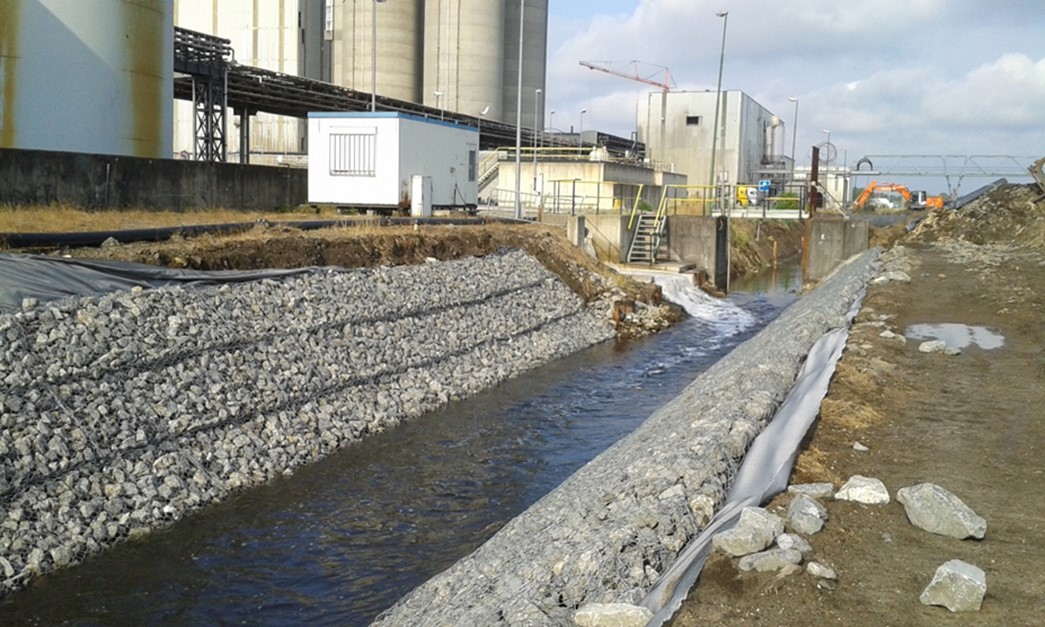
The Eindergatloop: erosion as a vector of contamination
A striking example is the Eindergatloop. Along certain stretches, the banks of this watercourse largely consist of zinc slags or metal‑bearing residual waste. Through erosion, Zn‑ and Cd‑rich particles enter the water, leading to increased metal concentrations in surface water.
In 2018, bank stabilisation and capping were carried out over a stretch of approximately 1 km, using geotextiles and gabions.
- Finishing with topsoil and sown grass creates a more natural appearance;
- Further erosion of zinc slags into the watercourse is prevented;
- Heavy metal concentrations in the surface water decreased locally.
Even though no zinc slags are observed downstream in the sediment layer, metal concentrations in surface water still exceed standards due to the inflow of contaminated groundwater.
This is why various remediation methods are currently being investigated.
This case illustrates that an area‑based, integrated approach is essential to sustainably address historical sediment contamination. Technical feasibility, cost‑effectiveness and ecological benefits must be carefully balanced.

New rules call for integrated expertise
From a technical perspective, sediments intersect with several disciplines: soil and groundwater, surface water, ecology, industrial discharges, hydraulics, and more. Moreover, these disciplines fall under different authorities.
Sweco addresses this fragmentation – and the complexities it entails – through an integrated approach. We have experience and expertise across all these disciplines, enabling us to provide appropriate solutions for any challenges encountered.
The amended 2024 Soil Decree makes sediment investigations a structural component of statutory soil policy.
This has implications for owners, operators and watercourse managers:
- increased responsibility for sediment contamination they (co‑)cause;
- clearly defining remediation obligations and risks through robust investigations;
- in order to improve the water quality and ecological status of our watercourses through targeted measures.
Would you like to know what the new regulations mean for your watercourse, project area or site?
Our experts are ready to help you develop a practical and future‑proof approach.
Other news
Water-Land-Schap 2.0 prepares the Vliet valley for drought and flooding
Read more

Sweco confirms strong sustainability performance with EcoVadis Gold
Read more
Sweco welcomes Technocon employees and strengthens its advanced steel expertise
Read more