

Sweco Belgium
Infiltration as a design tool for a robust living environment
The Regional Urban Planning Regulation on Rainwater (GSVH) sets out the rules for all environmental permit applications in the public domain in Flanders. In an update dated 7 January 2025, every new, redeveloped or extended paved surface – from parking bays to village squares – must maximise the retention, infiltration and reuse of rainwater. Sweco supports clients in using infiltration as a design tool rather than a permitting risk.
From a box-ticking exercise to integrated design thinking
In practice, infiltration is still often treated as a “final step” when preparing an environmental permit application: add an infiltration facility to comply with the Rainwater Regulation, and that’s it.
As architecture and engineering consultants, we see that this approach is insufficient. Water and soil must become leading factors in the design, rather than an add-on. Infiltration plays a crucial role in this, not only for rainwater but also for other water flows:
- groundwater (dewatering water, drainage water);
- run-off rainwater from roofs, squares and roads;
- potentially treated flows, depending on soil quality and stratification.
A circular approach can help counteract desiccation, stabilise groundwater levels and better absorb peak rainfall events. For example, by re-infiltrating dewatering water during the construction phase.
The subsurface as a starting point for the preliminary design
A well-considered infiltration strategy always starts with a clear understanding of the subsurface.
This is already crucial during the preliminary design phase.
With this knowledge, our consultants can make targeted choices that deliver the best return on investment:
provide infiltration where the soil is permeable and clean,
provide storage and buffering in areas with lower infiltration potential,
while avoiding sensitive or contaminated zones.
First the water system,
then the paving
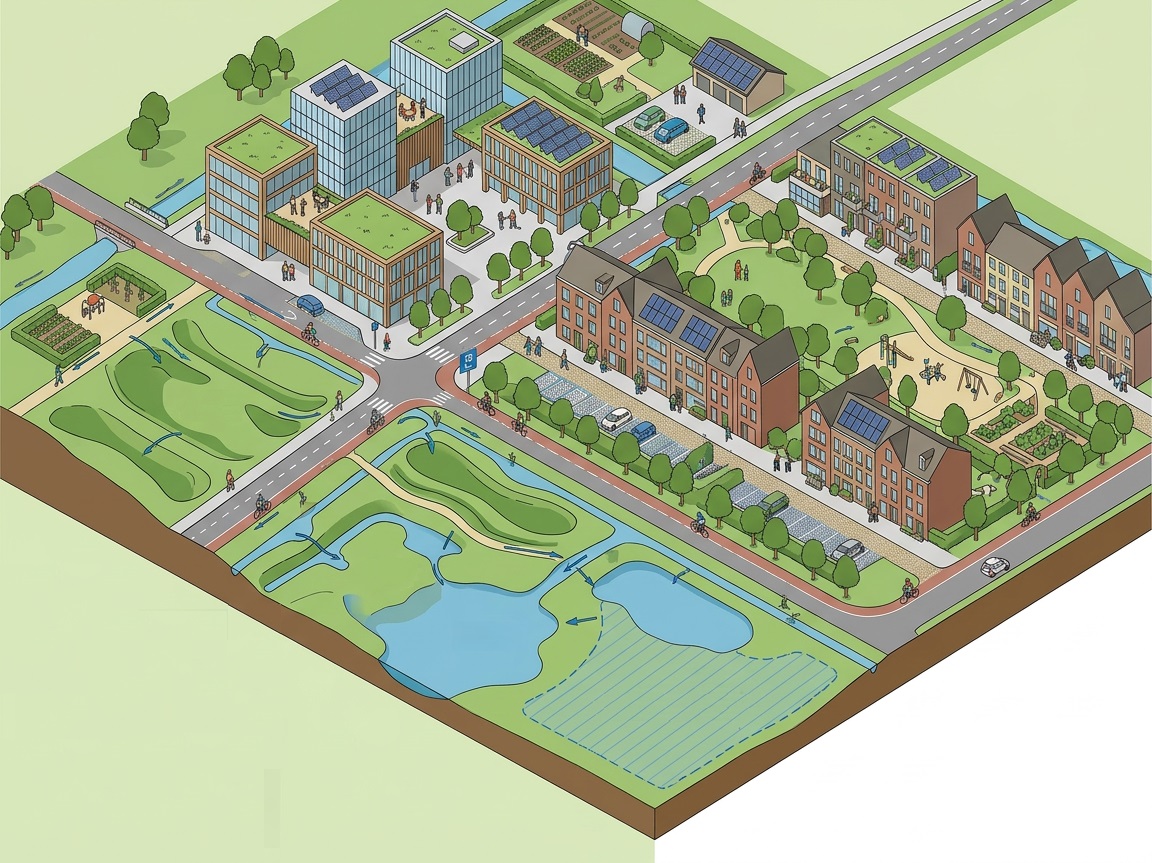
A climate-adaptive design reverses the traditional process and starts with the water system:
- We first determine the logic of swales, ditches, open water, low-lying and floodable areas.
- We then position roads and paths, preferably using permeable paving where appropriate and technically feasible.
- Next come building volumes and green spaces or parks, aligned with the natural relief and water run-off.
Buildings on slightly higher ground
+
lower-lying areas for collection, storage and infiltration
=
a robust system that is better able to cope with both peak rainfall and periods of drought
Taking this approach from the preliminary design stage results in fewer design revisions and optimises long-term investment.
AI-generated image
The question is therefore no longer, “Where do we put a swale?”, but rather “How do we organise the entire water system of this site, above and below ground, so that infiltration can take place to the greatest possible extent and in a safe manner?”
Linde Vanlook, soil consultant at Sweco
Safeguarding soil quality
during the construction phase
Infiltration facilities only function properly in healthy, non-compacted soil.
That is why we advocate considering construction logistics as early as the design and tendering stages.
This helps prevent unnecessary soil compaction and preserves infiltration capacity.
- Work as much as possible from existing or future paved areas: limit the construction zone to areas that are already paved or will be paved anyway.
- Where this is not possible, construct site roads using gravel surfacing or track plates to limit soil compaction.
- Avoid construction zones and storage areas on clay soils or other sensitive ground.
- On dry sandy soils, the soil must be recompacted after backfilling to prevent overly loose structures.
- If compaction has nevertheless occurred, the soil must be mechanically loosened after completion, so that infiltration capacity is restored.
Infiltration facilities
that continue to perform
Our consultants also provide a well-considered vision for management and maintenance, ensuring that infiltration facilities remain effective in the long term:
- Slopes must not be too steep, both from a safety perspective and to allow mowing and inspection.
- Accessibility for maintenance teams and equipment must be incorporated from the design stage.
In a climate context characterised by longer dry periods and more intense peak rainfall events, we also seek facilities that:
- have sufficient storage capacity to absorb peak discharges and reduce flooding;
- at the same time play an important role in replenishing groundwater reserves;
- are, where possible, used to retain winter water for use in summer (irrigation, green space management, cooling, etc.).
Infiltration: a central theme in the environmental permit
The GSVH makes infiltration a central theme in the environmental permit process.
Using tools such as the Sweco Loket and a permit scan, Sweco carries out early-stage assessments:
- whether the project complies with the Rainwater Regulation;
- how infiltration and rainwater management can be integrated into the preliminary study and design;
- where a well-substantiated deviation is meaningful and defensible, in line with the Rainwater Circular.
Our aim?
Turning regulatory pressure into design power.
Infiltration not as a mandatory box to tick, but as a lever for liveable, climate-resilient public space.
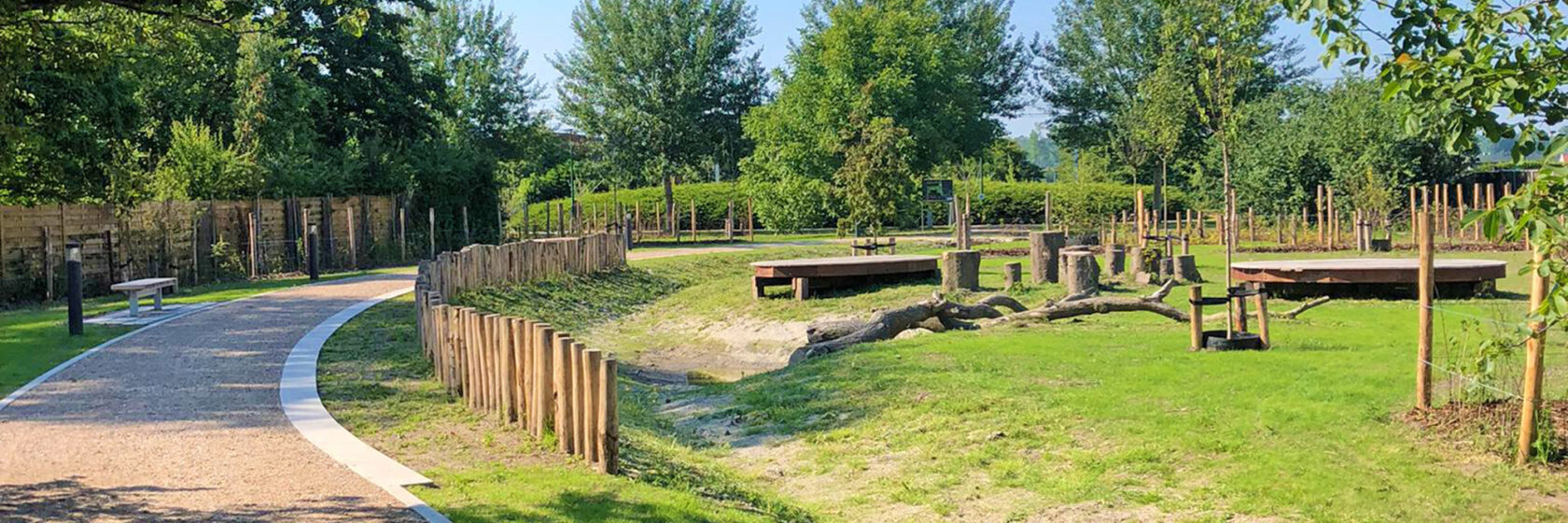
Sweco supports public and private clients throughout all phases of infiltration and rainwater projects.
Infiltration studies and groundwater monitoring
Determining infiltration capacity;
(real-time) monitoring of groundwater levels using telemetric data loggers
Soil and groundwater investigations
Environmental soil surveys and interpretation of soil profiles;
mapping contamination, soil structure and gley phenomena
Hydraulic modelling and water balances
Demonstrating sound hydraulic performance (Sirio model);
advanced modelling (ICM) where required;
preparing water balances
Support with material choices and paving concepts
including advice on sustainable and permeable paving
Application of the rainwater cascade
retain > infiltrate > reuse > delayed discharge
Sweco connects legislation, soil expertise and design. We help municipalities, sewer network operators, developers and other clients deliver projects that are fully compliant from a permitting perspective and contribute to climate-adaptive, resilient living environments.
Discover how infiltration can become a lever for quality and climate adaptation in your project.
Other news
Water-Land-Schap 2.0 prepares the Vliet valley for drought and flooding
Read more

Sweco confirms strong sustainability performance with EcoVadis Gold
Read more
Sweco welcomes Technocon employees and strengthens its advanced steel expertise
Read more