
Sweco Belgium
Smarter on the way with mobility management
In Flanders, commuting to work or school accounts for only a quarter of all passenger kilometres travelled, yet it causes enormous peak loads during rush hours. To reduce congestion and improve accessibility, we must embrace sustainable alternatives and smart mobility management. Our mobility experts Veerle Duportail and Tijs Veyt share their knowledge on the subject.
From car king to bike king
Despite the rise of electric bikes and mobility budgets, the car remains king when it comes to commuting. With cafeteria plans, the company car remains the most popular choice, and the number of registered lease cars has reached a record high. Teleworking could offer a solution to peak-hour congestion. However, although 38% of employees report working from home regularly, we are witnessing the emergence of the “dido economy” (the TuTh economy): a phenomenon where employees tend to go into the office on Tuesdays and Thursdays. This leads to unprecedented peak loads on roads, parking facilities, and public transport.
There is great potential for cycling, however, as a quarter of employees live less than five kilometres from work and more than half within a ten-kilometre radius. 2024 nevertheless became a record year for traffic congestion.
Are multimodal workplaces the solution?
There is a shift underway from traditional industrial estates on the urban periphery towards workplaces located within urban areas and accessible via multimodal transport. This encourages smarter mobility behaviour but also creates new traffic bottlenecks, particularly around cities and regional economic hubs. Moreover, permit procedures often encounter problems related to mobility impact, air quality, and noise pollution. Expanding road infrastructure is also unsustainable. Flanders must therefore seek sustainable and systematic mobility solutions to manage peak loads efficiently.
At Sweco, we believe that smart alignment of demand and supply can create space for mobility. By deploying innovative solutions and technologies, we can develop a more efficient mobility system that takes into account the needs of all stakeholders.
Veerle Duportail, mobility manager

The power of soft policy measures
The solution for smarter mobility lies in better aligning demand and supply. This includes spreading out travel times, steering mobility according to actual needs, and offering powerful alternatives that genuinely work. The driving force behind this mobility management consists of ‘soft’ measures such as clear communication, smart service provision, and close collaboration between different partners. It is precisely this soft approach that often makes hard interventions truly effective.
In practice, it all comes down to collaboration at every level. Policymakers, spatial planners, companies, and industrial estates: only by joining forces can momentum be created within the system. A coordinated approach in which all stakeholders collaborate not only makes our mobility policy more efficient but also more sustainable and adaptable.
Success factors and bottlenecks
From study to practical implementation – Numerous mobility studies already exist at regional, urban, and industrial estate levels, for instance on cycling infrastructure and public transport. The problem, therefore, lies not in a lack of knowledge but in implementation. Resources and responsibilities are fragmented, and crucial questions around management are insufficiently addressed. Building a good cycle path on an industrial estate is one thing, but who ensures it remains free of snow and ice?
Companies as driving forces – Companies themselves can do much to change mobility behaviour. However, not every company has the resources or long-term certainty to sustain such measures, even though continuity is fundamental for lasting change.
Employers are willing – In the battle for talent, forward-thinking mobility can be a key asset for employers to enhance their company’s attractiveness. But a catalyst is needed to sustain initiatives. Mobility policy can only work with sufficient critical mass. Without that group dynamic, initiatives come to a standstill and the bigger picture is left behind, even if the individual will is present.
The missing link in mobility policy
Companies can be engines of mobility change but often lack the overview and clout to achieve structural progress. Collaboration at the industrial estate level is therefore necessary, but difficult to sustain in practice. Although individual initiatives may achieve temporary success, they often fade due to a lack of shared, coordinated strategy.
Without a shared approach, mobility change at industrial estates remains stuck in good intentions and temporary successes.
Tijs Veyt, senior expert mobility
The belief in voluntary cooperation often clashes with the stubborn reality of free-riding behaviour. Some companies benefit from collective mobility solutions without investing in them themselves. With systems such as shared cars or collective transport, sufficient participation is important, because without critical mass, it simply does not work. Moreover, many companies think predominantly in short-term horizons: anything that doesn’t yield quick returns rarely gets prioritised. As a result, precisely those initiatives with the greatest impact remain stuck in the planning phase.
Meanwhile, different actors – from local authorities to road and site managers – operate with divergent objectives, resources, and priorities. And who makes the final decision when interests clash, for example between logistics development and cycling accessibility? Without an independent conductor who cuts through knots, coordinates interests, and enforces collaboration, we will not make progress. As long as no one truly takes the lead, good plans remain stuck around meeting tables, and mobility management doesn’t advance beyond isolated initiatives.
Towards a holistic sustainability strategy
Mobility must be part of a broader sustainable strategy encompassing waste management, energy use, water management, and green infrastructure; without this integration, mobility measures remain limited in effectiveness. Sustainable mobility solutions such as cycling and shared transport work best within a wider energy and spatial policy framework, where electric vehicles are supported by charging infrastructure linked to renewable energy sources. Moreover, smart parking solutions not only create space for greenery and water management but also contribute to an attractive and climate-resilient work environment.
Strategic decisions at the highest level are a crucial precondition. CEOs must integrate mobility management into the broader corporate strategy to remain future-proof and attract talent easily. Simultaneously, cross-sector collaboration enables companies to invest collectively and realise innovative solutions, allowing them to lead in sustainability initiatives.

This holistic approach is not only practical but increasingly appealing to employees, who more often choose employers with a strong focus on sustainability and a pleasant working environment. Smart mobility measures must go hand in hand with amenities such as green spaces and efficient water management, further enhancing employee wellbeing.
Veerle Duportail, mobility manager
The importance of a neutral conductor
What’s missing is a neutral conductor – a person or authority that not only sets a clear course but also monitors implementation, aligns interests, and continues steering towards results. This role could be filled by a mobility coordinator at the industrial estate level, a public actor, or a specialised organisation acting as an independent hub. Crucially, this catalyst must have sufficient mandate, resources, and perseverance to turn mobility projects from vision into reality. Only when one party connects all stakeholders and directs them purposefully does mobility management become a true lever for a more efficient, sustainable system that alleviates peak moments and makes mobility more manageable.
The role of a neutral conductor is vital for effective mobility management. Such a person, equipped with sufficient mandate and resources, can translate mobility projects from vision into execution.
Tijs Veyt, senior expert mobility
Eiland Zwijnaarde
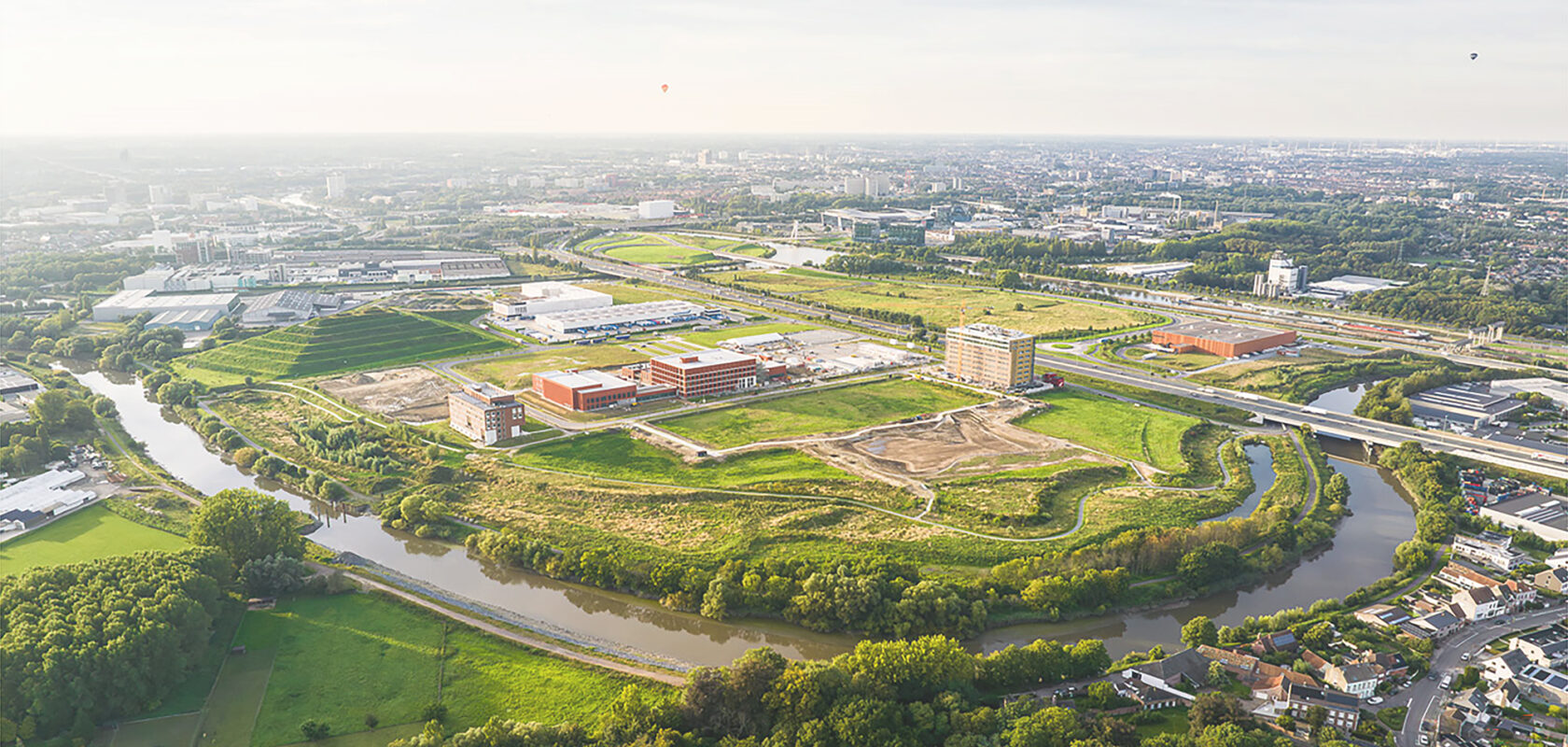
At the Eiland Zwijnaarde industrial estate, a pilot project is underway in which our mobility manager, working at the industrial estate level together with all relevant stakeholders, develops a strategy offering efficient, sustainable, and integrated mobility solutions. The goal is to roll out sustainable, integrated solutions that make Eiland Zwijnaarde a pioneering project in future-oriented mobility management. Veerle Duportail:
Eiland Zwijnaarde is growing rapidly, but it is reaching the limits of its accessibility by car. That is precisely why we are committed to smart mobility that can guarantee accessibility. A challenging assignment, with the ambition of embedding mobility measures within a Mobility Service Company.
4 steps in the process
- Focus on concrete, achievable steps. Small, visible improvements, such as better bicycle parking facilities, shared mobility projects, or collaborations around flexible working, can quickly generate impact and build trust among companies.
- Choose a thematic focal point. The bicycle is a logical choice here: cycling is gaining popularity and represents a clear business case for companies. A safe, fine-meshed cycling network, comfortable bicycle infrastructure at the workplace, lease bikes, bike allowances, and shared bikes for the ‘last mile’ to and from stations or multimodal junctions make cycling more attractive.
- Strengthen communication and participation. Start from a clear analysis of mobility problems and work towards a shared vision of the future. When all actors can identify with the same narrative, collaboration becomes self-evident and concrete solutions emerge more quickly. Also mobilise companies with affinity and ambition around sustainability. These ‘champions’ help build critical mass and lend legitimacy to the mobility manager’s message, thereby significantly increasing support for sustainable mobility.
- Start small, but think big. An approach to mobility management at an industrial estate must work on multiple tracks simultaneously. What constitutes a robust and widely supported organisational structure? What financial resources are available? Which measures at the industrial estate level also impact the wider environment (e.g., regarding public transport)? How do we integrate other value streams, such as energy? In this context, the strategic management of ‘hard’ assets (such as parking spaces) plays a crucial role. Shared parking, for instance, can contribute to more efficient space use, but whoever manages the parking infrastructure or operates the charging infrastructure largely determines how mobility behaviour will develop and whether revenues flow back into sustainable alternatives.

Smart mobility is key
To improve accessibility in Flanders and reduce traffic congestion, we must embrace sustainable alternatives and smart mobility management strategies. At Sweco, we are committed to developing innovative solutions that contribute to a more efficient and sustainable mobility system. By promoting cycling mobility, optimising public transport, investing in technology, and placing sustainability at the core, we can create a future in which mobility runs smoothly and efficiently for everyone.
Source: Based on an article from Ruimte no. 65 (May 2025), published by the Vlaamse Vereniging voor Ruimte en Planning.
Overig nieuws
Stakeholder management creates space for better projects
Read more

Spatial policy plans: making today’s choices for tomorrow’s city
Read more

From housing study to action-oriented housing policy
Read more