
Sweco Belgium
What forgotten landfills can teach us about brownfield development
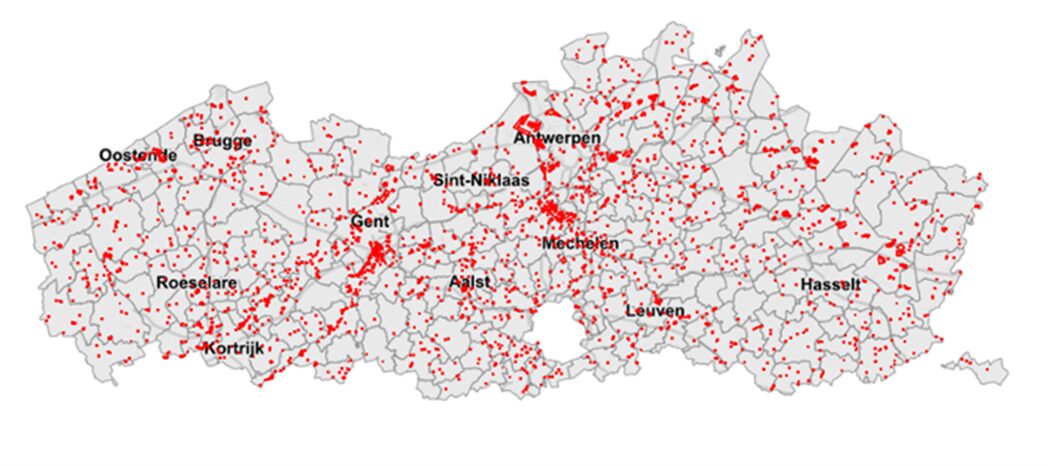
In Flanders, there are more than 2,500 historical landfills, covering over 100 km² – an area comparable to Ghent and its surroundings. They are forgotten places: hidden behind trees, enclosed by industry or temporarily designated as nature. For years, we have seen them as a burden. But in times of spatial and climate pressure, they suddenly become interesting: as space for water, nature, energy, recreation, housing or industry.
At Sweco, we see these landfills as the starting point for a new circular and spatial future.
These insights apply just as much to other contaminated or underused sites:
- brownfields,
- former industrial sites,
- railway zones,
- transhipment areas, and so on.
From looking away to a ‘soil reflex’
The reality today: many landfills remain untouched due to a lack of resolve.
- Because of the negative connotations associated with landfills, there is a fear of opening a Pandora’s box of problems when they are brought back into use.
- Local authorities and owners are uncertain about the risks, costs and responsibilities involved.
- In spatial plans, the subsurface is often literally overlooked: maps show “green” areas where landfill waste is actually present, or planning boundaries are drawn around the landfill.
Yet a shift is underway. OVAM has mapped the landfills. Where much remained invisible just a few years ago, the knowledge base on their location, type and the status of soil investigations (OBO, BBO, remediation, etc.) has now grown significantly.
Revalorisation: more than remediation alone
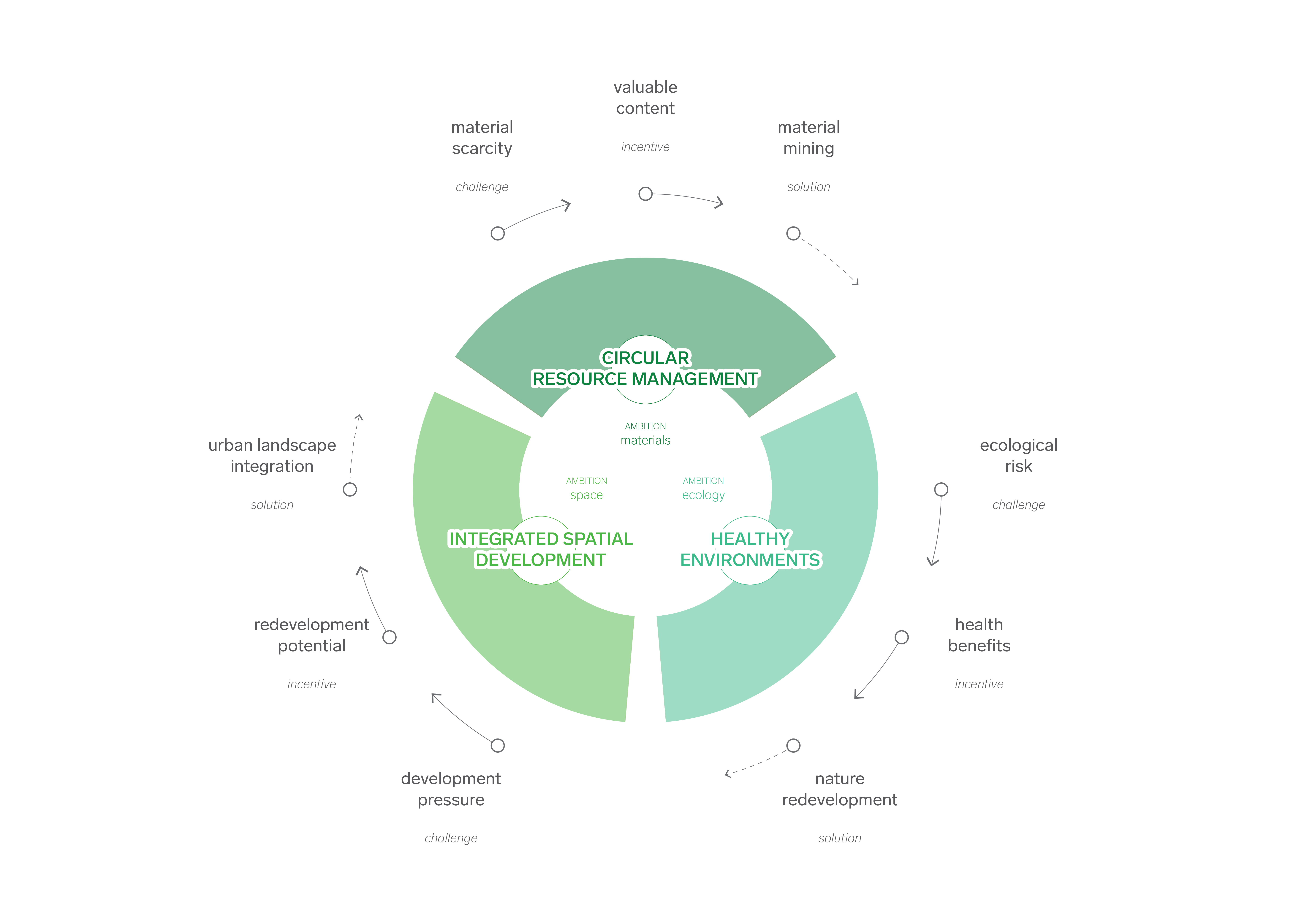
“Revalorisation” restores value to what was once regarded as worthless – both the materials and the space.
There are roughly three types of ambition:
- Material reuse
Landfill mining, or the recovery of materials from landfills. At present, this is still only marginally profitable, but in a context of scarce raw materials it is becoming increasingly relevant. - Ecological gains
through nature development, tree planting and green spaces that act as buffers against heat, drought and flooding. - Spatial gains
for housing and mixed urban development, industry or logistics, energy production (solar panels, wind turbines), recreation and park development.
In practice, this often comes down to smart combinations.
Sweco has contributed to projects where:
- remediated landfills are (partly) preserved as ecologically valuable parks, linked to residential development;
- historical landfill material makes way for water buffering, thereby reducing flood risk;
- temporary cultural or recreational uses are created pending definitive redevelopment.
This integrated approach is equally valuable for other brownfield and redevelopment projects, such as railway zones, former industrial sites, contaminated port areas, zones along waterways, and so on.
The expertise we apply to landfills can be directly applied in this broader context.
The next step? A systemic shift, from looking away to an automatic “soil reflex”, starting with the question:
What are the long-term ambitions here? What do we want for this place and its surroundings?
What is in the soil, what risks are associated with it, and what opportunities arise if we address this in an integrated way?
A reflex that is relevant for every brownfield or complex site.Gert Vandermosten, senior expert process management
Why it seems so complex,
and how you can still make progress
Landfills and brownfield sites are complex on several levels, and this complexity often causes projects to stall.
This is precisely where a partner like Sweco can make the difference.
- What is in the soil?
- What about groundwater contamination?
- Are there PFAS or other substances of concern?
- Can remediation be carried out without creating new risks?
- Strict rules governing the relocation and repurposing of waste and soil.
- No automatic remediation obligation for many landfills.
- A difficult balance between voluntary remediation and enforceable obligations.
- High upfront investment costs.
- Benefits (spatial, ecological and societal) that often only become apparent in the long term.
- A need for new financing models and value creation
(for example, in combination with energy, housing and climate adaptation).
- Many stakeholders are involved: owners, municipalities, OVAM, VMM, government departments, developers and citizens.
- Decision‑making requires time, trust and a clear division of roles.
- Local authorities are under significant capacity pressure.
An integrated approach, from ambition to implementation
Together with OVAM and other partners, Sweco has, over the past few years, developed a kind of “ideal pathway” for tackling landfills.
We apply the same logic to other soil cases and brownfield developments.
Sharpening ambitions
We do not start with “what is the problem?”, but with “what do we want for this place in the long term?”.
– Are we aiming for nature, woodland, recreation, energy, housing, industry, or combinations thereof?
– What does the surrounding area require (agricultural land, valley, urban context, watercourse, residential neighbourhood…)?
– How does this fit within existing spatial plans and policy frameworks?
We bring owners, local authorities, OVAM and other stakeholders together around a shared vision for the future. Without a widely supported ambition, there is no sustainable project.
Mapping the subsurface and risks
In parallel, technical investigations are carried out, including soil and groundwater studies, historical research, risk assessments and, where relevant, advanced techniques such as PFAS fingerprinting.
This shows where the real risks lie, where measures can be limited, where excavation is required, and where land use can be safely reassigned.
Practical translation through flow charts and rules of thumb
To make the complexity manageable, we have – on behalf of OVAM – developed flow charts for potential functions. Using a number of clear criteria, planners, policymakers, owners and developers gain a solid framework:
– When is afforestation safe?
– Where can energy production take place without increasing risk?
– When is temporary use possible, and under what conditions?
Stakeholder management and governance
Sweco facilitates the stakeholder process to turn a technical soil exercise into a widely supported area development.
Financing and value creation
Finally, we help explore integrated business cases, potential funding sources and phasing over time.
Examples: from problematic site to asset
There are already several examples where this shift has been achieved:
– former factory sites transformed into mixed urban districts;
– port areas evolving into circular hubs;
– contaminated railway zones converted into parks, cycling links or new urban neighbourhoods.
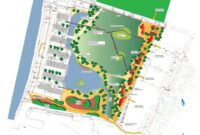
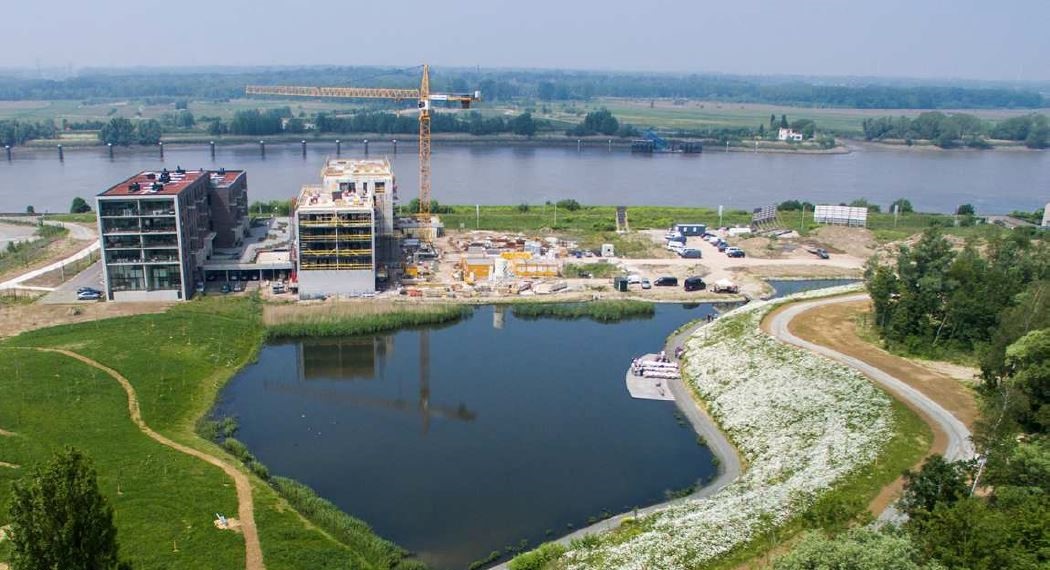
Landfill with ecological park and residential development
Through careful phasing and targeted remediation, valuable nature has been preserved.
The neighbourhood gained a high-quality park, the residential development benefits from its experiential value, and the soil challenges were made manageable.
Temporary use on contaminated sites
Cultural and recreational projects demonstrate how, with the right safety measures, sites can already be brought into use while the long-term vision is still being developed.
In this way, a “black box” once again becomes a meaningful place in the city or municipality.
Sweco as a partner
in soil revalorisation and brownfield development
Landfills clearly demonstrate that many spatial challenges also apply to a wide range of brownfields:
- Soil and water are guiding factors
They help determine what can happen where, what risks exist, and where opportunities lie. - Subsurface and surface must be designed together
You cannot plan sustainably if you ignore the subsurface.
This applies to nature and water, but equally to energy, mobility and housing. - Transition requires new ways of thinking
The old reflex of bypassing contaminated sites and always looking for “new” land is no longer tenable.
The future lies, to a large extent, in the revaluation of existing, complex places.
Sweco helps public authorities, investors and developers make that shift – from soil remediation as a “cost” to area development as an “opportunity”.
Get in touch with Sweco. We would be pleased to explore how we can turn your challenging site into a catalyst for sustainable area development.
Other news

Using water as an ally in climate adaptation
Read more
Water management without reuse is no longer fit for purpose
Read more
Industry and water: permit certainty starts with demonstrable water quality
Read more