

Sweco Belgium
Brominated flame retardants: the “next emerging contaminant” to anticipate today
In recent years, PFAS has dominated discussions on contaminants. Yet in the shadow of PFAS, a new generation of “emerging contaminants” is coming to the fore. One such group is brominated flame retardants: substances encountered in everyday products such as electronic devices, textiles, construction materials and plastics, and which are increasingly being detected in soil, sediment and waste streams.
Sweco has been closely monitoring these emerging contaminants for many years and supports public authorities and companies with research, risk assessment and policy development. In this article, we take a closer look at brominated flame retardants, their possible implications for your activities, and how your organisation can prepare.

What are brominated flame retardants?
Brominated flame retardants, or BFRs, form a subgroup of flame retardants. They are a broad group of organic bromine compounds that reduce the flammability of materials. They are used, among other things, in:
- electrical and electronic equipment
- plastics and components in vehicles
- textiles (furniture, curtains, technical fabrics)
- construction and insulation materials
- paints, coatings and resins
From a fire‑safety perspective, BFRs are particularly attractive: they are effective, relatively inexpensive and easy to incorporate into a wide range of materials. However, these advantages come with a downside.
Many BFRs degrade very slowly, can accumulate in soil, sediment and the food chain, and often exhibit bioaccumulative and toxic properties. For the major and most concerning subgroups – PBDEs, PBBs and HBCDs – there is evidence of disruptive effects on the nervous system.
At the same time, scientific knowledge remains incomplete: due to the wide variety of BFRs, sufficient information on toxicity, exposure and environmental behaviour is only available for a limited number of substances.
Pathways to humans and the environment
International guidelines set the ambition to protect the environment and human health from these and other persistent organic pollutants (POPs). The Stockholm Convention entered into force in 2004 and has since been signed and implemented by 186 parties. Through the Restriction of Hazardous Substances Directive, the EU has restricted hazardous substances in electrical and electronic equipment since 2011, including the BFR subgroups PBDEs and PBBs. Since 2019, the EU POPs Regulation has prohibited the use of POP‑containing BFRs and is working towards the phase‑out of POPs.
Belgium currently has no fully developed regulatory framework for brominated flame retardants in soil and sediment.
That does not mean that there has been no progress.
In 2020, OVAM published an overview of trigger values for BFRs. These trigger values indicate the concentrations below which no significant effects on living organisms are expected – guidance that can be applied in a project context.
Brominated flame retardants can enter the environment throughout the entire life cycle of treated products:
- During production and processing through wastewater discharge, residues, dust and emissions, as well as via atmospheric deposition around industrial sites.
- During use through gradual emissions from materials (abrasion of plastics, release of textile fibres, dust formation).
- During and after end‑of‑life through leaching, emissions during incineration or incomplete combustion of plastics and BFR‑containing components, often unintentionally due to a lack of awareness of their presence.
For humans and animals, exposure occurs both directly (for example during processing, incidents or fires) and indirectly via contaminated air, soil, water, dust and food.
Sweco prepares you for next emerging contaminants
Sweco has been investing in expertise on next emerging contaminants for many years. We work closely with public authorities and knowledge institutions to develop data, methodologies and policy.
For brominated flame retardants, we have contributed to, among other things:
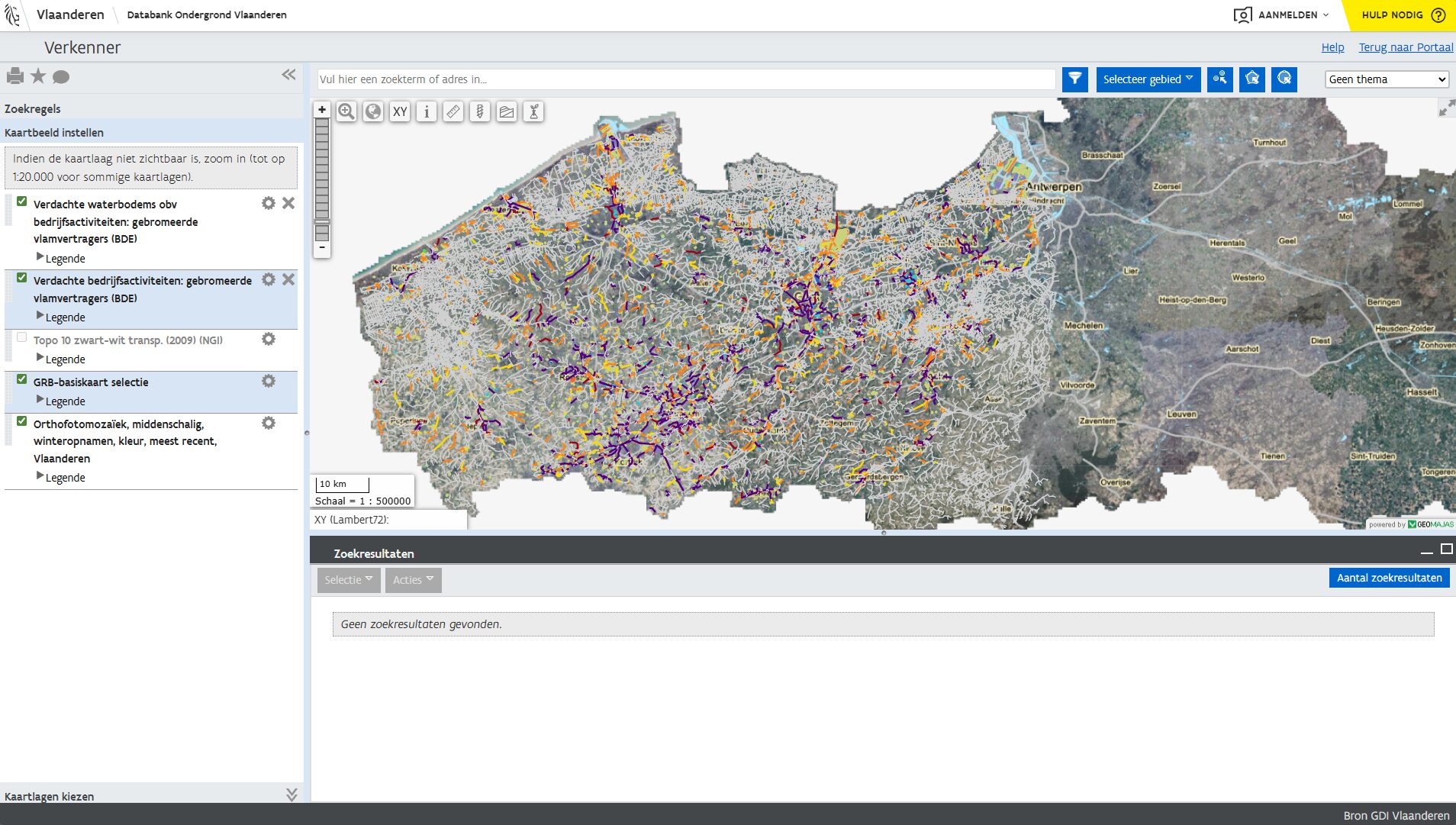
- hotspot maps based on measured concentrations and exceedances of trigger values;
- identifying potential risk sites by combining these hotspots with VLAREBO indicators. In practice, these predictions often correspond closely with contamination found on site;
- a multi‑criteria analysis for sediments, identifying areas with a higher priority for investigation or remediation;
- supporting DOV (Databank Ondergrond Vlaanderen) with maps, data, reports and guidelines, making information easily accessible and interpretable;
- the literature review “Gebromeerde vlamvertragers in sediment“, for and with OVAM and De Vlaamse Waterweg.
In addition, our soil consultants support OVAM in developing new soil legislation and integrating emerging contaminants into statutory investigations.
With this experience, we are already able to fully integrate brominated flame retardants into risk assessments and strategic decision‑making.
Why BFRs matter for your organisation
Although no fully developed regulatory framework exists yet, BFRs are already relevant today for industry, infrastructure managers, property developers and public authorities.
Anticipate the future
In statutory soil investigations, BFRs may already emerge as a relevant parameter, particularly at sites linked to textiles, electronics, plastics, waste processing or fire incidents.
Avoid unpleasant surprises in the future by proactively including BFRs in your analyses and taking a strategic approach to the insights they provide.
Sediment and dredged material
In the management and maintenance of watercourses (desilting, dredging), a key question arises: how should BFR‑containing dredged material be handled?
An early‑stage approach can help you control costs and risks while remaining compliant with future legislation.
Waste and recycling chains
For waste processors and recycling companies, traceability and risk management related to BFRs are becoming increasingly important.
Reputation and duty of care
Explicitly include BFRs and other emerging contaminants in your ESG policy, due diligence and risk assessments, and demonstrate that you are proactively meeting your (soil) duty of care.
Sweco combines expertise in chemistry, soil, water, legislation and data analysis.
We help you make brominated flame retardants and other emerging contaminants visible and manageable.
From screenings and preliminary studies, through soil and sediment investigations, hotspot and risk analyses, to policy and strategy on emerging contaminants, as well as remediation concepts and management.
Would you like to understand the potential impact of brominated flame retardants and other emerging contaminants on your projects, infrastructure, waste or recycling chain?
Our experts are happy to work with you on a proactive, future‑proof approach.
Other news

Stakeholder management creates space for better projects
Read more

Spatial policy plans: making today’s choices for tomorrow’s city
Read more

From housing study to action-oriented housing policy
Read more