
Sweco Belgium
Building with nature: how architecture and biodiversity go hand in hand
Our cities are growing. Yet as we build, nature is disappearing. The built environment has a significant impact on biodiversity: natural habitats often have to give way to new construction projects, while highly fragmented landscapes and the high proportion of paved surfaces in cities make it difficult for animals to move safely from one green space to another.
The city as an ecosystem
Nature-inclusive building directly addresses this challenge by contributing to local biodiversity through targeted interventions, expanding habitats for species and improving the permeability of the built environment. Working with nature is not only in the interest of plants and animals – it is above all in the interest of people themselves.
- Research shows that less access to greenery in residential environments is associated with poorer mental health and lower wellbeing.
- Studies often show higher levels of social interaction, neighbourhood cohesion and perceived safety in greener, better-maintained public spaces.
- Nature and biodiversity support carbon storage, air purification and wider health benefits.
- Nature in the city increases resilience to climate change, helping to combat urban heat islands, pollution and flooding.
- Nature-inclusive building increases the market value of real estate. A healthier living environment with greater comfort is more attractive in the rental and sales markets.
At least 3trees are visible from your home | Tree canopy cover is at least 30% in your neighbourhood | You live no more than 300metres from a public green space |
At Sweco, we believe that every building project is an opportunity: an opportunity to see buildings not as closed volumes, but as active contributors to a healthy living environment – for people and for nature.
From roof to surroundings: an integrated approach
Nature-inclusive building is not a series of isolated interventions.
It is an integrated approach in which the building and its surroundings are considered as one.
It starts with the right approach – and the right people around the table.
Start with what is already there.
A development site always has an ecological history.
- Which animals are already present?
- Which trees, shrubs or water features are already present?
- Which ecological corridors run through or along the site?
By understanding and respecting these existing qualities, you build on a living foundation – and avoid the unnecessary loss of valuable habitats.
Did you know?
One mature tree that is felled must be replaced by 400 newly planted trees to deliver the same benefits.
Involve an ecologist from the very first sketch.
Every animal species has its own specific needs: the swift needs a clear flight path to its nest entrance, the house sparrow needs dust baths, and bats only thrive where there is sufficient darkness.
An ecologist brings this knowledge into the process from the start of the design phase. Moreover, nature-inclusive building is often cheaper than expected: simple, low-tech measures included at the drawing board often involve no additional cost.
The building itself as a habitat.
From façade to roof, a building offers opportunities to increase biodiversity while also delivering benefits for end users and the surrounding area.
Green roofs support biodiversity, water retention and cooling.
Green façades help reduce particulate matter, provide insulation, and offer food and shelter for insects and birds.
Integrated nesting facilities – such as nest bricks, bat roof tiles or cavity openings – give protected species a permanent place, without compromising energy performance or architectural quality.
The immediate surroundings as an extension.
The building is only one part of the story. The immediate surroundings – with native trees and shrubs, flower-rich borders, wadis and unpaved zones – are at least as important.
A good guideline here is the eight key requirements that animal species need:
Reproduction – Food – Water – Dispersal – Safety – Limited disturbance – Connection – Variation
By incorporating all these needs into the design, you create a robust and vibrant urban ecosystem.
As an ecologist, I see that the best results are achieved when we are brought in from the very first sketches. This allows us to map the existing ecological value of a site and translate it directly into concrete design choices. Biodiversity is not an afterthought – it is a starting point.
Carmen Van Mechelen, ecologist at Sweco

BREEAM: biodiversity as a measurable sustainability performance
Nature-inclusive building is not a standalone measure – it is an integral part of a broader sustainability strategy. In Belgium, BREEAM is the most widely used certification scheme for sustainable building and assesses a project against ten key aspects, including energy, water, materials, health and ecology.
Within the “ecology” category, the promotion of biodiversity and the protection of natural habitats are specifically assessed.
To effectively increase ecological value, collaboration with a recognised ecologist during the BREEAM process is mandatory. This aligns seamlessly with the recommendation to involve an ecologist from the very beginning: ecological and certification ambitions reinforce each other.
The rating achieved – from “Pass” to “Outstanding” – is not only a quality label, but also a strategic tool that strengthens the market value and future resilience of a building.
Make well-informed sustainability decisions based on clear analysis
What strikes me time and again is how much potential lies in the space around a building. A two-metre strip with native flowers, a small water feature, a row of shrubs creating a transition to the street – it may seem modest, but for insects, birds and small mammals it makes a world of difference. Urban green connections are the lifelines of our urban wildlife, and as designers we hold the key to creating or severing those connections.
Nina Wauters, ecologist at Sweco
Sweco in practice
Inspiring projects where biodiversity makes a difference
Proximus Tower, Brussels
Proximus Tower, Brussels
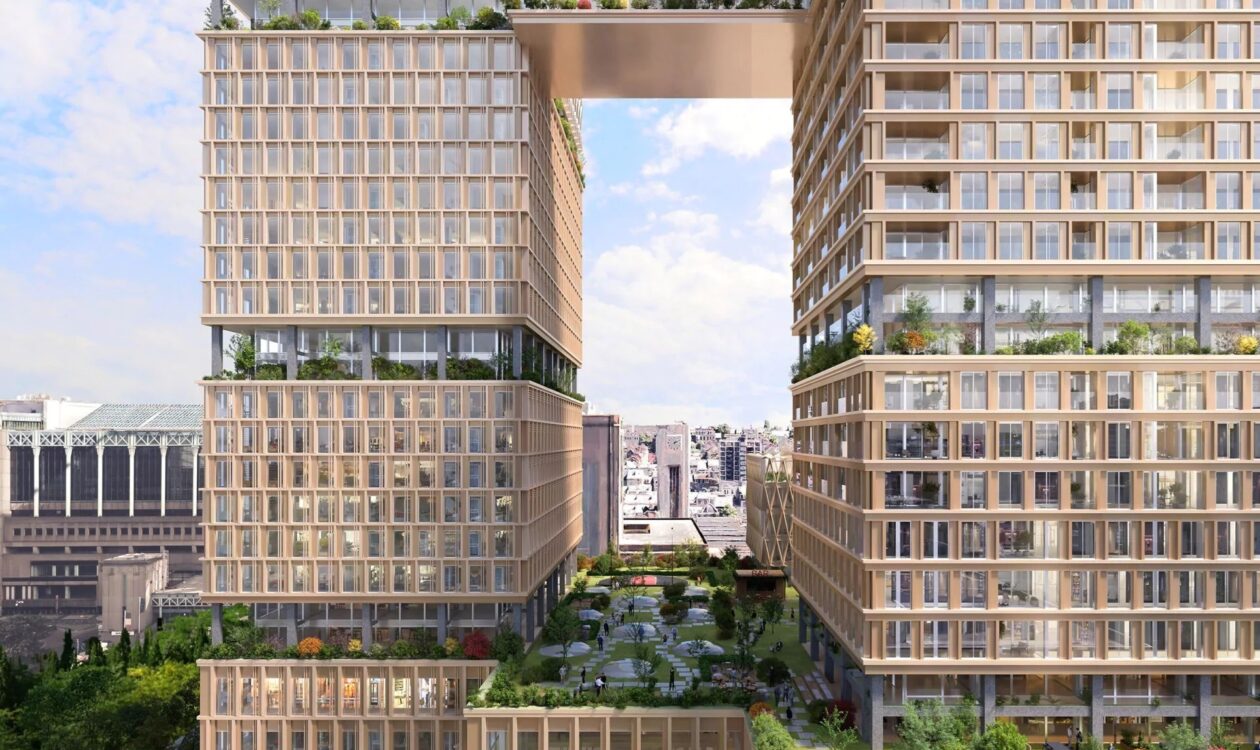
The redevelopment of the Proximus Towers in Brussels’ North District is one of the most ambitious nature-inclusive projects in Belgium. More than one hectare of greenery — from extensive green roofs with native plants to vertical greening and a ‘small forest’ — is being integrated into a site of just 1.3 ha. Dedicated nesting facilities for house sparrows, swifts, black redstarts and peregrine falcons turn the building into a true urban habitat. The project also strengthens the east-west ecological corridor of the North District and retains more than 2,200 m³ of rainwater. The project is aiming for BREEAM, DGNB, WELL and BiodiverCity certification.
Vandemoortele Food Experience Center, Ghent
Vandemoortele Food Experience Center, Ghent
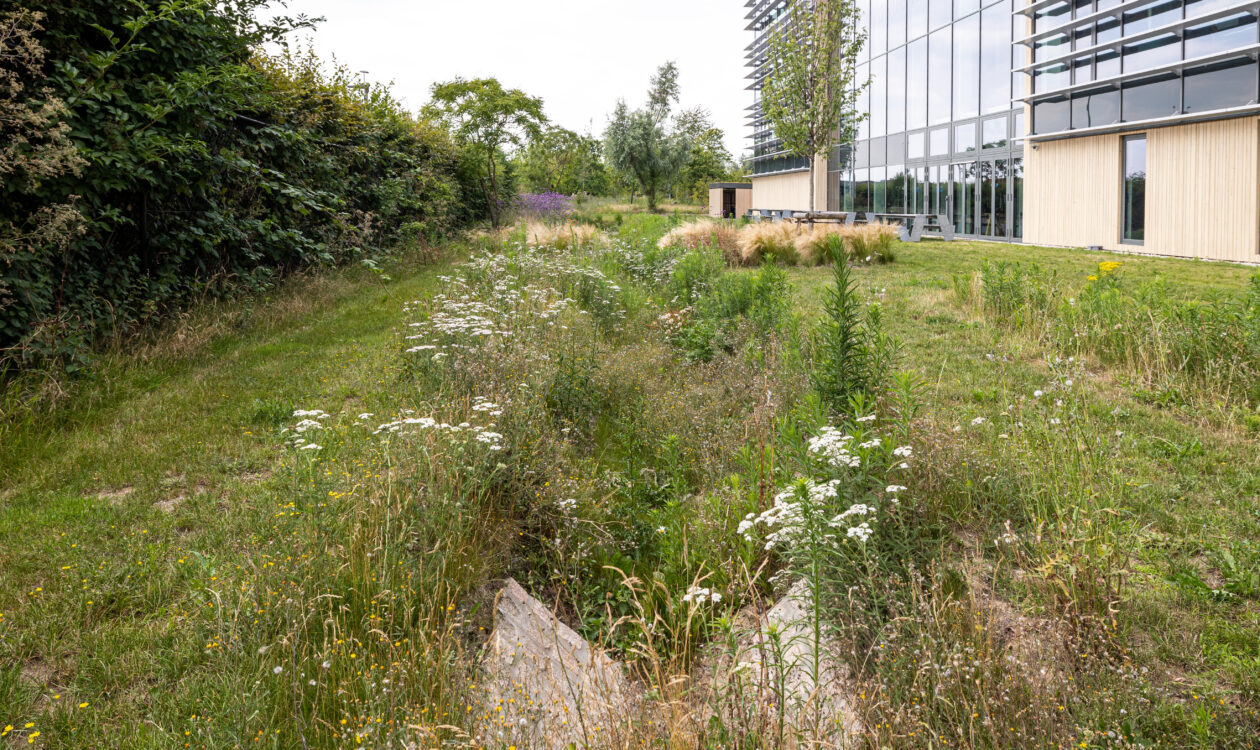
Vandemoortele’s new headquarters along the E17 in Ghent achieved BREEAM Excellent certification and combines a nearly zero-energy building with an extensive ecological landscape design of 25,000 m². The existing ecological buffer zone was fully preserved and strengthened, and the entire 300-space car park was constructed without a connection to the sewerage network — every drop of rainwater infiltrates on site. An ecological management plan guides the maintenance of meadows, trees, hedges and banks, with the use of pesticides completely prohibited. Intelligent lighting systems limit light pollution, allowing wildlife on and around the site to thrive undisturbed.
Heilig Hart Regional Hospital, Tienen
Heilig Hart Regional Hospital, Tienen
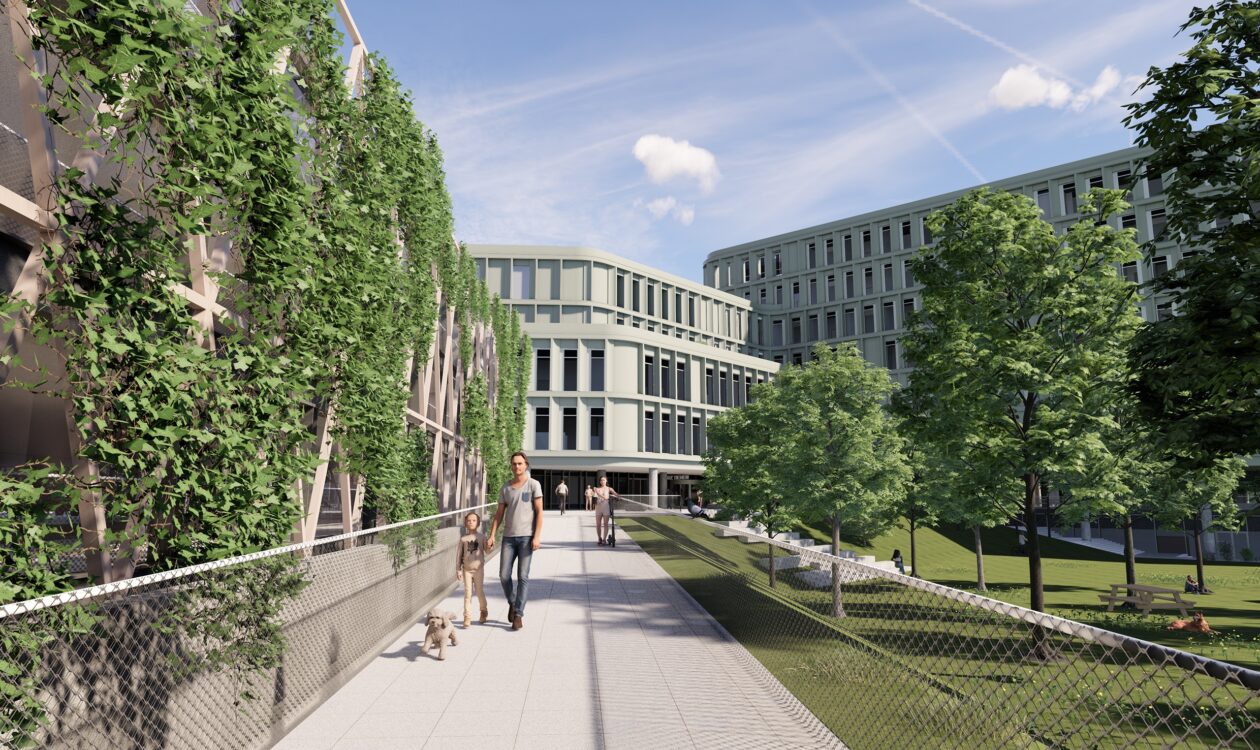
The new hospital in Tienen is based on a clear ecological and landscape vision, integrating the distinctive Hageland landscape — fields, meadows, ditches and rows of trees — into a robust blue-green network on and around the site. By building compactly, maximum high-quality outdoor space is preserved, and any greenery removed was more than offset. Native planting, green roofs and roof gardens strengthen both biodiversity and the building’s thermal comfort.
Building a living city
A building must function on multiple levels. It can be a home for the house sparrow nesting in the façade, the bat sheltering in the cavity wall, or the bee foraging on the green roof. Buildings can and should coexist harmoniously with their surroundings — not by encroaching on nature, but by becoming part of a larger ecological story.
Biodiversity is not an optional extra.
It is a design principle.
Our consultants address pollution, resource management and climate change in the city by placing nature and biodiversity at the heart of the solution. Inclusive and sustainable cities offer benefits for health, economic vitality and social equity.
Our architects, landscape architects and ecologists bring their expertise together from the very first sketch.
Small interventions, big impact. Curious to find out how we can integrate biodiversity into your project?
Other news
Stakeholder management creates space for better projects
Read more
Spatial policy plans: making today’s choices for tomorrow’s city
Read more
From housing study to action-oriented housing policy
Read more