
Sweco Belgium
Healthy soil: optimising long‑term cost-benefit
In Europe, 2028 is marked as a tipping point: by then, Member States must start delivering concretely on the European soil ambitions in their regions. In Flanders, OVAM is working on a new Soil Decree in response to this – a process in which Sweco is actively involved.
For policymakers, companies and developers, soil is therefore no longer a purely technical detail, but a strategic factor: it helps determine the feasibility, cost and quality of projects.
Why soil can make or break your project
The most important societal challenges of today converge in the soil:
Climate change
Soils are crucial for water storage, resilience to drought, flood risk management and carbon storage. Disturbed soils have consequences for infrastructure, real estate and agriculture.
Disappearing biodiversity
Soil is the foundation for plants, insects and soil life. Impoverished soils result in fewer ecosystem services and less resilient green infrastructure.
Public health and historical legacy
Europe has a heavy industrial and urban legacy, with impacts on agriculture, drinking water, child-friendly play spaces and healthy neighbourhoods – and therefore on risk, liability and public support.
Space scarcity
Flanders and large parts of Europe are heavily paved and intensively used. Creating new space for living, working, nature or infrastructure requires choices about depaving, reusing existing sites and making smart use of every m².
In short: projects, master plans or investments that ignore the soil face a higher risk of delays, additional costs and societal resistance.
Considering soil at an early stage leads to more robust, future-proof solutions.
From remediation alone
to broader soil quality
In recent decades, the focus has – rightly – been on eliminating contamination: remediation remains essential. However, a purely remediation-driven approach will no longer deliver today’s and tomorrow’s objectives.
- Certain contaminants are widespread or partly naturally occurring
(such as some heavy metals). - The societal cost of making all soil completely “clean” is not always proportionate.
That is why Sweco advocates a broader approach to soil quality:
- managing risks while maximising soil functions at the same time;
- defining clear priorities: where intervention is unavoidable and where it can be phased;
- exploiting circularity: not automatically treating contaminated soil as waste, but examining whether concentrating, delineating or changing its use delivers better outcomes.
This approach generates tangible benefits: better-substantiated trade-offs and a clearer narrative for permitting authorities and stakeholders.
That is why Sweco does not believe in isolated soil trajectories. The best cost–benefit balance is achieved when soil helps determine, from the very first concept, which scenarios are feasible.
Werner Staes, Business Unit Manager, Environmental Services at Sweco
Soil touches every sector and every type of project
Healthy soil goes beyond nature. At Sweco, we take a broad perspective:
- Agricultural areas
Soil structure, organic matter, water management and potential contamination all play a role in determining the productivity, business security and long-term value of agricultural land.
- Old industrial sites and brownfields
Redeveloping these sites requires a smart link between remediation, new uses and financing. Using soil strategically creates opportunities for locations that would otherwise remain unused.
- Urban environment
Depaving, swales and greening only work if the soil allows it.
A clear understanding of the soil prevents climate adaptation projects from disappointing at a later stage.
- Environment and social justice
Vulnerable groups often live in neighbourhoods with a higher environmental burden.
Investing in soil quality in these areas is also a social statement.
Every soil has potential, but not everywhere in the same way.
A detailed analysis of this potential supports better choices on land use, levels of investment and timing.
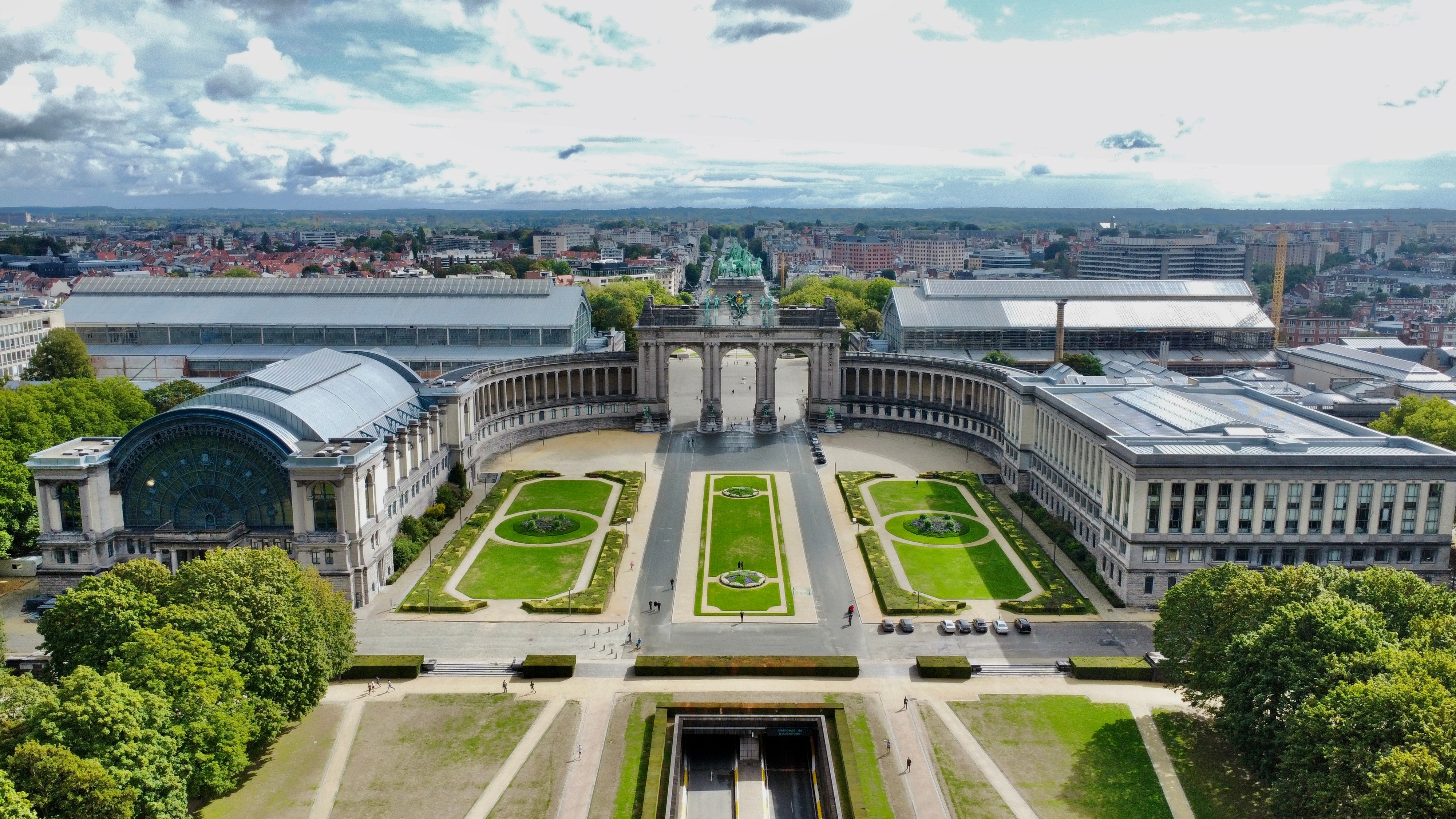
Case study: Cinquantenaire Park
By Belgium’s 200th anniversary in 2030, the iconic Cinquantenaire Park will have undergone a major renovation. Commissioned by the Ministry of the Brussels-Capital Region, Sweco – together with Michel Pauwels and OMGEVING – starts from in-depth soil studies. We map the soil structure, bearing capacity and infiltration capacity in detail in order to align the ecological redesign, planting strategy, rejuvenation of the tree population and water management precisely with the subsoil. This allows us to sustainably combine biodiversity, climate adaptation, water management, sports and recreational functions, and circular material choices. In this way, Cinquantenaire Park is firmly anchored for the long term as the green lung of Brussels, rooted in healthy, revalorised soil.
Read more about this fascinating project
Healthy soil calls for integrated decisions
Soil is never purely a technical file. It sits at the intersection of
spatial planning and urban design;
water and climate adaptation;
infrastructure and mobility;
nature development and ecosystem services;
health, regulation and public support.
That is why Sweco does not believe in isolated soil trajectories. The best cost–benefit balance is achieved when soil helps determine, from the very first concept, which scenarios are feasible.
Integrated decisions also require a multidisciplinary approach: we bring together soil specialists with water experts, urban planners, mobility planners, ecologists and permitting specialists. This results in:
- fewer late-stage surprises;
- coherent advice;
- a clear narrative that makes sense technically, financially and in policy terms.
Sweco’s combined technical, conceptual and policy expertise in soil projects is recognised through our role as co-author of a policy study for the Flemish Department of Environment on improvement strategies following depaving.
Between ambition and reality:
making smart choices together
European and Belgian ambitions for soil, depaving, climate and nature for 2030 and 2050 are high.
In practice, however, implementation is complex.
We expect the new Soil Decree to support precisely this integrated approach. Sweco brings its practical experience to the table, ensuring that policy provides instruments that are workable in real projects.
Healthy soil is the result of well-considered choices.
Would you like to know how we can support you in addressing soil within your area development, urban project or infrastructure dossier?
Our experts help ensure that soil does not become a last-minute obstacle, but a strategic lever for better, more robust and future-proof decisions.
Other news
Südspidol takes a major step towards the people-centred hospital of tomorrow
Read more
Stakeholder management creates space for better projects
Read more

Spatial policy plans: making today’s choices for tomorrow’s city
Read more