

Sweco Belgium
The parking ladder: take control of parking policy, one step at a time
Parking policy is one of the few policy areas in which a municipality controls all the levers. It also determines how much space remains for people. A smart parking policy enables municipalities to green their streets, make shopping areas more attractive, reduce traffic searching for a space and encourage sustainable mobility. The impact is considerable: up to 30% of urban traffic consists of drivers looking for parking. Fewer cars circling around therefore means a better quality of life for residents and visitors.
Admittedly, “parking is a battle,” a mobility officer once told us. “Parking policy is political suicide,” an alderman added—before going ahead with it anyway, because he believed it had to be done. For them, and for everyone working at a town hall who recognises themselves in these words, we wrote this Expert Talk about proactive parking policy: a six-step ladder, from counting to building. It is not a plea to do everything at once in one giant leap, but an invitation to start in a more focused way.
Tijs Veyt, Parking Policy Expert at Sweco
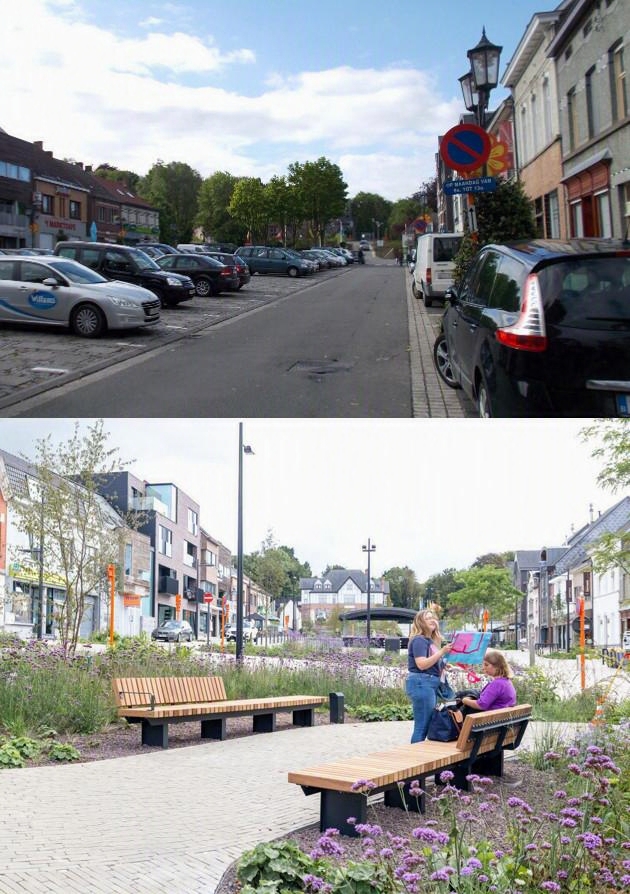
Why parking policy gives municipalities so much local leverage
Those two statements sum up what we see time and again in parking projects. The officer is right: parking is a battle because every square metre of public space can only be allocated once, and because everyone—the resident, retailer, visitor, care provider and contractor with a van—believes their claim is the obvious one.
The alderman is also partly right: no local issue generates complaints as reliably before the results become visible. Introduce a blue zone and you will first hear months of grumbling; only later will you see higher turnover in the shopping area. That is not a flaw in the topic—it is built into its structure. Knowing this allows you to plan for it.
The sober counterpoint to that battle is the opening statement: nowhere else in mobility policy does a municipality decide so much for itself. Public transport and taxation are decided elsewhere, as are regional roads for the most part. But who may park where, for how long, at what price and under what conditions is determined by the municipal council.
That lever reaches far. Every on-street parking space takes up ten to fifteen square metres of public space; a car is stationary for more than 95% of its life and spends around 80% of the time at its owner’s home. Parking policy therefore directly shapes how scarce space in a town centre is divided between parked cars, pavements, bicycle parking, terraces and greenery. It affects road safety at school gates, access to shopping areas, housing affordability, municipal finances and, more recently, the energy transition. Few policy areas combine such impact with so much local autonomy.
That combination is precisely what makes the dossier so demanding: high expectations in the area where local authorities have the greatest responsibility, with complaints always arriving before results. Parking fatigue is therefore perfectly rational—and worth acknowledging before blaming yourself or your administration. But it rests on one misconception: that not deciding is neutral. It is not. Without policy, public space is allocated according to one rule—first come, first parked—and funded through one mechanism: general municipal resources. The cost appears in no multiannual budget. That is why we start there.
Photo: © Eva Vermeylen – Beyond the parking reflex: Gavere shows the power of integrated design
The hidden subsidy for parking
A public above-ground parking space can easily cost a municipality €500 a year, including depreciation of construction and renewal, maintenance and the occupation of ten to fifteen square metres of land. Organisational costs—parking meters, signs, software and enforcement—come on top. What the user pays is usually only a fraction of that amount, and in many places literally nothing.
The difference is a subsidy. A municipality with 2,000 public spaces contributes roughly €800,000 to €1 million every year—an amount the council does not consciously approve, that is not budgeted in any multiannual plan and is silently renewed annually. Moreover, this hidden subsidy benefits only part of the population: 28% of Belgian households do not own a car and therefore do not benefit. In cities such as Antwerp, Leuven and Ostend the figure exceeds 40%, and in the Brussels-Capital Region it is more than half.
Proactive parking policy essentially means making that hidden subsidy visible and dealing with it consciously: where do we maintain it because we choose to, where do we phase it out and where do we use the proceeds for something else? This need not happen in a single move. Reforming parking policy is, by definition, a step-by-step process. But it starts with having the courage to do the maths.
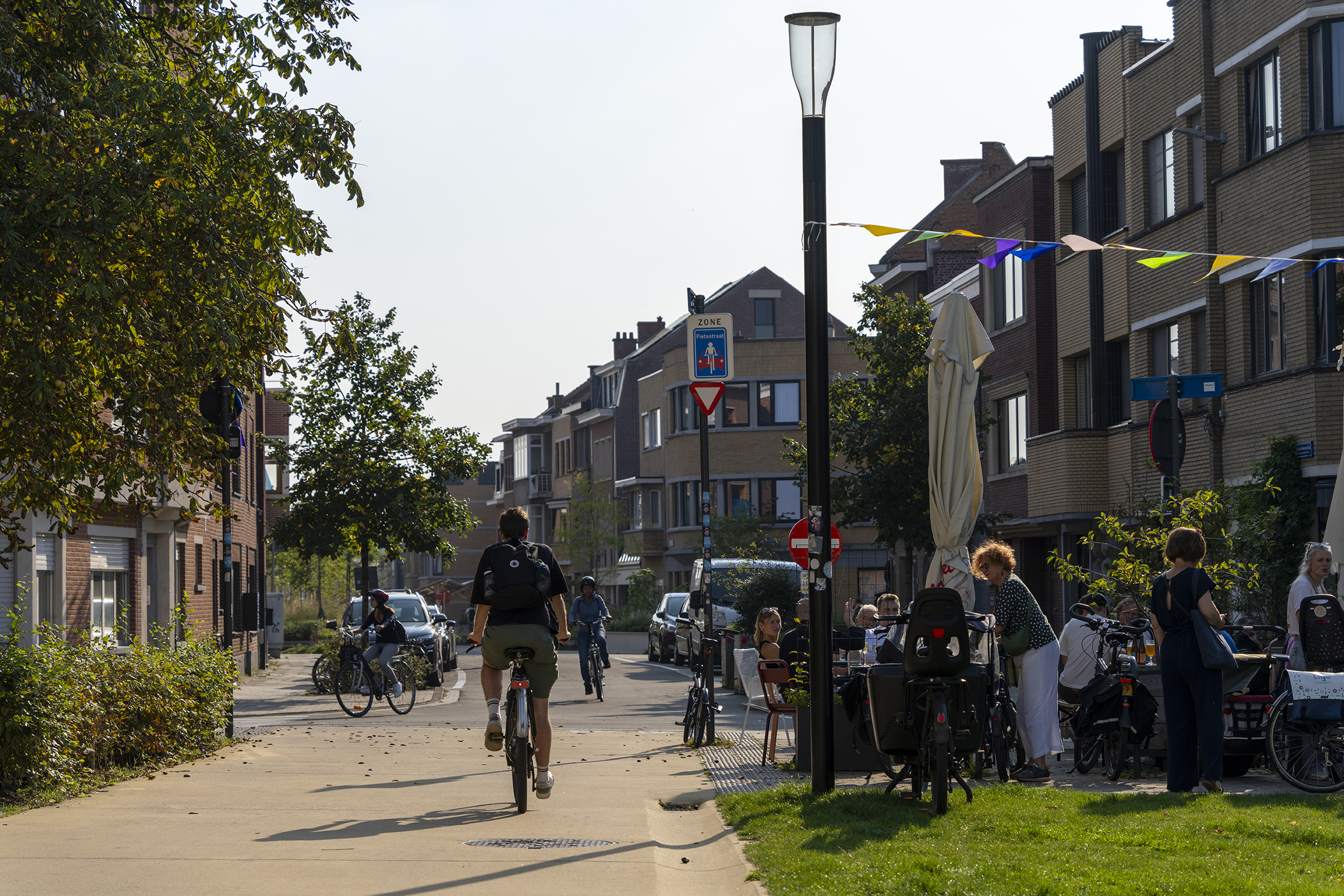
© Bram Goots – Meunierstraat Leuven
A parking ladder, not a leap
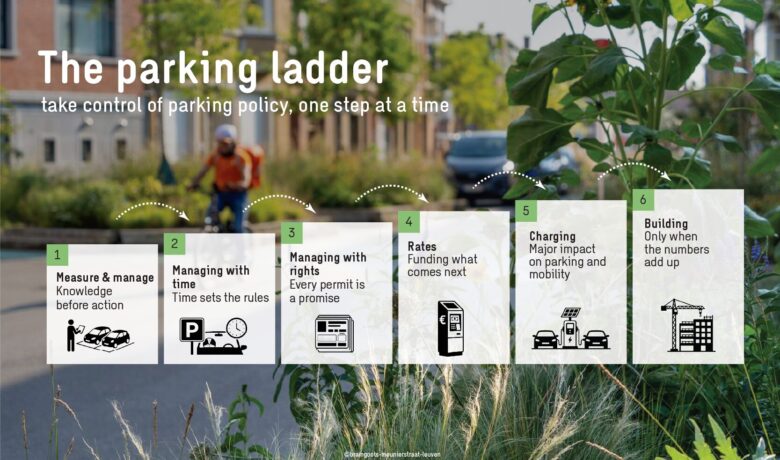
The rest of this article sets out a six-step parking ladder: measure, time, rights, pricing, charging and building. The order is deliberate: each step enables the next, and every higher step assumes that the previous one is in place. You do not need to reach the top. A municipality of 15,000 residents that gets the first three steps right has a better parking policy than a city that promises a building at step six without having step four in order. What you must avoid is allowing steps to undermine each other—the most common and most expensive pitfall.
Step 1: measure and manage, the step that pays for itself
The first step is not a measure but knowledge: an inventory of the parking stock—how many spaces, under which regime and how many and what type of permits per zone—combined with a parking survey at three or four well-chosen moments, such as market day, a busy shopping Saturday, an evening when residents are home and the end of the school day.
The cost is modest: a few weeks of staff time if done in-house, or several thousand to roughly €10,000 when outsourced, depending on the number of zones and counting moments. The return is disproportionate because measured pressure often differs from perceived pressure in both directions. Residents may experience chaos where comfortable spare capacity exists, while a quieter zone may structurally exceed the critical occupancy level of around 85%, where search traffic and illegal parking begin. Data shifts the conversation from “my street is unbearable” to “zone three is at 92%, while zone five is at 60%”.
To go further, turn snapshots into a management tool. Record capacity and regimes in a GIS environment so every redevelopment project starts with parking data rather than another debate. The same database supports honest communication with neighbourhoods and is a prerequisite for waiting lists or priority rules for permits: without knowing a zone’s capacity, you cannot explain why permit numbers must be capped.
Step 2: manage through time, the clock decides
The first real measure is the simplest: limit parking duration through a blue zone around the shopping area, school or station. The principle is straightforward: time guides the driver. An occasional visitor is barely deterred by a €2 ticket, but a two-hour limit makes the space unsuitable for an employee who wants to park for eight hours while keeping it available for a customer who needs forty minutes. The clock—not the cash register—puts the right driver in the right place.
The visible cost is limited to signs and communication. The real cost lies in what is often forgotten: enforcement. A blue zone without checks becomes a dead letter within six months.
Two classic pitfalls recur. First, drawing the zone too narrowly shifts pressure to the first unrestricted street outside it. Draw the centre together with its surrounding area. Second, discovering exceptions only when users arrive at the counter. Care providers, teachers and car-sharing organisations all have legitimate needs that require parking rights, target-group policies and administrative capacity that should be budgeted in advance.
Step 3: manage through rights, the overbooked aircraft
This is the hardest step: policy on resident permits and other parking authorisations. The questions are simple—who receives a permit, how many per household and what price applies to the first and second—but the total determines whether everything else works. In some urban zones we studied, more permits circulate than spaces exist. Every permit is a promise. Issuing more promises than seats is like operating a permanently overbooked aircraft, only nobody volunteers to get off. The frustration is labelled a “parking problem”, although it is really an “issuance problem”. A blue zone cannot repair that.
The good news is that this is the cheapest step. Amending a municipal fee regulation requires a council meeting and several months, not infrastructure. Its impact extends beyond the street: unlimited parking rights also undermine private initiatives, neighbourhood parking and low-car developments. These only work when surrounding streets have a watertight regime under which new residents have no right to a resident permit, as already applied in Mechelen and Lier. Otherwise, the new neighbourhood simply parks in the old one.
The classic error is obvious: tightening the regime with one hand while leaving the permit tap open with the other.
Step 4: pricing, not a tax on drivers, but a financing instrument
Paid parking has a reputation in Flanders as a punitive tax, and that reputation is the greatest obstacle at this step. Yet paid parking is more logical than it seems: every investment in new parking infrastructure creates a financing gap.
A built parking space, especially one mainly used by residents, almost never generates enough revenue to cover construction and operation. The logical way to close that gap is through revenue from existing surrounding parking and, increasingly, electric charging. Anyone planning a parking building, underground facility or proper park-and-ride site in the future should already consider whether today’s pricing policy will make it affordable.
A sound principle is that on-street parking is time-limited and more expensive than parking in a garage or on the outskirts. Reverse that relationship and search traffic will continue driving through the centre while expensive infrastructure stands empty. Organisational costs—meters or digital registration, software and enforcement—come on top of the €500 each space already costs annually, which is precisely why asking users to contribute more is reasonable.
The classic mistake is treating the tariff as an isolated revenue item and then freezing it for ten years. The key calculation fits on a coaster: multiply the number of public spaces by €500 and compare the result with annual parking revenue. The difference is your municipality’s hidden subsidy.
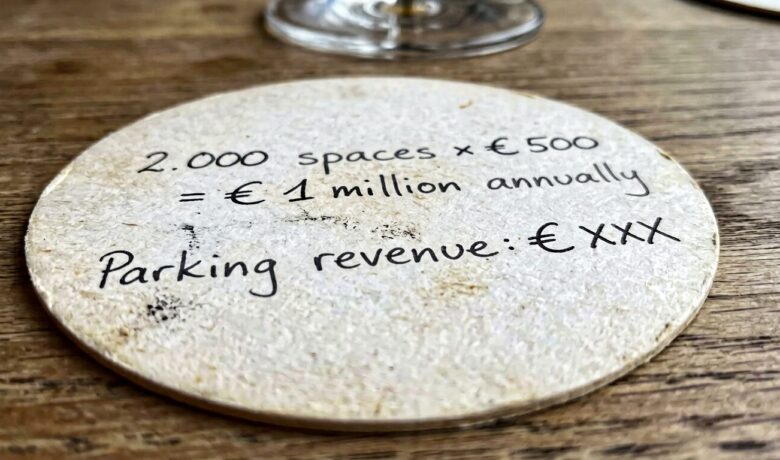
Photo Credit: Generated with AI—illustrative concept
Step 5: charging, climate policy quietly becomes parking policy
The newest step is arriving by itself: the electric vehicle fleet is growing and requests for charging points are pouring in. The real wave is still to come. Until now, electric cars were mainly driven by households able to charge at home. As new and second-hand EVs become commonplace, they will appear in every street, including where terraced houses and flats have no private parking. Those unable to charge at home will charge on the street.
Without a plan, the logic is “the charging point follows the car”: the first applicant determines the location, the network becomes fragmented and every new point triggers debate. A strategic charging plan reverses this logic through an area-based estimate of demand, coordination with the grid operator, clusters of charging points at locations chosen by the municipality and phased implementation. For many municipalities, this is an accessible first step into proactive parking policy.
But a larger question lies underneath: who will own that charging network? Every charging bay is a parking space on public land, and charging will generate a structural revenue stream for decades. Broadly, municipalities can join the Flemish charging concession, include charging in their own local concession—especially when a parking concession is being renewed—or place it within an autonomous municipal company.
The final option deserves more attention. Kortrijk has long managed street parking and car parks through Parko, Leuven has opened public roofs to cooperative solar panels through its urban development agency, and many municipalities already have autonomous companies with experience in operations and energy.
Locally rooted energy cooperatives can also contribute capital, expertise and public support. Connecting locally generated power, storage and charging points on municipal land is one of the greatest untapped opportunities in this dossier: it creates a municipal asset.
The classic mistake is therefore not technical but administrative: never explicitly asking the ownership question, allowing it to be answered by the order in which applications arrive.
Step 6: building, do not promise a money pit
At the top of the ladder lies the temptation that eventually enters every parking debate: “why don’t we simply build more?” Two rules must be stated clearly.
First, new supply comes only after optimising existing supply. An empty supermarket car park at 8 pm beside an overcrowded residential street is not a capacity problem but an agreements problem. Investigate and contract shared use first, because additional supply also attracts additional cars.
Most new parking is built not by municipalities but by developers, supermarkets and offices. Parking regulations determine how much they build and, above all, how: collectively rather than plot by plot, with standards adapted by function and area. Going further means turning parking standards into mobility standards covering car spaces, comfortable bicycle parking, shared mobility and proximity to amenities and public transport. These standards only work alongside regulated streets; otherwise expensive underground spaces remain empty while the street stays full.
Second, a parking building is almost never profitable on its own. An underground space can cost €30,000 to €40,000 to build, while an above-ground space in a parking structure costs €20,000 to €25,000. Without accompanying policy, operation therefore produces a structural annual deficit. Promising a parking building without addressing the surrounding streets means promising a money pit, funded through revenue from steps four and five or covered every year from public resources. The same applies to a low-car neighbourhood: no watertight surrounding zone, no low-car neighbourhood.
Public support and communication make parking policy successful
Why do so many parking processes still fail even when the right steps are chosen? We have seen technically watertight plans collapse and modest plans succeed. The difference was never the quality of the study; it was ownership of the story. A plan that only the consultant can explain dies at the first difficult residents’ meeting. A council and administration able to explain why this zone, why this tariff and why now can hold their ground.
That ownership is not created through communication after the fact. It requires investment in the process beforehand: workshops, decision notes that show the consequences of each option rather than 100-page reports, and predetermined evaluation moments so adjustments become planned learning. It also requires one mental shift: resistance is not evidence of bad policy; it is evidence that policy exists. Those who plan for it—with phasing and a story capable of withstanding six months of criticism—persist where others reverse course.
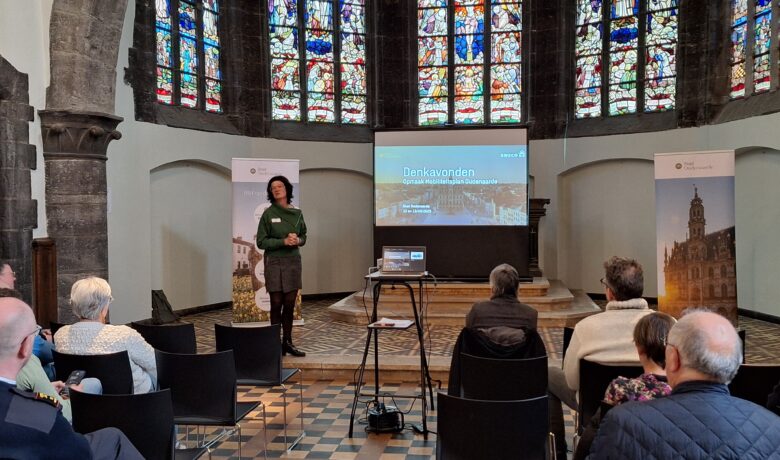
Photo: Mobility plan for Oudenaarde: stakeholders help determine the route
Climb the parking ladder with Sweco
“Parking policy is political suicide,” said the alderman. He was right on one condition: it is suicide for those who jump too high without the step below—who promise a building without pricing policy, a low-car neighbourhood without a watertight surrounding zone or a blue zone without enforcement. But the reverse also exists: a municipality that starts by counting, lets the clock guide users, issues permits more selectively, uses pricing to finance policy, claims ownership of the charging network before someone else does and only builds when the numbers add up. That municipality is no longer fighting; it is governing, one step at a time, at a pace its council and staff can manage.
Which step is your municipality on today? And which one will you take during this term?
Sweco supports cities and municipalities at every step of the parking ladder: parking surveys and data management, regimes and regulations, parking ordinances and standards, strategic charging plans, concession reviews and financial assessments of investments—with as much attention to the shared story as to the figures.
Other News

The parking ladder: take control of parking policy, one step at a time
Read more

Approved by children: designing safe school environments
Read more

More eyes at sea: Sweco designs offshore platform concept for marine monitoring and enforcement in the North Sea
Read more