

Sweco Belgium
Wildfire does not stop at the forest edge
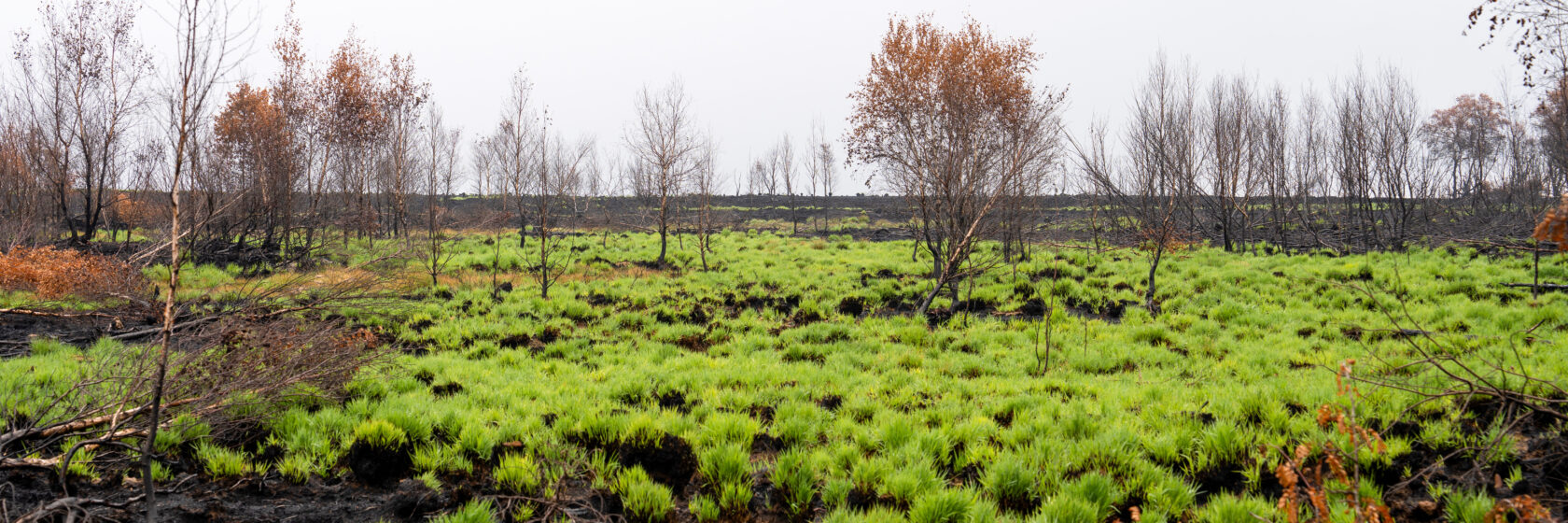
Ten years ago, a major wildfire in Europe made the news. Today, it has become a season. We are familiar with wildfires in Portugal, Greece, France and Spain. But this summer, we also saw them in Cheshire, along the Danube, in the High Fens and at an air show in Limburg. We continue to treat wildfires as exceptional events: bad luck, a dry summer, a careless hiker. They are no longer exceptions. Wildfire is a structural risk, and a structural risk does not call for a better response, but for coordinated governance.
What this summer teaches us
The most striking stories of this summer were not primarily about forests, but about infrastructure. In Greece, the electricity grid is believed to be responsible for around three-quarters of the land area burned this year. A short circuit in power lines, some of them decades old, combined with drought and wind, is enough. Here, the asset is not the victim of the fire, but the ignition source. This immediately raises the question of liability.
In Cheshire, a historic steam train caused a trackside fire that spread close to homes; the railway line remained closed for days. Railway verges are underestimated infrastructure: long, dry, grass-covered strips connecting residential areas, nature reserves and industrial zones. Belgium has thousands of kilometres of them.
In Le Porge, Gironde, bomb disposal experts found around four hundred shells and projectile remnants from the Second World War after the fire. With the Westhoek, military domains and former training grounds, we know in Belgium that our soil has a memory.
In Hungary, the Danube fell so low that the country’s only nuclear power plant nearly had to shut down due to a shortage of cooling water. The emergency solution, diverting waterways, increased the risk of wildfires elsewhere. Drought becomes a water problem, then an energy problem, and the solution creates a new fire risk. No one has the full picture on the table.
And then there is Trévillach in southern France. A major fire reached a solar park, but only around one hundred panels were damaged; the rest remained operational. This was not luck, but the result of four concrete choices: vegetation management, defensible space around the installation, fire-resistant fencing with good access, and physical separation between the PV fields. Prevention works. It is not expensive, not highly technological and not unknown. Someone simply needs to decide and act.

Why Belgium is different
The High Fens proved this year that this is not just a Southern European problem: around 3,000 hectares went up in flames, compared with 600 hectares at the Groot Schietveld in 2021 and 450 hectares on the Kalmthout Heath in 2011. Yet surface area is not the right measure for Belgium.
Because of our high population and infrastructure density, a small fire can have major consequences: ten hectares in the Pyrenees is a local incident; ten hectares next to a hospital, motorway or high-voltage substation is a crisis. Nature, housing, industry and healthcare are literally side by side; the Kempen region is effectively one large wildland-urban interface. The impact also extends beyond the flames: smoke can close motorways and airports, while the failure of a single line can affect thousands of connections kilometres away.
Moreover, our policies and organisations have historically been designed around flooding and conventional building fires. We have excellent expertise and procedures for these risks, but not for integrated wildfire risk. Fire does not respect regional, provincial or national borders either. Cooperation across sectors and borders, and the sharing of resources for prevention, suppression and recovery, are more important than ever.
Who owns the risk?
In August, Grunde Jomaas asked the question: “Who owns wildfire risk?” His analysis: wildfire risk is distributed among insurers, government, owners and communities, but that distribution has never been consciously defined.
Translated to the Belgian context: homes and contents are insured, but without risk-differentiated pricing. Someone who makes their garden fire-resilient pays the same as someone who does not, so there is no financial incentive for prevention. Burned natural areas are not compensated; restoration remains the responsibility of ANB, Natuurpunt, DNF and private forest owners. Fire suppression works, but capacity in the event of several simultaneous fires remains an open question. Critical infrastructure operators each focus on their own networks, without cross-sector cascade analysis. And prevention and land management are fragmented across regions, municipalities and owners.
In short: in Belgium, the home is insured, but the landscape, continuity and prevention are not. Or, to paraphrase Jomaas: a flammable hillside has no advocate. A building has an owner, an architect and an insurer. A railway verge or heathland alongside a railway line does not, and as long as no one takes responsibility for it, nothing happens until it burns.
Data and detection: available, but not yet decision-ready
Looking at the wildfire chain, from detection and reporting to interpretation, response and recovery, it becomes clear that data itself is not lacking. It exists, but it is fragmented and dispersed across services, sectors and research projects. What is missing is structure and validation: shared definitions, formats and quality controls that make the data genuinely usable as a basis for decision-making.
The same applies to detection. Satellites, sensors and cameras offer significant potential. But before we base decisions on them, we need to thoroughly investigate and evaluate how well they perform and how reliable they are in the Belgian context, while working towards uniform standards and procedures. Only then can we invest resources intelligently rather than in a fragmented way.
Today, the process also breaks down in the middle of the chain: who reports what to whom, within what timeframe, based on which map and which mandate, and who makes the decision? This is a question of governance and, quite frankly, awareness as well.
A second gap is translation into practice. Research produces risk models, fire-behaviour simulations, fuel-type and WUI maps, and near-real-time satellite detection. An asset owner asks different questions. What does this mean for my power lines, my healthcare campus, my terminal? Who does what at three in the morning? What should I include in my investment plan? What do I report under CSRD and ESRS E1? What will stand up to scrutiny from my insurer and board of directors? A research report is not a decision. Someone needs to translate it.
A consortium with clear coordination
This can only work through a consortium structured in three layers. Knowledge: FIRE-MAP, PXL, KU Leuven, UAntwerpen, CERAC, EFI and the Pau Costa Foundation. Ownership: grid operators and industry, healthcare, airports and railways, ANB and nature managers, fire and rescue zones and NCCN, insurers, municipalities and provinces. And between them, coordination: connecting, translating, designing and embedding. This is the role we at Sweco want to take on. To do so, we bring together the expertise of Fire & Emergency and Nature, Climate & Energy, complemented by specific wildfire expertise from across the Sweco Group and extensive experience in developing policy plans.
We are developing this into eight modules: from a shared vision to prevention, detection and protocols, response and evacuation, recovery, evaluation and communication, as well as cost allocation and a legal and policy framework through to 2030. The aim is not to produce eight reports, but to ensure that every organisation knows its role at every stage of the chain.
Three proposals
A consortium with clear coordination
This can only work through a consortium structured in three layers. Knowledge: FIRE-MAP, PXL, KU Leuven, UAntwerpen, CERAC, EFI and the Pau Costa Foundation. Ownership: grid operators and industry, healthcare, airports and railways, ANB and nature managers, fire and rescue zones and NCCN, insurers, municipalities and provinces. And between them, coordination: connecting, translating, designing and embedding. This is the role we at Sweco want to take on. To do so, we bring together the expertise of Fire & Emergency and Nature, Climate & Energy, complemented by specific wildfire expertise from across the Sweco Group and extensive experience in developing policy plans.
Bring industry to the table in Belgium.
Before the programme starts in 2027, establish a user group comprising grid operators, healthcare organisations, railways, airports and insurers, and involve them in defining the research questions, including the evaluation of detection technologies in terms of performance and reliability.
One shared, structured and validated wildfire database.
Bring together detection and risk data from FIRE-MAP, incident data from fire and rescue zones, and claims data from insurers within a single framework based on common standards. As long as this data remains fragmented, every risk map will remain an estimate.
These proposals do not require new legislation or a major budget. They require one thing: someone to take ownership. A flammable hillside has no advocate. Let us make sure it gets one.
Ralf Bruyninckx
Ralf Bruyninckx
More news

Wildfire does not stop at the forest edge
Read more
Water-Land-Schap 2.0 prepares the Vliet valley for drought and flooding
Read more
Sweco confirms strong sustainability performance with EcoVadis Gold
Read more